
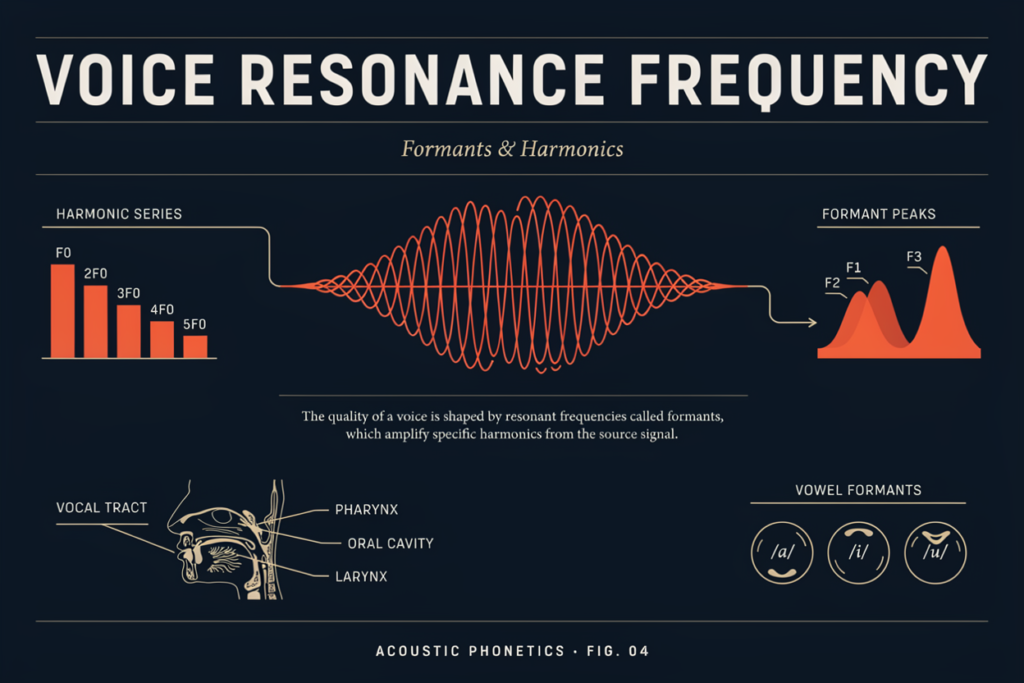
Voice resonance frequency describes the frequencies at which the vocal tract naturally reinforces sound produced by the vocal folds. It is not one fixed number for each person. Instead, the voice contains several changing resonances that shape vowel quality, tone color, clarity, and projection.
Pitch and resonance are different. Pitch mainly follows the vibration rate of the vocal folds, while resonance depends on how the throat, mouth, tongue, jaw, lips, and soft palate shape the sound. Understanding the difference between resonance and frequency makes this distinction easier.
What Is Voice Resonance Frequency?
Voice resonance frequency is one of several frequencies at which the vocal tract naturally reinforces acoustic energy. Unlike fundamental frequency, which mainly determines pitch, vocal-tract resonances shape timbre, vowel quality, clarity, and projection.
Why the Voice Has Multiple Resonances
The vocal tract acts like an adjustable acoustic tube whose shape changes with the tongue, jaw, lips, soft palate, and pharynx.
Each configuration produces several resonances, commonly discussed as the first, second, third, and higher formants.
Resonance Frequency vs. Fundamental Frequency
Fundamental frequency, or F0, comes mainly from the repeating vibration of the vocal folds. It is the measurement most closely associated with how high or low a voice sounds.
Resonance occurs after that sound is created. The vocal tract filters the source by strengthening some frequency regions and reducing others. Learning how vocal fundamental frequency works helps separate the sound source from the filter.
How Does Vocal Resonance Work?
Vocal resonance follows a source-filter process. The vocal folds create a sound containing a fundamental and harmonics, while the vocal tract reshapes that sound by emphasizing frequencies near its resonances.
The Vocal Folds Create the Source
If the fundamental is 100 Hz, the voice may also contain harmonics near 200 Hz, 300 Hz, 400 Hz, and higher. These harmonics form the raw material that the vocal tract filters.
The Vocal Tract Filters the Sound
The pharynx, mouth, tongue, jaw, lips, and soft palate determine which frequencies receive the most reinforcement. Lip rounding often lowers some resonances, while a wider jaw opening often raises the first formant.
A harmonic near a resonance may become stronger, which is why two people can sing the same pitch yet sound different.
What Are Formants in the Human Voice?
Formants are prominent frequency regions in the sound spectrum created by vocal-tract resonance. They are commonly labeled F1, F2, F3, and higher.
What F1 and F2 Tell Us
F1 and F2 are especially important for vowel identity. F1 is strongly influenced by tongue height and jaw opening, while F2 is strongly influenced by whether the tongue is positioned toward the front or back of the mouth.
A singer can therefore hold the same note while changing from “ee” to “ah.” The pitch stays nearly constant, but the resonance pattern changes.
What Higher Formants Affect
Higher formants contribute to timbre, brightness, identity, and projection, helping distinguish voices with similar pitch.
In practical teaching, formants and resonances are often treated as the same. More precisely, resonance describes the acoustic behavior of the tract, while a formant is a visible concentration of energy in the resulting spectrum.
Voice Resonance Frequency vs. Voice Pitch
Pitch mainly reflects vocal-fold vibration, while resonance reflects how the vocal tract filters that sound.
| Feature | Voice pitch | Vocal resonance |
|---|---|---|
| Main source | Vocal-fold vibration | Vocal-tract shape |
| Common measurement | Fundamental frequency, F0 | Formant frequencies |
| Main perception | High or low sound | Tone color, vowel quality, projection |
| Changes with | Fold length, tension, and mass | Tongue, jaw, lips, pharynx, and soft palate |
| Number of frequencies | One main F0 | Several simultaneous resonances |
Two singers can produce the same note while sounding different because their formant patterns are not identical. This is one reason pitch and measured frequency do not fully describe vocal tone.
A voice may also sound deeper because it has stronger low-frequency energy or darker vowel shaping, even when F0 does not change.
What Frequencies Are Associated With Vocal Resonance?
There is no universal resonance-frequency chart for every voice. Formant values vary with anatomy, age, language, vowel, vocal style, and recording method.
Approximate Vowel Formant Regions
The following values are broad educational examples for adult speech.
| Vowel example | Approximate F1 | Approximate F2 |
| “ee” as in see | 250–350 Hz | 2,000–3,000 Hz |
| “ih” as in sit | 350–500 Hz | 1,700–2,500 Hz |
| “ah” as in father | 600–900 Hz | 900–1,500 Hz |
| “oh” as in go | 400–600 Hz | 700–1,200 Hz |
| “oo” as in food | 250–400 Hz | 600–1,000 Hz |
Ranges overlap.
Why Vocal-Tract Length Matters
A longer vocal tract generally produces lower and more closely spaced resonances. A shorter tract generally produces higher and more widely spaced resonances.
The wider frequency range of the human voice includes both the source from the vocal folds and the resonant filtering created by the tract.
What Is the Singer’s Formant?
The singer’s formant is a concentration of acoustic energy often associated with a cluster around the third and fourth formants. In many trained classical voices, it appears roughly in the 2,500 to 3,500 Hz region.
How It Helps Projection
An orchestra produces substantial energy at lower frequencies. Concentrating vocal energy in a less crowded higher-frequency region can help a classical voice remain audible without relying only on greater loudness.
Not every style uses the same strategy. Pop, rock, musical theatre, and speech-based singing may rely more on twang, belt-related shaping, brighter vowels, or microphones. The frequency patterns used by singers vary by genre and technique.
Can You Change Your Voice Resonance?
You can change resonance by adjusting the shape of the vocal tract. Tongue position, lip shape, jaw opening, pharyngeal space, and soft-palate position all influence which frequencies are reinforced.
Vowel Shaping and Resonance Tuning
Singers often modify vowels slightly as pitch rises. Small adjustments can help a harmonic interact more efficiently with a vocal-tract resonance while preserving the intended word.
Semi-Occluded Exercises
Lip trills, humming, voiced fricatives, and straw phonation partially narrow the vocal tract. These exercises may improve coordination between airflow, vocal-fold vibration, and acoustic feedback.
They should not be used to force one ideal resonance frequency. Vibrations felt in the face or chest are useful sensations, but they are not direct measurements of where resonance occurs.
How Is Voice Resonance Frequency Measured?
Voice resonance is examined with spectrograms and formant-tracking software because several frequencies must be estimated at once.
Spectrograms and Formant Tracking
A spectrogram shows acoustic energy across frequency and time. Formants often appear as darker horizontal bands.
A guide to how voice frequencies are analyzed provides more context for reading these measurements.
Why Phone Apps Usually Measure F0
Most simple apps focus on fundamental frequency because it is useful for identifying pitch. A result such as 120 Hz usually refers to F0, not the complete resonance pattern.
Room reflections, noise, poor microphones, and incorrect settings can produce misleading formant estimates. Treat a single app reading as an estimate.
Common Myths About Vocal Resonance
| Myth | Reality |
| Everyone has one natural resonance frequency | The vocal tract has several changing resonances |
| Chest voice resonates only in the chest | Chest vibration is a sensation, not an acoustic location |
| A nasal sensation always means a nasal voice | Facial vibration can occur without excessive nasal airflow |
| Lower resonance always means lower pitch | Pitch mainly depends on F0 |
| More resonance means greater loudness | Efficient resonance can improve clarity without more force |
| A pitch detector measures every resonance | Most pitch detectors mainly estimate F0 |
Frequently Asked Questions
Does every person have one voice resonance frequency?
No. Each person has several vocal-tract resonances, and they change with every vowel and articulation.
What is the difference between pitch and resonance?
Pitch mainly reflects fundamental frequency from vocal-fold vibration. Resonance describes how the vocal tract strengthens or weakens different frequency regions.
What are normal vocal formant frequencies?
There is no single normal set. F1 often falls within a few hundred hertz, while F2 and higher formants may extend into several thousand hertz.
Can resonance make your voice sound deeper?
Yes. Stronger low-frequency energy and darker vowel shaping can make a voice sound deeper without lowering its fundamental frequency.
What frequency is the singer’s formant?
The singer’s formant is commonly associated with energy around 2,500 to 3,500 Hz in trained classical singing. The exact value varies by singer, vowel, and technique.
Can a smartphone measure voice resonance accurately?
A smartphone can provide rough acoustic information, but most simple apps measure pitch rather than full resonance patterns. Reliable analysis requires suitable software and careful interpretation.

Bobby is a voice analysis and vocal testing writer at VoiceFrequencyTest. He focuses on vocal frequency analysis, pitch recognition, voice measurement tools, and singing education for vocalists, musicians, creators, and beginners.