
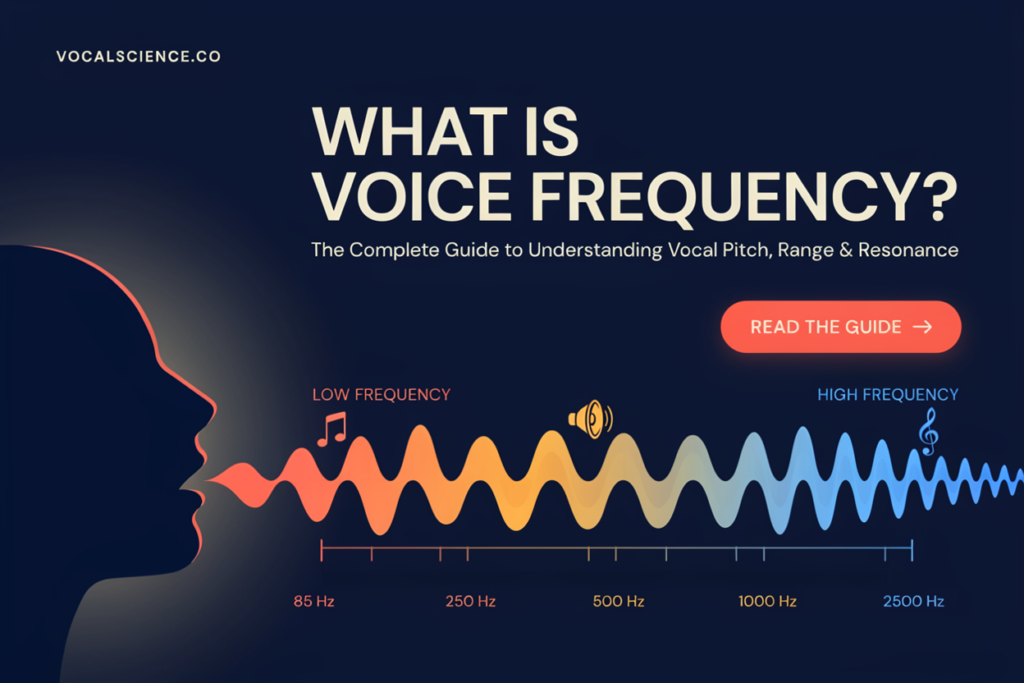
Voice frequency is the rate at which the vocal folds vibrate while producing a voiced sound. It is measured in Hertz (Hz), and one Hertz means one vibration cycle per second. In everyday voice analysis, the term usually refers to fundamental frequency, or F0, which strongly influences whether a voice is heard as relatively low or high.
A person speaking at 120 Hz produces about 120 vocal-fold vibration cycles each second. Resonance, harmonics, articulation, and loudness also shape the sound listeners recognize.
For broader context, compare a measurement with a human voice frequency reference rather than treating one reading as a fixed label.
What Is Voice Frequency?
Voice frequency is an acoustic measurement of how often a repeating voice waveform cycles each second. The most important value in basic analysis is fundamental frequency, written as F0, which reflects the primary vibration rate of the vocal folds.
Air from the lungs passes through the larynx and sets the vocal folds into vibration. This creates a complex sound containing a fundamental frequency and higher frequencies called harmonics.
Fundamental frequency and harmonics
The fundamental is usually the lowest repeating frequency in a voiced sound. Harmonics occur at whole-number multiples of it. A sound with an F0 of 100 Hz may also contain energy near 200, 300, and 400 Hz, and their relative strength affects vocal tone. A detailed guide to vocal F0 explains how this value is used in voice analysis.
Why one frequency does not define a voice
Two speakers can produce the same F0 and still sound different. The vocal tract filters the sound, strengthening some frequencies and weakening others. Resonance, breathiness, roughness, nasality, and articulation shape individual voice quality.
How Is Voice Frequency Measured?
Voice frequency is measured by recording a voiced sound and estimating how many times its waveform repeats per second. Acoustic software normally reports the result in Hertz as a changing frequency trace, an average, or a median F0.
A sustained vowel such as “ah” is easier to analyze than continuous speech, which contains pitch changes, consonants, and pauses.
What does Hertz mean?
Hertz is the standard unit of frequency. A measurement of 150 Hz means the waveform completes about 150 cycles in one second.
Frequency and cycle duration are inversely related: 100 Hz equals a 0.01-second cycle, while 200 Hz equals a 0.005-second cycle.
Why readings vary
Your voice does not stay at one exact frequency. F0 rises and falls with intonation, emphasis, emotion, and speaking style.
Noise, room echo, microphone quality, breathiness, vocal fry, and the analysis algorithm can affect results. A consistent voice-frequency measurement process makes comparisons more useful.
A browser-based check is only an estimate. Persistent hoarseness, pain, sudden pitch changes, or loss of vocal control should be assessed by a qualified healthcare professional.
Voice Frequency vs Pitch vs Resonance
Frequency is a physical measurement, pitch is the perceived highness or lowness of sound, and resonance is the way the vocal tract shapes and amplifies that sound. The terms are connected but not interchangeable.
| Term | Meaning | Typical description |
|---|---|---|
| Frequency | Waveform cycles per second | Hertz |
| Fundamental frequency | Main rate of vocal-fold vibration | F0 in Hz |
| Pitch | Perceived highness or lowness | Notes or semitones |
| Resonance | Filtering by the vocal tract | Formants and spectral energy |
| Vocal range | Lowest to highest usable pitch | Notes, semitones, or Hz |
Frequency and pitch
A higher F0 usually produces a higher perceived pitch, but pitch is a hearing-based interpretation rather than only a number. Musical notes describe pitch categories, while Hertz gives a numerical acoustic measurement.
This frequency and pitch comparison explores the distinction in more detail.
Resonance and vocal tone
Resonance does not simply raise or lower F0. It emphasizes parts of the harmonic spectrum, which is why a voice may sound bright, dark, warm, or nasal without a large change in fundamental frequency.
Understanding how resonance differs from frequency helps explain why two voices at the same Hz value can have very different timbres.
What Is a Normal Voice Frequency?
There is no single normal frequency for every person. Conversational F0 varies with anatomy, age, language, speaking task, health, and individual habit.
The Voice Foundation gives reference values of about 110 Hz for men, 180–220 Hz for women, and around 300 Hz for children. One clinical study reported means of 112.0 Hz for male voices and 195.8 Hz for female voices. These are averages, not strict boundaries.
| Group | Approximate conversational reference | Important context |
| Adult men | Around 110 Hz | Many speakers fall above or below it |
| Adult women | Around 180–220 Hz | Individual variation is expected |
| Children | Around 300 Hz | Frequency changes as the larynx develops |
| Any speaker | A changing range | Intonation continuously shifts F0 |
Use a normal voice-frequency range guide to interpret averages with appropriate context.
Speaking frequency is not singing range
Speaking F0 describes the vibration rate used during speech. Singing range covers the lowest and highest pitches a singer can produce.
A person may speak near 120 Hz but sing far below and above that value. Voice classification also considers tessitura—the comfortable and resonant part of the range—along with timbre, register transitions, and technique.
Why studies report different averages
Studies may analyze vowels, reading, counting, or conversation, while age, language, equipment, and analysis methods can change the reported values.
A frequency result is therefore a sample of vocal behavior, not proof of a voice type, personality, attractiveness, or health status.
What Affects Voice Frequency?
Voice frequency is influenced by vocal-fold length, tissue tension, and vibration pattern. Laryngeal muscles adjust these properties throughout speech and singing.
Anatomy and development
Longer vocal folds generally support lower fundamental frequencies when other conditions are comparable. During puberty, growth of the larynx and changes in vocal-fold dimensions can cause a substantial shift in speaking F0.
Children commonly have higher frequencies because their vocal folds and vocal tracts are smaller. Adult voices may change with aging, hormones, muscle control, and tissue changes.
Technique, health, and emotion
Increasing vocal-fold length and tension can raise F0, while other coordinated adjustments can lower it. Singers train breath pressure, vocal-fold vibration, and vocal-tract shaping to move efficiently between pitches.
Swelling, dehydration, fatigue, inflammation, and some neurological or hormonal changes may alter vibration. Emotion can also shift F0 through changes in intonation, airflow, and muscular tension.
One unusual reading is rarely meaningful. Repeated changes with discomfort or persistent hoarseness deserve attention.
How Should You Interpret a Voice-Frequency Result?
Interpret a result by considering the speaking task, recording conditions, normal variation, and purpose. Comparisons are most useful when recordings are made under similar conditions.
For a simple self-check, record a comfortable sustained vowel and a short spoken passage. Repeat each sample and compare the average or median values. The vowel shows relatively stable phonation, while the passage captures natural intonation.
A voice-frequency chart with context can show broad patterns, but it should not be used to diagnose a disorder or assign a singing category.
Myth: one number defines your voice
Reality: voice identity comes from F0, resonance, harmonics, articulation, timing, and loudness. Frequency also changes from moment to moment.
Myth: lower F0 always sounds deeper
Reality: a low fundamental often contributes to a deep impression, but resonance and harmonic balance also matter. A low reading caused by vocal fry may not represent a person’s normal conversational voice.
Myth: speaking frequency reveals voice type
Reality: singing voice type cannot be determined reliably from speaking F0 alone. Classification considers range, tessitura, vocal weight, timbre, register transitions, and trained function. A voice-frequency-by-type overview should be treated as a broad reference, not a diagnosis.
Frequently Asked Questions
What is the normal voice frequency for adults?
There is no universal normal value. Many adult male voices center near 110 Hz and many adult female voices near 180–220 Hz during speech, but healthy individuals may fall outside those averages.
Is voice frequency the same as vocal range?
No. Voice frequency is a measurement at a particular moment, while vocal range covers the lowest to highest pitches a person can produce.
Can voice frequency change over time?
Yes. Frequency changes naturally with age, puberty, hormones, health, training, emotion, and speaking habits. It also changes continuously within normal speech.
Why do two people at the same frequency sound different?
They may share the same fundamental frequency but have different resonance patterns, harmonic strengths, breathiness, articulation, and loudness. Those features create distinct timbres.
How accurate is an online voice-frequency reading?
Accuracy depends on microphone quality, noise, room acoustics, vocal stability, and the detection algorithm. Repeated measurements under consistent conditions are more useful than one reading, but an online result remains an estimate.

Bobby is a voice analysis and vocal testing writer at VoiceFrequencyTest. He focuses on vocal frequency analysis, pitch recognition, voice measurement tools, and singing education for vocalists, musicians, creators, and beginners.