
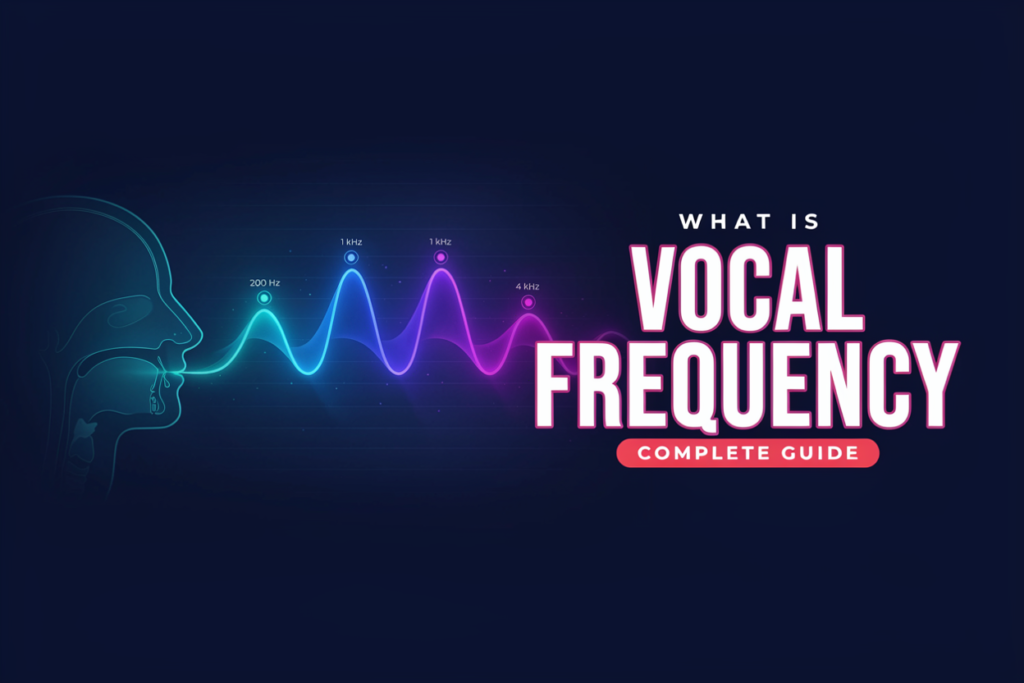
Vocal frequency is the rate at which your vocal folds vibrate during speech or singing, measured in Hertz (Hz). This vibration rate is called the fundamental frequency, or F0, and it provides the basic pitch of your voice. A lower F0 usually sounds deeper, while a higher F0 usually sounds brighter or higher-pitched.
That number does not describe the whole voice. Resonance, harmonics, and vocal-tract shape also affect how a voice sounds.
What Is Vocal Frequency?
Vocal frequency is the number of vibration cycles your vocal folds complete each second. If your vocal folds vibrate 100 times per second, the fundamental frequency of that sound is 100 Hz.
The term usually refers to the fundamental frequency of speech or singing. See this guide to how voice frequency works for the broader concept.
What Is Fundamental Frequency?
Fundamental frequency is the lowest repeating frequency in a periodic sound. In the human voice, it is created by the vibration of the vocal folds inside the larynx.
For example:
- 100 Hz means 100 vibration cycles per second.
- 150 Hz means 150 vibration cycles per second.
- 220 Hz means 220 vibration cycles per second.
A faster vibration rate usually creates a higher perceived pitch. A more technical explanation appears in the guide to fundamental frequency in the human voice.
Is Vocal Frequency the Same as the Whole Voice?
No. A voice recording contains more than one frequency.
The voice also includes harmonics—frequencies above F0—and resonances shaped by the throat, mouth, and nasal cavities. These create vocal color, warmth, brightness, and individuality.
How Is Vocal Frequency Measured?
Vocal frequency is measured by analyzing a recorded voice signal and estimating its fundamental frequency in Hertz. A pitch tracker identifies repeating vibration patterns and reports either a momentary F0 or a summary such as average or median F0.
Natural speech gives a more useful result than the lowest note you can force.
What Is Hertz?
Hertz is the standard unit of frequency. One Hertz equals one cycle per second.
When a voice analyzer reports 120 Hz, it means the detected vocal-fold vibration pattern repeats approximately 120 times each second. The number describes frequency, not loudness. Loudness is normally discussed using sound-pressure level or decibels.
Average vs. Median Frequency
An average F0 adds the measured pitch values and divides by the number of observations. A median F0 identifies the middle value after the measurements are arranged from lowest to highest.
Median frequency can be useful because vocal fry, tracking errors, or sudden pitch jumps may distort the average. Reviewing both values across a longer sample is more reliable.
For a repeatable process, follow this method for measuring vocal frequency accurately.
Vocal Frequency vs. Pitch: What Is the Difference?
Frequency is a physical measurement, while pitch is the way the auditory system perceives that frequency. The two are closely connected, but they are not identical.
A voice with a lower fundamental frequency will usually be perceived as lower in pitch. However, perception is also influenced by loudness, harmonics, resonance, and listening context.
| Concept | Meaning | Common unit |
|---|---|---|
| Vocal frequency | Physical vibration rate | Hertz |
| Pitch | Perceived highness or lowness | Musical note or perceptual description |
| Loudness | Perceived strength of sound | Often related to decibels |
| Resonance | Shaping and amplification of frequencies | Described through formants and spectral patterns |
See this comparison of voice frequency and perceived pitch for more detail.
Vocal Frequency vs. Voice Resonance
Vocal frequency establishes the basic pitch, while resonance shapes the tone and character of the sound. Two people can produce the same F0 and still sound noticeably different.
| Vocal frequency | Vocal resonance |
| Begins with vocal-fold vibration | Develops in the vocal tract |
| Strongly affects pitch | Strongly affects tone and timbre |
| Expressed in Hertz | Described through formants and spectral balance |
| Can be similar between two speakers | May still make those speakers sound very different |
One speaker at 120 Hz may sound dark and heavy, while another at the same frequency sounds lighter because the resonant balance differs. See the guide to resonance compared with frequency.
Vocal Frequency vs. Speech Frequency
Vocal frequency and speech frequency are often confused.
Vocal frequency usually refers to the fundamental frequency produced by vocal-fold vibration. Speech frequency can refer to the much wider range of acoustic energy needed to understand spoken language.
Traditional telephone systems emphasize roughly 300–3400 Hz because much of the information needed for intelligible speech lies there. This does not mean the vocal folds vibrate within that band. A man may speak near 115 Hz while his recording contains harmonics and consonant energy extending into several thousand Hertz.
What Is a Normal Vocal Frequency?
There is no single normal number for everyone. Average vocal frequency varies with age, anatomy, speaking style, emotional state, language, health, and recording method.
| Speaker group | Approximate average speaking F0 |
| Adult men | Roughly 93–135 Hz |
| Adult women | Roughly 162–238 Hz |
| Children | Often above 200 Hz |
These overlapping ranges are references, not strict biological or medical boundaries.
For a wider reference, compare your result with the site’s human voice frequency range guide and normal voice frequency ranges.
What Affects Vocal Frequency?
Vocal frequency can change from one moment to another and across a lifetime.
Age and Puberty
During puberty, the larynx and vocal folds grow. Increased vocal-fold length and mass commonly lower F0, while aging can change tissue flexibility and coordination.
Vocal-Fold Size and Tension
Longer or thicker vocal folds generally vibrate more slowly, while shorter or tenser folds vibrate faster.
Emotion and Speaking Style
Excitement, nervousness, fatigue, reading, and public speaking can all shift habitual pitch.
Vocal Health
Swelling, irritation, dehydration, or excessive tension can affect vibration. A sudden unexplained pitch change, persistent hoarseness, discomfort, or increased effort should not be judged only by an app result.
How Can You Measure Your Vocal Frequency?
Use a natural speech sample rather than forcing your lowest or highest sound.
- Record 20–30 seconds of comfortable speech.
- Choose a quiet room with little echo.
- Keep the microphone at a consistent distance.
- Speak at normal volume and pace.
- Analyze both average and median F0.
- Repeat the process two or three times.
- Compare the central values, not a single extreme reading.
A sustained vowel may not represent habitual speech because connected speech includes natural intonation and pitch movement. Browser measurements are estimates; noise, vocal fry, and octave errors can produce unstable results. Compare readings with the voice frequency chart.
Why Can Two Voices at the Same Frequency Sound Different?
Two voices at 120 Hz can sound completely different because frequency is only one acoustic feature.
One speaker may have stronger lower harmonics and a darker resonant balance. Another may have brighter formants or more breathiness. Both can share the same F0 while differing in timbre, clarity, and perceived depth. Vocal frequency measures the pitch foundation, not the entire vocal identity.
Common Myths About Vocal Frequency
Lower Frequency Always Means a Better Voice
A lower F0 does not automatically mean a healthier or more skilled voice. Comfort, clarity, control, and efficiency matter more.
One Measurement Defines Your Voice
Frequency changes across the day and between speaking tasks, so one short recording cannot define your habitual voice.
Frequency Alone Determines Voice Type
Bass, baritone, tenor, alto, mezzo-soprano, and soprano are singing classifications. They depend on usable range, tessitura, tone, passaggi, and comfort, not only speaking F0.
A Pitch App Is Always Exact
Pitch software can mistake a harmonic for F0 or report the wrong octave. Multiple natural-speech samples are more dependable.
Frequently Asked Questions
What is vocal frequency measured in?
Vocal frequency is measured in Hertz. One Hertz equals one vibration cycle per second.
What is a normal vocal frequency?
Adult male speaking voices often average around 93–135 Hz, while adult female voices often average around 162–238 Hz. Individual healthy voices can fall outside these broad reference ranges.
Is vocal frequency the same as pitch?
No. Frequency is the physical vibration rate, while pitch is the perceived highness or lowness of that sound.
Does vocal frequency determine voice type?
No. Singing voice type depends on usable range, tessitura, vocal tone, passaggi, and comfort in addition to pitch.
Can vocal frequency change with age?
Yes. Puberty, aging, hormones, tissue changes, and speaking habits can alter average fundamental frequency over time.
How accurate are voice frequency apps?
They can provide useful estimates, but accuracy depends on microphone quality, room noise, vocal stability, and the pitch-detection method. Repeating a natural speech sample gives a more reliable result than relying on one instant reading.

Bobby is a voice analysis and vocal testing writer at VoiceFrequencyTest. He focuses on vocal frequency analysis, pitch recognition, voice measurement tools, and singing education for vocalists, musicians, creators, and beginners.