
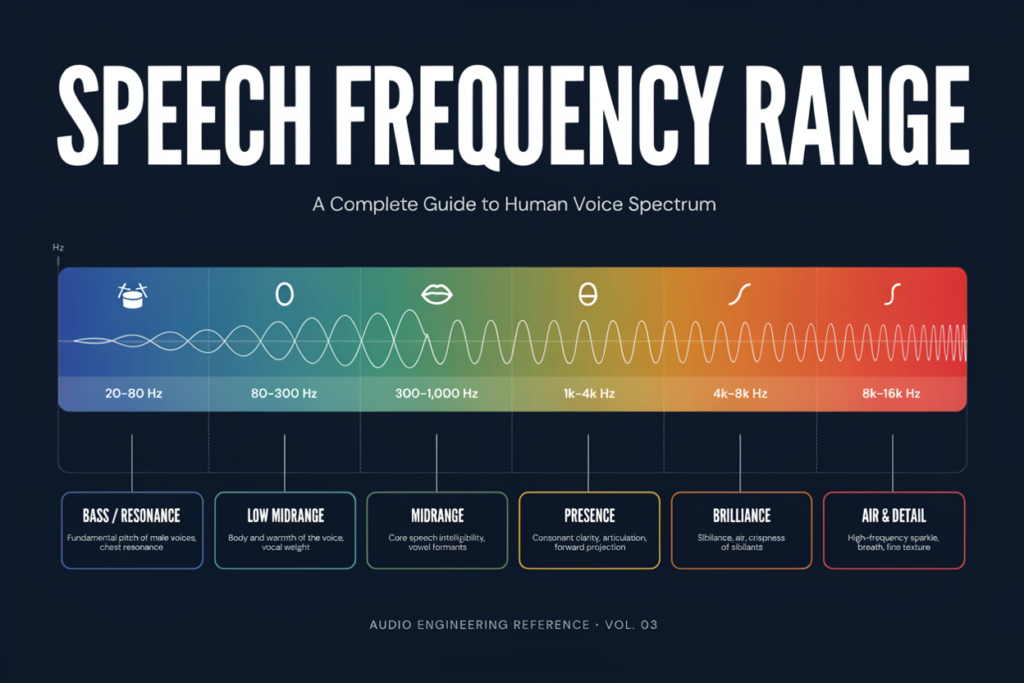
Human speech contains useful acoustic energy across roughly 125–8,000 Hz, although the exact range depends on the speaker and the purpose of measurement. The familiar 300–3,400 Hz range is the traditional telephone voice band, while frequencies around 1–4 kHz are especially important for intelligibility and higher frequencies help preserve consonant detail and naturalness.
Understanding what voice frequency means helps: speech includes F0, harmonics, and resonance-shaped energy far above basic pitch.
What Is the Speech Frequency Range?
The broad practical speech range is about 125–8,000 Hz. Narrower figures may instead describe telephone transmission, F0, intelligibility, or a specific recording system.
| Approximate range | What it usually describes |
|---|---|
| 80–300 Hz | Typical region containing much adult speaking F0 |
| 125–8,000 Hz | Broad useful speech spectrum |
| 250–4,000 Hz | Core range carrying much speech information |
| 300–3,400 Hz | Traditional telephone voice band |
| 1,000–4,000 Hz | Region especially important for intelligibility |
Broad acoustic range of speech
Natural speech contains low-frequency energy from vocal-fold vibration and higher-frequency energy from harmonics, formants, and consonants. A full recording therefore contains much more than the speaker’s basic pitch.
The guide to the human voice frequency range explains how these different components fit into the wider spectrum of a voice.
Why no single number works everywhere
One source may describe the full acoustic spectrum, while another may describe only the frequencies required for understandable communication. A pitch-analysis page may report F0, while a telecommunications page reports channel bandwidth.
Why Is 300–3,400 Hz Called the Voice Band?
The 300–3,400 Hz range is the traditional narrowband telephone voice band. It was chosen to transmit understandable speech efficiently, not to reproduce the full natural sound of a human voice.
What narrowband speech preserves
Telephone bandwidth preserves much of the energy needed to recognize words. Midrange vowel information and many important consonant cues remain audible.
What narrowband speech removes
The band cuts much of the low-frequency fullness below 300 Hz and some high-frequency consonant detail above 3,400 Hz. The result is efficient communication but reduced warmth, brightness, and speaker realism.
Sounds such as “s” and “f” can become less distinct when high-frequency information is limited.
Why the number is often misunderstood
Which Frequencies Matter Most for Speech Intelligibility?
Frequencies from roughly 1–4 kHz are especially important for speech intelligibility. They contain many consonant cues that help listeners distinguish one word from another.
Vowels carry power
Vowels usually contain strong low- and mid-frequency energy. They contribute loudness, rhythm, and the general shape of syllables.
Consonants carry clarity
Consonants often contain less total energy but more information needed to identify words. Fricatives such as “s,” “f,” and “sh” can extend several kilohertz above the strongest vowel energy.
| Speech element | Approximate emphasis | Main perceptual role |
| Vowels | About 250–2,000 Hz | Loudness, syllable shape, vowel identity |
| Voiced consonants | About 250–4,000 Hz | Word structure and transitions |
| Unvoiced consonants | About 2,000–8,000 Hz | Clarity and word distinction |
Audibility versus intelligibility
Audibility means that speech can be heard. Intelligibility means that the words can be correctly understood.
What Is the Difference Between Speech Frequency and Fundamental Frequency?
Fundamental frequency, or F0, is the vibration rate of the vocal folds. Speech frequency range describes the wider spectrum produced by F0, harmonics, vocal-tract resonance, and consonant noise.
F0 and speaking pitch
Many adult male voices use habitual F0 values around 100–120 Hz, while many adult female voices use higher averages. These are broad population tendencies, not fixed categories.
The article on fundamental frequency in voice explains why F0 is the main acoustic measurement associated with speaking pitch.
A 120 Hz voice contains much more than 120 Hz
Suppose a speaker’s F0 is 120 Hz. The vocal-fold source can also contain harmonics near 240, 360, 480, 600 Hz, and upward.
Pitch is not bandwidth
Pitch is the perceived height of the fundamental pattern. Bandwidth describes the span of frequencies included in the full signal.
The guide comparing voice frequency and pitch helps separate these ideas.
What Role Do Formants Play in Speech?
Formants are prominent energy regions created by vocal-tract resonance. They help listeners distinguish vowels even when the speaker’s fundamental frequency changes.
F1 and F2
The first two formants, commonly called F1 and F2, are especially important for vowel identity. Their positions change when the tongue, jaw, lips, and throat alter the vocal tract’s shape.
Formants versus harmonics
Harmonics come from the vocal-fold source and occur at multiples of F0. Formants describe frequency regions strengthened by the vocal tract.
The explanation of voice resonance frequency covers how these resonances shape the spectrum of speech.
Speech Frequency Ranges by Application
Different applications use different bandwidths because they prioritize intelligibility, naturalness, storage, or measurement.
| Application | Approximate useful range | Main goal |
| Narrowband telephone | 300–3,400 Hz | Basic intelligibility with low data use |
| Wideband calling | About 50–7,000 Hz | Clearer, more natural speech |
| Podcast recording | Often 80–15,000 Hz or wider | Natural tone and consonant detail |
| Speech audiometry | Test-dependent speech bands | Measure understanding and hearing ability |
| Speech recognition | System-dependent | Preserve cues needed for accurate decoding |
Telephone and video calls
Podcasts and studio speech
Recorded speech often benefits from a much wider bandwidth than telephone audio. Full-range microphones preserve tone, breath detail, consonants, and speaker identity.
Hearing and speech testing
How Do Male, Female, and Child Speech Differ?
Male, female, and child speech differ most clearly in average F0 and formant spacing, but their full acoustic spectra overlap extensively.
Differences in F0
The comparison of male and female voice frequency provides broader reference ranges.
Differences in vocal-tract resonance
A shorter vocal tract generally produces higher formant frequencies, while a longer tract generally produces lower formants. ## How Should You Record or Process Speech?
Use high-pass filtering carefully
A high-pass filter can reduce rumble, handling noise, and low-frequency hum. If set too high, it removes warmth and may make speech sound thin.
Preserve consonant detail
Aggressive cuts above 3–4 kHz may reduce hiss but can also weaken “s,” “f,” “t,” and “sh.” This can reduce clarity even when the recording remains loud.
Avoid one-size-fits-all EQ
A pitch or frequency measurement also depends on the analysis method. The guide to how voice frequency is measured explains what a pitch tracker does and does not report.
Common Speech Frequency Range Myths
Human speech only occupies 300–3,400 Hz
Reality: That figure describes traditional telephone bandwidth, not the complete natural speech spectrum.
A 100 Hz voice contains only low frequencies
Reality: A 100 Hz F0 produces harmonics and resonance-shaped energy extending far above 100 Hz.
Vowels matter more than consonants for understanding
Reality: Vowels carry substantial power, but consonants often provide the detail needed to distinguish words.
Frequencies above 4 kHz do not matter
Reality: Higher frequencies improve consonant clarity, naturalness, and speaker identification, even when basic words remain understandable without them.
Speech range equals hearing range
Reality: Human hearing covers a much wider span than speech. Speech occupies only part of the audible spectrum.
For context on how normal values are interpreted, see the guide to a normal voice frequency range.
Frequently Asked Questions
What is the complete frequency range of human speech?
A practical broad range is about 125–8,000 Hz, though natural recordings may contain useful energy outside it. The answer depends on whether you mean F0, intelligibility, full-spectrum audio, or transmission bandwidth.
Why do telephones use 300–3,400 Hz?
This range preserves enough speech information for understandable communication while limiting bandwidth. It sacrifices some warmth and high-frequency detail to improve efficiency.
Which frequencies make speech understandable?
The 1–4 kHz region is especially important because it contains many consonant cues. Vowels contribute more power, while consonants often provide more word-level detail.
Are consonants higher in frequency than vowels?
Many unvoiced consonants emphasize higher frequencies than vowels, often extending into the 2–8 kHz region. Voiced consonants and vowels also contain overlapping lower-frequency energy.
Is speaking frequency the same as speech bandwidth?
No. Speaking frequency usually refers to F0, while speech bandwidth describes the full range of frequencies contained or transmitted in the signal.
Does high-frequency hearing loss affect speech clarity?
Yes. Reduced high-frequency hearing can make consonants such as “s,” “f,” and “th” harder to distinguish, especially in background noise.

Bobby is a voice analysis and vocal testing writer at VoiceFrequencyTest. He focuses on vocal frequency analysis, pitch recognition, voice measurement tools, and singing education for vocalists, musicians, creators, and beginners.