
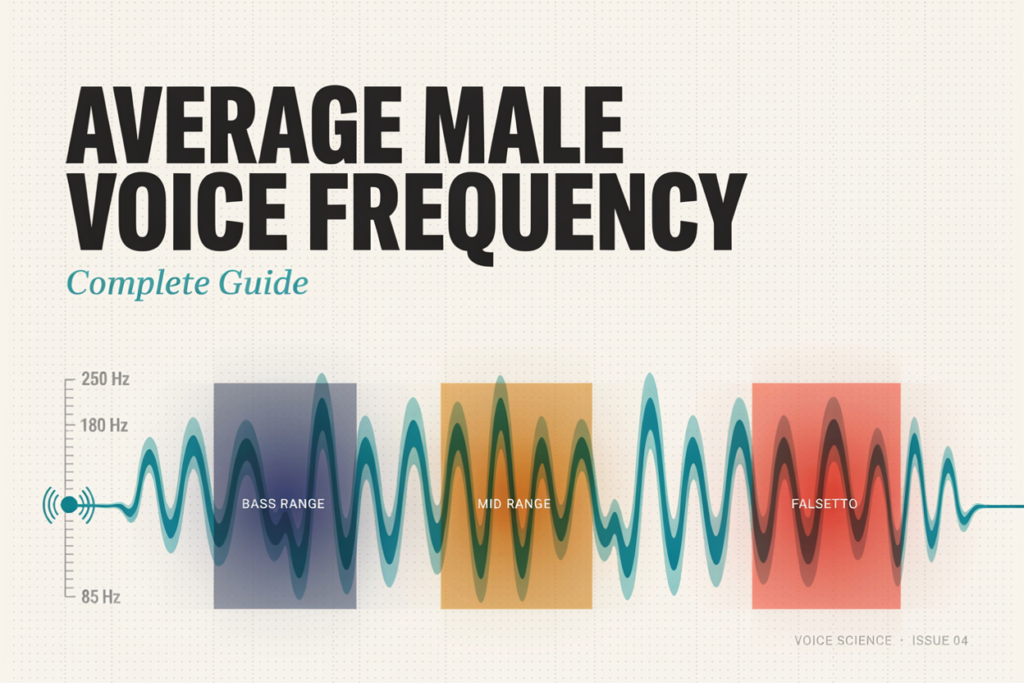
The average adult male speaking voice has a fundamental frequency of about 110–120 Hz. In natural conversation, many men fall somewhere between roughly 85 and 155 Hz, although healthy voices can sit outside that range because of age, anatomy, speaking style, language, and measurement method.
Fundamental frequency, or F0, is the rate at which the vocal folds repeat their vibration cycle. It does not describe every frequency contained in the voice. A recording of a man speaking at 120 Hz also contains harmonics and resonant energy far above that value.
To interpret your own result accurately, first understand how voice frequency is measured using natural speech rather than a forced low note.
What Is the Average Male Voice Frequency?
The most useful single estimate for the average male speaking voice is approximately 110–120 Hz. A broad conversational reference range of about 85–155 Hz is more realistic than treating one number as a universal standard.
| Measurement or description | Approximate frequency |
|---|---|
| Commonly cited adult male average | 110–120 Hz |
| Broad conversational range | About 85–155 Hz |
| Lower-pitched male voice | Often below 100 Hz |
| Higher-pitched male voice | Often above 140–150 Hz |
| Individual habitual averages reported in research | Roughly 78–182 Hz |
These values refer to habitual speaking pitch, not the lowest sound someone can produce. A man may briefly drop to 75 Hz at the end of a sentence while averaging 115 Hz across a full recording.
Why Is 120 Hz Commonly Used?
A value near 120 Hz sits close to the center of several published male speaking-frequency findings, so it works well as a rounded reference. It is not a pass-or-fail target.
Different studies also measure different tasks. Reading aloud, sustained vowels, spontaneous speech, and loud speech can all produce different results. The guide to fundamental frequency in voice explains why F0 is the value most pitch trackers report.
What Does Male Voice Frequency Actually Measure?
Male voice frequency usually means fundamental frequency, measured in Hertz. One Hertz equals one vibration cycle per second, so a voice with an F0 of 120 Hz is producing about 120 vocal-fold cycles each second.
Fundamental Frequency vs. the Full Voice Spectrum
A male voice measured at 120 Hz is not made of a single 120 Hz tone. The vocal folds generate a fundamental plus harmonics, while the throat, mouth, and nasal cavities reshape that sound through resonance.
That is why a spectrum analyzer may show energy across hundreds or thousands of Hertz even when the reported pitch remains near 120 Hz. The article on male voice frequency covers this wider acoustic picture.
Why Do Male Voice Frequency Figures Vary?
Male voice frequency figures vary because speakers, speech tasks, and analysis methods vary. A relaxed conversation, formal reading passage, and sustained vowel may all produce different averages from the same person.
Age, Puberty, and Anatomy
During male puberty, the larynx grows and the vocal folds usually become longer and thicker. That added mass allows them to vibrate more slowly, which commonly lowers speaking pitch.
Frequency may continue changing with age because of hormonal changes, tissue flexibility, muscle function, respiratory support, and health.
Recording and Analysis Method
Pitch trackers can report mean, median, minimum, maximum, or a full pitch contour. These values answer different questions.
The mean can be pulled upward by brief pitch jumps or downward by vocal fry. The median is often more stable because it reduces the influence of short extreme values.
How Should You Measure Your Average Speaking Frequency?
The most reliable at-home estimate comes from several short samples of natural speech. A single low note or held vowel does not represent everyday speaking frequency.
- Record 20–30 seconds of relaxed speech in a quiet room.
- Keep the microphone at a consistent distance.
- Speak naturally instead of deliberately lowering your voice.
- Analyze voiced speech rather than silence or background noise.
- Record both the average and median F0.
- Repeat the process two or three times.
- Compare the central results rather than the lowest detected pitch.
For a fuller workflow, see how to check voice frequency without confusing a momentary low point with a true speaking average.
Common Measurement Errors
Background noise, poor microphone placement, and creaky phonation can confuse pitch detection. Octave errors are also common: software may report 60 Hz when the actual pitch is 120 Hz, or 240 Hz when it is 120 Hz.
Repeating the test and checking whether the pitch contour looks realistic helps identify these mistakes.
Is Your Male Voice Frequency Low, Average, or High?
A practical interpretation can help, but the boundaries should remain flexible.
| Average conversational F0 | General interpretation |
| Below 85 Hz | Very low for many adult male speakers |
| 85–100 Hz | Lower-pitched male voice |
| 100–130 Hz | Near a commonly reported male average |
| 130–155 Hz | Higher part of many male reference ranges |
| Above 155 Hz | Higher than many male averages, but possible naturally |
A result around 100 Hz is commonly perceived as low, while 115–120 Hz sits near the center of many male references. The comparison of low and high voice frequency explains why these categories overlap rather than forming hard boundaries.
Can Two Men at 120 Hz Sound Different?
Yes. One speaker may have stronger low-frequency resonance and a darker spectral balance, while another has brighter resonance and more energy in higher harmonics.
Their F0 is the same, but one may sound deeper. This is why voice resonance and frequency should be considered together.
How Does Male Frequency Compare With Female and Child Voices?
Adult male voices usually average lower than adult female and prepubescent child voices, but the categories overlap.
| Speaker group | Broad average speaking-frequency reference |
| Adult men | About 110–120 Hz |
| Adult women | Commonly around 165–220 Hz |
| Prepubescent children | Often above 200 Hz |
These figures are broad population references, not identity tests. A naturally high male voice or low female voice can still be healthy. For a fuller comparison, see male and female voice frequency.
Does Male Speaking Frequency Determine Voice Type?
Male speaking frequency does not determine whether someone is a bass, baritone, or tenor. Singing voice type depends on usable range, tessitura—the range where the voice feels most comfortable—tone quality, passaggi, and vocal coordination.
Bass, Baritone, and Tenor
Bass voices generally sit lowest in classical male classification, baritones occupy the middle, and tenors sing higher. The classification is based on musical function and comfortable production rather than one conversational reading.
The guide to the bass voice frequency range explains low male singing voices in more detail.
Can a Man Safely Lower His Average Voice Frequency?
A man may develop a slightly lower and fuller habitual voice by reducing tension, improving breath coordination, and using resonance efficiently. Forcing the larynx downward or pressing into vocal fry is not a safe shortcut.
When a Voice Change Needs Attention
Sudden unexplained deepening, persistent hoarseness, pain, loss of range, or increased effort deserves attention from a qualified voice professional or clinician. A change that lasts for weeks should not automatically be treated as normal training progress.
Frequently Asked Questions
Is 120 Hz a normal male voice?
Yes. An average near 120 Hz falls close to many commonly reported adult male speaking values. Healthy male voices may still average considerably lower or higher.
Is 100 Hz considered a deep male voice?
A 100 Hz conversational average is generally on the lower side for adult men and may be perceived as deep. Resonance and vocal quality still influence how deep it sounds.
Is 150 Hz high for a male voice?
A 150 Hz average is higher than many commonly cited male averages, but it can occur naturally. Age, language, emotion, speaking style, and anatomy all affect habitual pitch.
What is the lowest normal male speaking frequency?
There is no universal lowest normal value. Some healthy men average below 85 Hz, but an unusually low reading should be repeated to rule out vocal fry or an octave-tracking error.
Does a deep speaking voice mean someone is a bass?
No. Bass is a singing classification based on comfortable range, tessitura, tone, and transition points. Speaking pitch alone cannot establish voice type.
Why does my measured voice frequency keep changing?
Voice frequency changes with sentence intonation, emotion, loudness, fatigue, posture, and recording conditions. Compare several natural speech samples instead of expecting one fixed number.

Bobby is a voice analysis and vocal testing writer at VoiceFrequencyTest. He focuses on vocal frequency analysis, pitch recognition, voice measurement tools, and singing education for vocalists, musicians, creators, and beginners.