
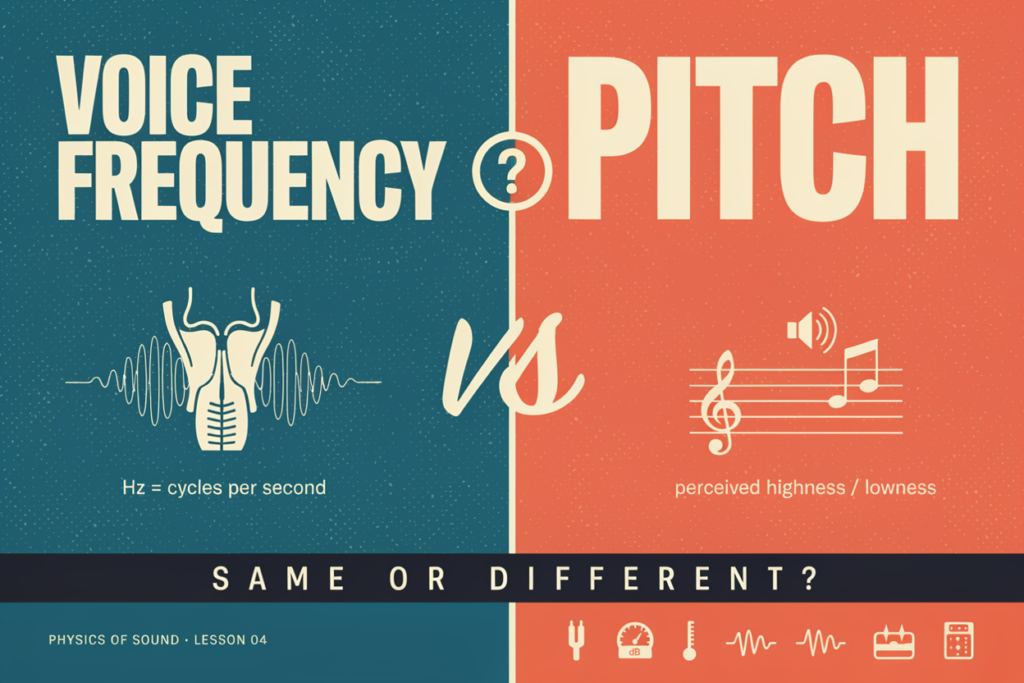
Voice frequency and pitch are closely related, but they are not the same thing. Voice frequency is a measurable physical property expressed in hertz (Hz), while pitch is the way our brain perceives how high or low a sound seems.
Understanding this difference helps explain why two voices with the same measured frequency can sound different and why pitch-detection apps estimate frequency rather than measuring human perception directly.
For background, see the physical meaning of voice frequency.
What Is the Difference Between Voice Frequency and Pitch?
Voice frequency is a physical measurement, usually expressed as the fundamental frequency (F0) in hertz, while pitch is the listener’s perception of how high or low the voice sounds. Higher F0 usually produces a higher perceived pitch, but harmonics, resonance, and hearing all influence perception.
Voice Frequency Is Measured in Hertz
Fundamental frequency represents how many times the vocal folds vibrate each second. A voice with an F0 of 120 Hz completes about 120 vibration cycles every second.
Learn more about how fundamental frequency is produced.
Pitch Is a Perceptual Experience
Pitch is not measured directly in hertz. Instead, it describes how listeners interpret the sound. Two voices with similar F0 values may still be perceived differently because of resonance, harmonics, and vocal quality.
Voice Frequency vs Pitch
| Feature | Voice Frequency | Pitch |
|---|---|---|
| Type | Physical measurement | Auditory perception |
| Unit | Hertz (Hz) | High/low sensation or musical note |
| Based on | Vocal-fold vibration | Brain’s interpretation |
| Measured by | Acoustic software | Human hearing |
| Example | 120 Hz | A relatively low speaking pitch |
How Are Frequency and Pitch Related?
Higher fundamental frequencies generally create higher perceived pitches, while lower frequencies usually sound lower.
However, the relationship is not perfectly linear.
Frequency and Octaves
When frequency doubles, the perceived pitch rises by one octave.
| Musical Note | Approximate Frequency |
| A2 | 110 Hz |
| A3 | 220 Hz |
| A4 | 440 Hz |
Does a Voice Contain Only One Frequency?
No.
A voiced sound contains:
- Fundamental frequency
- Harmonics
- Resonances
- Small noise components
For example, a voice with a 100 Hz fundamental may also contain energy around 200, 300, 400 Hz and beyond.
The frequencies contained in a vocal sound extend far beyond the fundamental.
Why Can Two Voices at the Same Frequency Sound Different?
Two speakers may both average 120 Hz while sounding completely different because of:
- Vocal resonance
- Formants
- Harmonic balance
- Accent
- Speaking rhythm
- Articulation
This is why the resonances that shape vocal tone matter alongside pitch.
Can You Hear Pitch Without the Fundamental?
Yes.
The auditory system can often perceive the pitch of a missing fundamental because harmonics preserve the spacing needed for the brain to infer the original pitch.
This explains why small speakers can still make voices sound low even when the lowest frequency is reproduced weakly.
Frequency, Pitch, and Musical Notes
Speech moves continuously, while music usually targets stable notes.
A person may speak around 120 Hz but never remain on one musical note for an entire sentence because natural speech constantly changes pitch.
How Do Pitch Detectors Measure Voice Frequency?
Most apps estimate fundamental frequency (F0) rather than perceived pitch.
They often use repeating waveform patterns to estimate vocal-fold vibration.
See how voice-analysis software estimates F0.
Common Errors
- Octave doubling
- Octave halving
- Vocal fry
- Background noise
- Poor microphones
The accuracy limits of pitch detection explain why repeated measurements are recommended.
Can Resonance Change Without Pitch Changing?
Yes.
A singer can hold exactly the same note while changing from “ee” to “ah.”
The fundamental frequency stays nearly constant, but resonance changes the tone color.
This illustrates how vocal resonance differs from frequency.
How to Measure Voice Frequency Correctly
- Record at least 30 seconds of natural speech.
- Use a quiet room.
- Measure the median or average F0.
- Repeat on different days.
- Treat results as estimates rather than exact biological values.
The changing pitch pattern used in speech is more informative than one isolated reading.
Common Myths
| Myth | Reality |
| Frequency and pitch are identical | Frequency is measured; pitch is perceived |
| A voice has only one frequency | Voices contain many frequencies |
| Two voices at 120 Hz sound identical | Resonance and timbre differ |
| Doubling Hz doubles perceived pitch | It raises pitch by one octave |
| Pitch apps measure resonance | They mainly estimate F0 |
Frequently Asked Questions
Is voice pitch measured in hertz?
Pitch is a perception, while hertz measures frequency. In practice, F0 is often used as the acoustic correlate of pitch.
Is fundamental frequency the same as pitch?
No. Fundamental frequency is a measurable property, while pitch is the listener’s perception.
Why do voices with the same frequency sound different?
Because resonance, harmonics, articulation, and timbre differ.
Can you hear pitch if the fundamental is missing?
Often yes. The brain can infer pitch from the harmonic pattern.
Why does a pitch detector show the wrong octave?
Noise, vocal fry, or tracking errors can cause octave doubling or halving.
Does changing resonance change pitch?
Usually no. Resonance mainly changes tone color while the fundamental frequency remains the same.

Bobby is a voice analysis and vocal testing writer at VoiceFrequencyTest. He focuses on vocal frequency analysis, pitch recognition, voice measurement tools, and singing education for vocalists, musicians, creators, and beginners.