
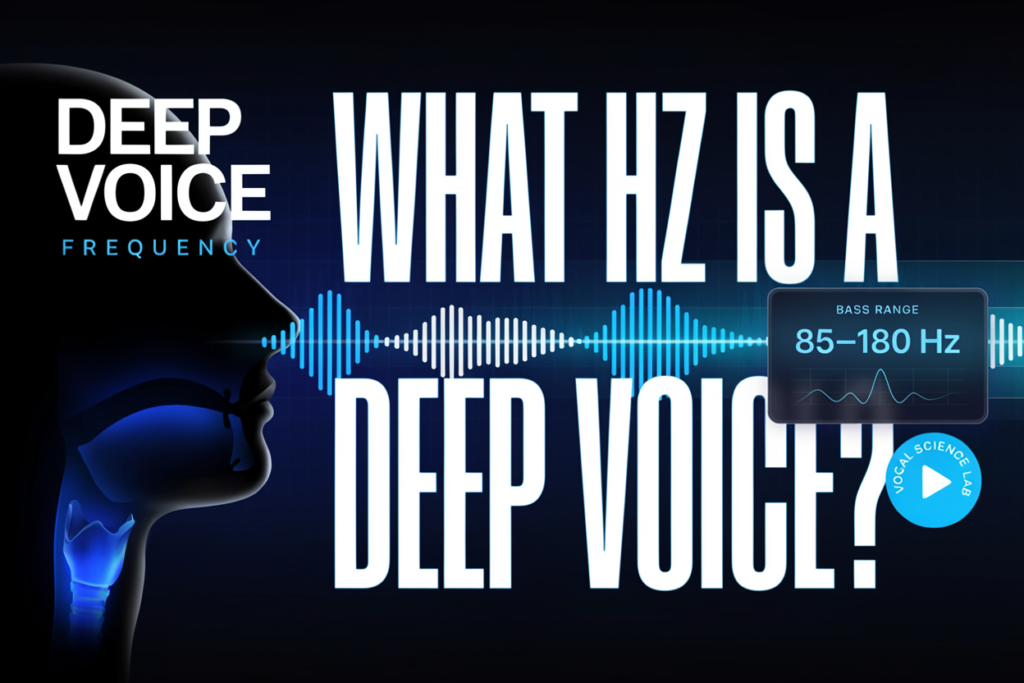
Deep voice frequency usually refers to a relatively low fundamental frequency, or F0, during comfortable speech. Many voices perceived as deep fall around 90–110 Hz for adult men, although healthy voices vary widely and resonance also plays a major role in how deep a voice sounds.
A deep voice is not defined by one isolated reading. The most useful measurement is the average or median pitch across natural speech, not the lowest number produced during vocal fry. Understanding how fundamental frequency works makes that distinction much clearer.
What Is Deep Voice Frequency?
Deep voice frequency is the lower fundamental-frequency region associated with a low-pitched speaking voice. In practical terms, adult male voices around 90–110 Hz are often perceived as deep, while values below about 90 Hz may sound very deep. These are descriptive ranges, not strict biological or clinical categories.
What Makes a Voice Sound Deep?
A low fundamental frequency is the main factor, but it is not the only one. A voice may sound deep because of:
- Lower vocal-fold vibration
- Strong low-frequency harmonics
- Darker resonance
- A larger vocal tract
- Slower or more relaxed speech
- Reduced pitch variation
This is why two people with the same F0 may still sound very different.
Deep Voice Frequency Range
The table below provides a practical reference for conversational speech.
| Voice description | Approximate speaking F0 |
|---|---|
| Very deep male voice | Below about 90 Hz |
| Deep male voice | About 90–110 Hz |
| Common adult male region | About 100–120 Hz |
| Overlapping mid-range region | About 120–180 Hz |
| Common adult female region | About 165–255 Hz |
These regions overlap. A woman can naturally have a low speaking voice, and a man can naturally speak above the common male average.
The guide to average male voice frequency gives more context for interpreting these numbers.
What Determines Deep Voice Frequency?
Deep voice frequency is shaped by anatomy, vocal-fold behavior, resonance, and speaking habits.
Vocal-Fold Length and Mass
Longer and heavier vocal folds generally vibrate more slowly, producing a lower F0. Shorter and lighter vocal folds usually vibrate faster.
Hormonal development during puberty often increases vocal-fold length and mass, which can lower habitual pitch. The amount of change varies considerably between individuals.
Vocal-Tract Resonance
The throat, mouth, tongue, jaw, and lips filter the sound created by the vocal folds. This filtering affects whether the voice sounds dark, bright, full, thin, or resonant.
A person with a moderate F0 may still sound deep if the lower harmonics are reinforced strongly. Learning how resonance affects vocal depth explains why pitch alone does not tell the whole story.
Harmonic Balance
The vocal folds produce a fundamental plus higher harmonics. A voice with strong low harmonics may sound fuller and heavier, while stronger upper harmonics may create a brighter impression.
Microphones, speakers, and room acoustics can also change harmonic balance, which is why the same speaker may sound deeper in one recording than another.
Speaking Style
Slow speech, relaxed delivery, lower intonation, and deliberate pacing may create a deeper impression. Excitement, questions, stress, or increased loudness often raise F0.
Vocal fry can also produce very low readings, but those readings may not represent normal modal speech.
Deep Voice vs. Bass Voice
A deep speaking voice and a bass singing voice are related, but they are not the same classification.
| Feature | Deep speaking voice | Bass singing voice |
| Main measurement | Average or median speaking F0 | Lowest and highest usable singing notes |
| Typical task | Conversation | Sustained musical performance |
| Main concern | Habitual pitch and resonance | Range, tessitura, tone, and projection |
| Example value | About 90–110 Hz | Often extends into low musical notes |
| Classification | Informal description | Formal singing voice type |
A singer may have a bass range but speak at a moderate pitch. Another person may speak very low without having the range, control, or tessitura needed for bass repertoire.
The bass voice frequency range and baritone voice frequency range show why speaking pitch cannot determine singing classification by itself.
Deep Voice vs. Vocal Fry
Vocal fry is a low, creaky register produced by slow and irregular vocal-fold pulses. It can generate readings far below a person’s normal speaking F0.
For example, someone may briefly reach 70–80 Hz in fry but average 115 Hz during natural conversation. The lower number shows the minimum detected pitch, not the habitual voice frequency.
A deep natural voice remains relatively low during ordinary connected speech without relying on creaky, unstable pulses.
Can You Naturally Deepen Your Voice?
You may be able to develop a fuller, calmer, and slightly lower speaking voice, but anatomy places practical limits on permanent pitch change.
Relax the Speaking Mechanism
Excess tension in the jaw, tongue, neck, or larynx may make the voice feel pressed or unnaturally high. Relaxed speech can reveal a more comfortable habitual pitch.
Do not push the larynx downward or force the throat open.
Improve Breath Coordination
Steady airflow can reduce squeezing and help the voice sound more stable. Breath support does not mean pushing large amounts of air.
Develop Resonance
Resonance exercises can make the voice sound richer without lowering F0 dramatically. Humming, voiced fricatives, and gentle speaking exercises may improve acoustic efficiency.
Use Realistic Expectations
Exercises may improve control and reduce unnecessary tension, but they cannot completely change vocal-fold anatomy. Permanent dramatic lowering usually requires more than simple practice.
Can Voice-Frequency Tests Measure Deep Voices?
Pitch apps can estimate F0, but their results depend on the microphone, room, sample length, and algorithm.
What Pitch Apps Measure
Most simple tools estimate the fundamental frequency of a sustained sound or speech sample. They do not fully measure resonance, timbre, or vocal quality.
You can measure your speaking frequency by recording a natural sample rather than relying on one word.
Common Measurement Errors
Low voices can be difficult for some algorithms to track. Common problems include:
- Octave halving
- Background rumble
- Vocal fry
- Poor microphone response
- Music or noise in the recording
- Very short samples
An octave error may cause the software to display a value at half or double the true F0.
Why Repeat Measurements Matter
Record at least 30 seconds of natural speech and check the median or average F0. Repeat the test on different days under similar conditions.
One unusually low reading should not define your voice.
Is a Deep Voice Better?
A deep voice is not automatically healthier, stronger, more attractive, or more authoritative. Those judgments depend on culture, context, speaking style, and listener preference.
A useful voice is comfortable, clear, flexible, and sustainable. Forcing the pitch downward may reduce clarity and increase strain.
If lowering the voice causes pain, persistent hoarseness, pressure, or fatigue, stop and review how to protect vocal-fold health.
Common Myths About Deep Voice Frequency
| Myth | Reality |
| Every deep voice is below 90 Hz | Many deep voices average above 90 Hz |
| Lower frequency always means a better voice | Clarity and comfort matter more |
| Bass singers always speak very low | Singing type and speaking F0 are different |
| Vocal fry proves a naturally deep voice | Fry may only show a temporary minimum |
| One test defines your permanent frequency | F0 changes with task, emotion, and context |
| Apps perfectly measure low voices | Tracking errors are common at low frequencies |
Frequently Asked Questions
What frequency is considered a deep voice?
A male speaking voice around 90–110 Hz is often perceived as deep. Values below about 90 Hz may sound very deep, but resonance and speaking style also affect perception.
Is 90 Hz a deep speaking voice?
Yes. A habitual speaking frequency near 90 Hz is generally considered low for an adult male voice. The reading should come from natural connected speech rather than one fry sound.
Can women have naturally deep voices?
Yes. Healthy female speaking frequencies vary widely, and some women naturally speak in lower overlapping regions.
What is the difference between a deep voice and a bass voice?
A deep voice describes conversational pitch, while bass is a singing classification based on range, tessitura, tone, and vocal function.
Can exercises permanently deepen your voice?
Exercises may reduce tension and improve resonance, which can make the voice sound deeper. They usually cannot create a dramatic permanent pitch change beyond anatomical limits.
Can a phone accurately measure deep voice frequency?
A phone can provide a useful estimate, but microphone filtering, background noise, fry, and pitch-tracking errors can affect the result.

Bobby is a voice analysis and vocal testing writer at VoiceFrequencyTest. He focuses on vocal frequency analysis, pitch recognition, voice measurement tools, and singing education for vocalists, musicians, creators, and beginners.