
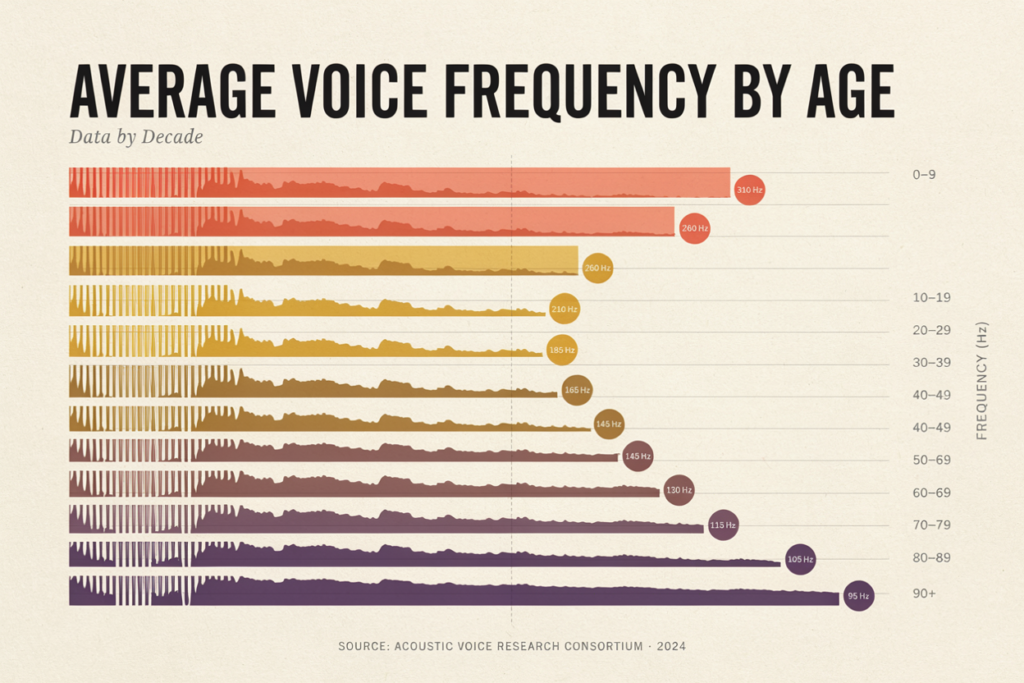
Average voice frequency generally decreases as the larynx grows. Infant cries may center near 500 Hz, children often speak around 250–400 Hz, adult women average roughly 200 Hz, and adult men roughly 125 Hz. These are broad population reference points, not diagnostic limits or a precise value for every age.
Here, voice frequency means fundamental frequency (F0)—the vocal-fold vibration rate measured in hertz and the acoustic basis of perceived pitch. It differs from singing range and the wider collection of harmonics in a recorded voice. See this explanation of fundamental frequency in the voice.
What Is the Average Voice Frequency by Age?
There is no scientifically valid frequency for every birthday. Development is gradual, puberty begins at different times, and results change with the speaking task. Use the chart as a life-stage guide.
| Life stage | Approximate speaking F0 | Typical pattern | How to interpret it |
|---|---|---|---|
| Infancy | Cry often near 500 Hz | High, rapidly changing frequency | Crying is not directly comparable with conversational speech |
| Early childhood | Often within 250–400 Hz | F0 falls as the larynx and vocal folds grow | Individual values vary widely |
| School-age childhood | Commonly around 250–300 Hz | Gradual decline before puberty | Differences between boys and girls are usually modest |
| Puberty and adolescence | Highly variable | A larger average drop occurs in boys; girls usually have a smaller decline | Pubertal stage matters more than exact age |
| Adult women | Roughly 180–220 Hz; about 200 Hz is a common reference | Relatively stable through much of adulthood | The distributions overlap with men’s voices |
| Adult men | Roughly 100–130 Hz; about 125 Hz is a common reference | Relatively stable through much of adulthood | Vocal fry can pull some readings lower |
| Older adulthood | No single universal range | Women’s F0 may decrease; men’s may increase, especially at advanced ages | Health, hormones, and vocal condition strongly affect the result |
The National Center for Voice and Speech gives broad reference points of about 500 Hz for infant cries, 250–400 Hz for children, 200 Hz for adult women, and 125 Hz for adult men. A normal voice-frequency range guide puts those averages in context without treating them as pass-or-fail thresholds.
Infants and young children
Infants produce high frequencies because their vocal folds are short and small. Mean F0 falls rapidly as the vocal mechanism develops. Cry frequency depends on the cry’s type and intensity, so it is not directly comparable with relaxed adult speech.
Children’s voices remain relatively high before puberty. Growth gradually lowers F0, but age groups overlap. Excitement, loudness, and reading versus spontaneous conversation may change the result substantially.
Teenagers and adults
Puberty creates the largest obvious age-related shift after early childhood. Average F0 falls in all adolescents, but the drop is typically much larger in boys. The timing can span several years, and temporary pitch breaks are common while the vocal system adjusts. A detailed look at voice changes during puberty explains why one “normal teenage Hz” number would be misleading.
After maturation, adult averages are more stable, although female and male distributions overlap. Comparing the average female speaking frequency with the average male speaking frequency is more useful than imposing one dividing line.
Why Does Voice Frequency Change With Age?
Voice frequency changes with age because the vocal folds and larynx grow, respond to hormones, and later undergo age-related changes in muscle, tissue, and respiratory support. Frequency is governed by the interacting effects of vocal-fold length, mass, and tension—not age alone.
Growth during childhood and puberty
Shorter, lighter vocal folds can vibrate more quickly, producing a higher F0. As children grow, the vocal folds become longer and the larynx enlarges, so habitual speaking frequency generally falls. Before puberty, average differences between boys and girls are limited compared with the separation seen after puberty.
During androgen-influenced puberty, the larynx generally enlarges and the vocal folds become longer and thicker. Their greater vibrating mass supports a slower cycle and a lower pitch. Other pubertal patterns usually produce less dramatic laryngeal growth, so the average F0 decline is smaller. Anatomy varies, however, and the figures do not reliably identify a person’s sex, gender, or developmental stage.
Changes in older voices
An aging voice may be affected by reduced muscle bulk, changes in tissue flexibility, altered hormone levels, less efficient breath support, medications, and health conditions. Research commonly finds that women’s mean F0 tends to decrease later in life, while men’s may rise, particularly in advanced age. This can narrow the average difference between groups, but individual patterns differ.
These shifts may occur with presbyphonia, age-related changes to voice function. It can involve weakness, breathiness, instability, or fatigue as well as pitch change; frequency alone cannot establish it.
How Do Male and Female Voice Frequencies Change Differently?
Male and female speaking frequencies are fairly similar in childhood, separate more strongly after puberty on average, and may move somewhat closer again in older age. The pattern describes populations rather than strict male and female frequency categories.
A post-puberty voice around 110 Hz and one around 220 Hz illustrate the average separation often reported between adult groups. Because 220 is twice 110, the pitches are one octave apart. Yet two people at the same F0 can sound very different because vocal-tract resonance, formants, harmonics, articulation, and intonation also shape perception. The broader male-versus-female frequency comparison explores that overlap and the limits of pitch-based classification.
Speaking F0 organizes conversational pitch, whereas vocal range covers a singer’s lowest and highest notes. Tessitura is the smaller comfortable area. Neither can be inferred reliably from age or speaking F0.
Why Might Your Measurement Differ From the Age Chart?
An age chart summarizes groups, while an analyzer measures one task under particular conditions. Language, emotion, loudness, register, health, microphone quality, and software settings affect the result.
Speech versus sustained vowels
Connected speech continuously changes in pitch, so a median F0 across 20–30 seconds is usually more representative than one instantaneous number. A sustained “ah” is easier for software to track but reflects a controlled task rather than everyday conversation. For a useful comparison, record both under similar conditions and repeat each measurement.
A practical method for measuring voice in hertz should use a quiet room, comfortable pitch, consistent microphone distance, and several samples. Browser-based or at-home checks remain estimates rather than clinical laboratory measurements.
Common tracking errors
Pitch software can mistake a harmonic for F0 and report double the true frequency, called an octave-up error. Vocal fry may produce irregular pulses that cause half-frequency or unstable readings. Background music, reverberation, another speaker, and clipping can also distort the result. Evaluate the pitch trace and median, not just the largest number on screen.
When Is a Voice-Frequency Change Worth Checking?
A gradual age-related shift without discomfort is often expected. A sudden or persistent change deserves more attention when it comes with hoarseness, pain, vocal fatigue, breathing difficulty, frequent pitch breaks, reduced loudness, or loss of usable range.
An unusual Hz reading by itself does not diagnose a voice disorder. If symptoms persist for several weeks, repeatedly interfere with speaking or singing, or follow surgery or injury, consult an appropriate healthcare professional such as an ear, nose, and throat physician or a speech-language pathologist. This overview of frequency and vocal-fold health explains why symptoms and change from your own baseline matter more than comparison with a population average.
Frequently Asked Questions
What is the average voice frequency of a child?
Children’s speaking F0 is often broadly referenced at 250–400 Hz, with frequency generally falling as they grow. The result varies with age, task, language, loudness, and the child’s individual development.
At what age does voice frequency change the most?
F0 falls rapidly during the first years of life and changes conspicuously again during puberty. There is no single age for the pubertal shift because its onset and progression vary among individuals.
What is a normal voice frequency for a teenager?
There is no single normal teenage frequency. Pubertal stage, anatomy, and speaking task create wide variation, and one adolescent may change gradually while another experiences a faster drop with temporary pitch instability.
Does everyone’s voice become deeper with age?
No. Frequency usually falls during growth, but later-life patterns differ: women’s average F0 may decrease, while men’s may increase in advanced age. Health and individual anatomy can produce different trajectories.
Why can an older man’s voice become higher?
Age-related loss of vocal-fold muscle mass and changes in tissue vibration can raise an older man’s habitual F0. Hormonal, respiratory, neurological, and general health factors may also contribute.
Can voice frequency determine someone’s exact age?
No. Age groups overlap too much, and F0 is influenced by anatomy, hormones, language, emotion, health, and speaking style. Frequency may contribute to an age estimate, but it cannot determine exact age reliably.

Bobby is a voice analysis and vocal testing writer at VoiceFrequencyTest. He focuses on vocal frequency analysis, pitch recognition, voice measurement tools, and singing education for vocalists, musicians, creators, and beginners.