
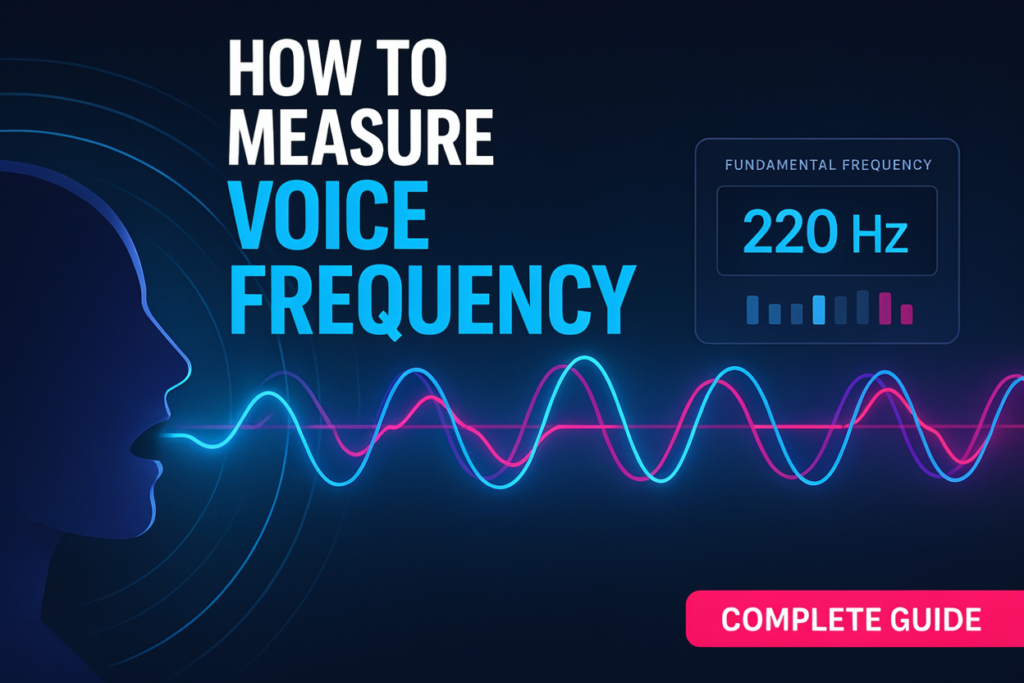
Voice frequency is measured by recording a voiced sound and using pitch-detection software to estimate its fundamental frequency, or F0, in hertz. For a reliable result, record both a steady vowel and 20–30 seconds of natural speech in a quiet room, then compare the median or average F0 across several recordings.
Before testing, it helps to understand what voice frequency means. In most everyday measurements, the term refers to fundamental frequency—not every frequency contained in your voice.
What Does Measuring Voice Frequency Mean?
Measuring voice frequency usually means finding the fundamental frequency of a voiced sound. Fundamental frequency, or F0, is the rate at which the vocal-fold vibration pattern repeats. A reading of 120 Hz means the pattern repeats about 120 times per second.
Fundamental frequency versus pitch
Frequency is a physical measurement, while pitch is how your brain perceives it. They are closely related, but loudness, resonance, and harmonics can affect how high or low a voice seems.
A detector normally estimates F0 from a recording. That value differs from the upper frequencies, called harmonics, that shape vocal tone. The guide to fundamental frequency in the human voice explains this distinction in more detail.
Frequency versus vocal range
A single frequency reading is not your vocal range. Vocal range covers your lowest to highest usable notes, while F0 describes one moment or summarizes a speech sample.
This is why two people with similar F0 readings may still sound different. The comparison between voice frequency and perceived pitch helps explain that difference.
How Do You Measure Voice Frequency?
To measure voice frequency, record a clear voiced sample, analyze it with a pitch detector, and repeat the test under similar conditions.
1. Choose a quiet environment
Turn off fans, music, and other sound sources. You do not need a studio, but background noise should be much quieter than your voice.
2. Keep the microphone position consistent
Place the microphone about 15–30 centimeters from your mouth. Keep the device, distance, and angle similar across repeated tests.
3. Record a sustained vowel
Take a comfortable breath and sustain “ah” for three to five seconds at your normal pitch. Do not force the sound lower or higher.
4. Record a speaking sample
Read a paragraph or speak naturally for at least 20–30 seconds. Speech naturally rises and falls, so the result will appear as a pitch contour rather than one fixed number.
5. Read the F0 result
Look for a value labeled F0, fundamental frequency, pitch, or frequency in Hz. A fuller explanation of how voice frequency is measured can help you understand common output labels.
6. Repeat the test
Make at least three recordings. Small differences are normal because breathing, posture, emotion, and vocal effort change from moment to moment.
Which Voice Sample Should You Use?
The best sample depends on what you want to learn. A sustained vowel is useful for steadiness, while connected speech better represents habitual speaking frequency.
| Sample type | Best use | Suggested length | Main limitation |
|---|---|---|---|
| Sustained “ah” | Checking a stable F0 | 3–5 seconds | May not represent normal speech |
| Reading passage | Estimating speaking F0 | 20–30 seconds | Can sound more formal |
| Natural conversation | Estimating habitual voice use | 30–60 seconds | Harder to reproduce |
| Sung note | Checking one musical pitch | 2–4 seconds | Does not describe speaking voice |
Sustained vowels
A sustained vowel creates a relatively regular signal, making it easy for software to track. It is useful for comparing one comfortable pitch across multiple sessions.
Reading and conversation
A reading passage gives you a controlled sample that can be repeated later. Natural conversation may better reflect your everyday voice but is harder to reproduce exactly.
For connected speech, the median F0 is often more useful than one instant reading because it reduces the influence of unusually high or low moments.
How Is Voice Frequency Calculated?
Pitch-detection software examines a waveform, identifies repeating cycles, and converts the repetition rate into hertz.
Vocal-fold periodicity
During voiced speech, the vocal folds create a repeating pattern. If that pattern repeats 150 times per second, the estimated F0 is approximately 150 Hz.
Real voices are not perfectly periodic, so the displayed number may move even during a sustained sound.
Pitch-tracking methods
Many detectors compare sections of the signal to find a repeating interval. Autocorrelation is one common approach: the program checks how closely the waveform matches a delayed version of itself.
A shorter repeating period indicates a higher frequency. A longer period indicates a lower frequency.
Harmonics versus F0
A voice recording contains F0 plus harmonics at higher frequencies. Harmonics affect brightness, depth, and vocal color, but they are not your fundamental frequency.
Reliable software evaluates the harmonic pattern rather than simply choosing the loudest frequency peak.
How Can You Improve Accuracy?
Accuracy improves when you control the recording setup, use enough voiced material, and compare several recordings.
Control noise and recording level
Avoid clipping, which occurs when a signal is recorded too loudly. Also avoid very quiet recordings where room noise competes with the voice.
The overview of voice-frequency test accuracy covers practical limitations that can affect browser and phone-based measurements.
Use consistent vocal effort
When tracking changes, use the same passage, device, microphone distance, and normal speaking effort. Hydration, fatigue, illness, and recent singing can affect the result.
Compare several measurements
Consider these repeated results:
- Sustained vowel 1: 118 Hz
- Sustained vowel 2: 121 Hz
- Sustained vowel 3: 119 Hz
- Natural-speech median: 124 Hz
These values form a consistent cluster. That pattern is more informative than a single reading that suddenly jumps to 240 Hz because of a tracking error.
Why Does a Reading Look Wrong?
A strange result often comes from an octave error, background noise, silence, or an unsuitable detector range.
| Suspicious result | Likely cause | Correction |
| Frequency doubles | Octave doubling | Repeat a steadier vowel |
| Frequency halves | Octave halving | Improve clarity or adjust settings |
| Reading disappears | Unvoiced consonant | Measure vowels and voiced speech |
| Graph jumps in silence | Background noise | Trim silence and reduce noise |
| Unstable low values | Vocal fry | Use a comfortable clear tone |
Octave errors
If your actual F0 is near 120 Hz, a detector may incorrectly show about 240 Hz or 60 Hz. Sudden exact doubling or halving is a strong clue that the software selected the wrong repeating pattern.
Unvoiced sounds and vocal fry
Sounds such as “s,” “f,” and “sh” do not contain regular vocal-fold vibration, so a detector may display no pitch. Vocal fry also contains irregular low-frequency pulses that are harder to track.
For a baseline measurement, use a clear, comfortable voice and exclude silence from the analysis.
How Should You Interpret the Result?
Treat voice frequency as a descriptive measurement, not a strict identity label or medical diagnosis. Compare repeated recordings with your own baseline before comparing yourself with population averages.
Reference charts provide context, but values overlap and vary with age, anatomy, language, emotion, and speaking style. The guide to a normal voice-frequency range explains why being outside an average does not automatically indicate a problem.
Voice-frequency software cannot diagnose vocal-fold damage. Persistent hoarseness, pain, sudden voice changes, or loss of range should be assessed by a qualified healthcare professional.
Frequently Asked Questions
Can a phone accurately measure voice frequency?
A phone can provide a useful estimate in a quiet room when the microphone is not overloaded. It should not be treated as a laboratory measurement.
How long should I record my voice?
Record a sustained vowel for three to five seconds and connected speech for at least 20–30 seconds. Longer speech samples usually produce a more representative average or median.
Should I measure speaking or singing frequency?
Measure speaking frequency to understand your habitual voice and sung notes to check musical pitch. These are different measurements.
Why does my frequency change between tests?
Voice frequency changes with emotion, emphasis, fatigue, posture, and vocal effort. Small differences are normal, so repeated measurements are more useful than one isolated reading.
Is average voice frequency the same as vocal range?
No. Average frequency summarizes F0 across a speech sample, while vocal range covers the lowest to highest usable notes.
Can voice frequency reveal a vocal health problem?
A measurement may show that your voice has changed, but it cannot identify the cause. Ongoing hoarseness, discomfort, or sudden pitch changes require professional assessment.

Bobby is a voice analysis and vocal testing writer at VoiceFrequencyTest. He focuses on vocal frequency analysis, pitch recognition, voice measurement tools, and singing education for vocalists, musicians, creators, and beginners.