
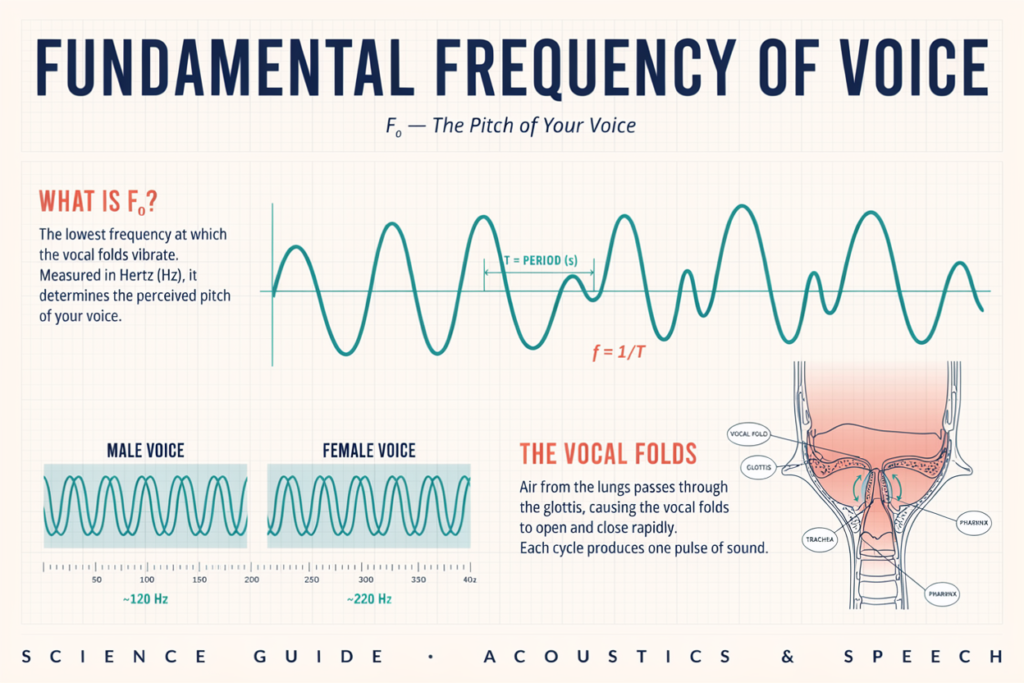
The fundamental frequency of voice, commonly written as F0, is the rate at which the vocal folds vibrate during a voiced sound. It is measured in hertz (Hz), meaning the number of vibration cycles that occur each second.
For example, an F0 of 120 Hz means the vocal-fold vibration pattern repeats approximately 120 times per second. Fundamental frequency is one of the most important acoustic measurements used to describe human voice, but it is only one part of what makes a voice sound unique.
A voice also depends on resonance, harmonics, articulation, loudness, and speaking style. Understanding F0 helps explain why voices differ, how pitch is produced, and how voice measurements are performed.
What Is Fundamental Frequency of Voice?
Fundamental frequency is the lowest repeating frequency component created when the vocal folds vibrate. During voiced speech, air from the lungs passes through the vocal folds, causing them to open and close in a repeating cycle.
The number of these cycles per second becomes the fundamental frequency.
A lower F0 means slower vocal-fold vibration, while a higher F0 means faster vibration. This physical measurement is closely related to perceived pitch.
For a broader introduction, see what voice frequency means.
How Do Vocal Folds Create Fundamental Frequency?
Voice production begins when air pressure from the lungs pushes through the closed vocal folds. The folds separate and return together repeatedly, creating a vibrating sound source.
Several physical factors influence F0:
- Vocal-fold length
- Vocal-fold thickness and mass
- Tissue tension
- Larynx position
- Muscle control
- Air pressure
Longer and thicker vocal folds generally vibrate more slowly, producing a lower fundamental frequency. Shorter and thinner folds usually vibrate faster, producing a higher F0.
This is why children generally have higher voices than adults and why puberty can significantly change speaking frequency.
What Is a Normal Fundamental Frequency?
There is no single normal F0 for all humans. Fundamental frequency varies according to age, anatomy, language, health, and speaking habits.
Common adult speaking references are:
| Voice group | Approximate average F0 |
|---|---|
| Adult men | Around 100–120 Hz |
| Adult women | Around 190–220 Hz |
| Children | Usually higher than adults |
These are population averages, not strict limits. A healthy voice may fall outside these values.
For more context, see the human voice frequency range guide.
Fundamental Frequency vs Pitch
Fundamental frequency and pitch are closely connected, but they are not exactly the same.
Fundamental frequency is an objective acoustic measurement. Pitch is the way the brain perceives the highness or lowness of a sound.
Two voices can have the same F0 but sound different because of differences in:
- Harmonic structure
- Resonance
- Vocal tract shape
- Voice quality
The relationship between these concepts is explained further in voice frequency versus pitch.
Fundamental Frequency vs Harmonics vs Formants
Many people confuse F0 with other important voice characteristics.
| Feature | Meaning | Function |
| Fundamental frequency | Vocal-fold vibration rate | Main pitch component |
| Harmonics | Frequencies above F0 | Add richness and tone color |
| Formants | Vocal-tract resonance areas | Shape vowels and vocal identity |
| Resonance | Amplification of frequencies | Creates fullness and character |
A singer may produce the same fundamental frequency as another singer but sound completely different because the harmonic balance and resonance are different.
Learn more about this difference in voice resonance versus frequency.
Does the Voice Have One Fixed Fundamental Frequency?
No. Human speech constantly changes frequency.
When people speak, their F0 moves up and down depending on:
- Emotional expression
- Sentence structure
- Questions versus statements
- Emphasis
- Speaking style
A voice analysis usually looks at measurements such as:
- Mean F0
- Median F0
- Minimum F0
- Maximum F0
- Pitch range
Median or average F0 from a longer speech sample is usually more useful than one instant reading.
How Is Fundamental Frequency Measured?
F0 can be measured using:
- Online voice frequency tools
- Smartphone pitch apps
- Acoustic analysis software
- Professional voice laboratories
A typical measurement process involves recording speech or a sustained vowel and analyzing the repeating vibration pattern.
For accurate testing:
- Use a quiet environment.
- Keep microphone distance consistent.
- Speak naturally.
- Record several samples.
- Compare average or median values.
More details are available in how voice frequency is measured.
Common Problems When Measuring F0
Fundamental frequency measurements can become inaccurate because of:
Background noise
Noise can confuse pitch-detection algorithms and create false readings.
Vocal fry
Irregular vocal-fold vibration may make tracking difficult.
Breathiness
Breathy voices contain less strong periodic information, making F0 harder to detect.
Incorrect software settings
Pitch-analysis tools require suitable frequency ranges. Incorrect settings can create octave errors where the software reports a frequency twice or half the true value.
Fundamental Frequency in Singing
For singers, F0 represents the frequency of a specific musical note.
Examples:
| Note | Frequency |
| A2 | 110 Hz |
| A3 | 220 Hz |
| A4 | 440 Hz |
| A5 | 880 Hz |
Although F0 helps identify notes, it does not determine singing voice type alone. A singer’s classification also depends on range, tessitura, resonance, and vocal quality.
A low speaking F0 does not automatically mean someone is a bass singer, and a high F0 does not automatically mean someone is a soprano.
Why Fundamental Frequency Changes With Age
F0 changes throughout life.
Children usually have higher F0 because their vocal folds are smaller and lighter. During puberty, growth of the larynx and vocal folds causes a noticeable decrease, especially in many male voices.
Aging can also affect F0 because of changes in vocal-fold tissue, muscle control, and vocal health.
Can Fundamental Frequency Show Vocal Health?
F0 is useful in voice research and clinical assessment, but it cannot diagnose vocal health by itself.
A normal-looking frequency does not guarantee healthy vocal function, and an unusual frequency does not automatically indicate a problem.
Professional voice evaluation may include:
- Acoustic measurements
- Vocal quality assessment
- Laryngeal examination
- Breathing and airflow analysis
Common Myths About Fundamental Frequency
Myth: Everyone has one permanent F0
Reality: Voice frequency changes continuously during speech.
Myth: F0 and pitch are identical
Reality: F0 is measured physically, while pitch is perceived.
Myth: Lower F0 always means a better voice
Reality: Voice quality depends on many factors beyond frequency.
Myth: F0 determines personality
Reality: Frequency may influence impressions, but it cannot reveal personality.
Myth: One online test gives a perfect answer
Reality: Reliable measurement requires good recording conditions and repeated samples.
Frequently Asked Questions
What does F0 mean in voice analysis?
F0 means fundamental frequency. It represents the rate of vocal-fold vibration during voiced sound.
Is fundamental frequency the same as vocal pitch?
Not exactly. F0 is an acoustic measurement, while pitch is the listener’s perception of frequency.
What is the average fundamental frequency of a male voice?
Many adult male voices average around 100–120 Hz during speech, although individual variation is large.
What is the average fundamental frequency of a female voice?
Many adult female voices average around 190–220 Hz during speech, but values vary widely.
How can I measure my voice’s fundamental frequency?
You can use a pitch detector, voice analysis app, or acoustic software. Multiple recordings usually provide a more reliable estimate.
Can fundamental frequency determine voice type?
No. Voice type depends on range, tessitura, resonance, timbre, and other vocal characteristics in addition to frequency.

Bobby is a voice analysis and vocal testing writer at VoiceFrequencyTest. He focuses on vocal frequency analysis, pitch recognition, voice measurement tools, and singing education for vocalists, musicians, creators, and beginners.