
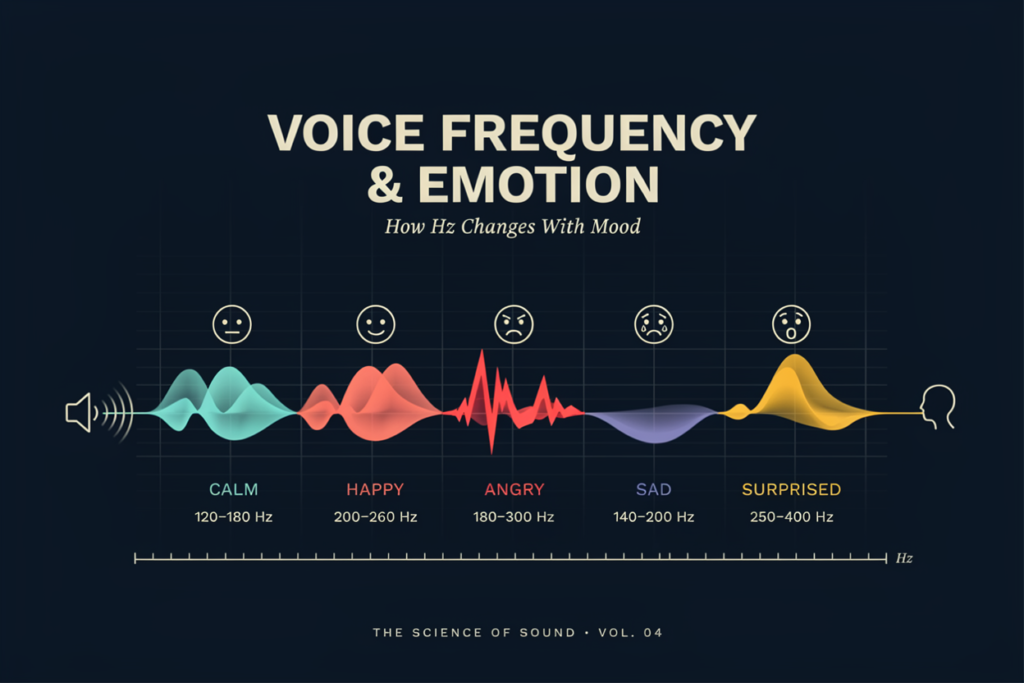
Emotion changes voice frequency by affecting vocal-fold tension, breathing, and vocal effort. High-arousal states such as excitement, fear, and hot anger often raise or widen fundamental frequency, while sadness, calmness, and boredom often produce a lower or narrower pitch pattern. These are tendencies, not fixed rules: no single frequency can reliably identify what someone feels.
The measurable feature is fundamental frequency (F0)—vocal-fold vibration cycles per second, expressed in hertz. F0 influences pitch, but listeners also use loudness, rhythm, timbre, pauses, and context. Understanding the difference between frequency and perceived pitch prevents treating one Hz value as a complete emotional description.
How Does Emotion Affect Voice Frequency?
Emotion can alter average F0, pitch range, and pitch contour—the path pitch follows across a phrase. High emotional arousal generally produces more vocal energy and often a higher F0; low arousal commonly produces less variation and a lower or more restrained pattern. Positive versus negative emotion alone is a weaker predictor because fear and excitement can share high-arousal features despite feeling very different.
Why emotional arousal often raises F0
During fear, excitement, or intense anger, the body may increase respiratory drive and tighten muscles involved in phonation. Greater vocal-fold tension can make the folds vibrate faster, raising F0. A speaker may also become louder, speak faster, or use wider pitch movements.
The response is not universal. Some people constrict the throat or shift into a pressed or breathy voice. A rise from 110 to 135 Hz may be meaningful for one speaker even though 135 Hz is ordinary for another. Compare the same person using similar words and conditions; a guide to fundamental frequency in voice production explains the baseline.
Why contour matters as much as average frequency
Two recordings can have the same mean F0 but sound emotionally different. One may remain level, while the other rises sharply or jumps between stressed syllables. Surprise may rise abruptly, sadness may have a narrow descending contour, and excitement may combine a higher average with broad variation. These overlapping patterns are clues, not labels.
What Do Different Emotions Tend to Sound Like?
Emotions have overlapping acoustic profiles rather than exact frequency signatures. Banse and Scherer’s study of 224 acted vocal expressions found distinguishable patterns across 14 emotions, but no emotion was defined by F0 alone. The table summarizes commonly reported tendencies, not diagnostic thresholds.
| Emotion or state | Typical F0 tendency | Pitch variation | Loudness and rate | Important limitation |
|---|---|---|---|---|
| Excitement or joy | Often higher | Usually wide and animated | Often louder and faster | Quiet happiness or relief may sound gentler |
| Surprise | Often rises rapidly | Large, abrupt movement | May begin loudly or quickly | Pleasant and unpleasant surprise can overlap |
| Hot anger | Often higher | Wide or sharply stressed | Loud, forceful, often fast | Controlled anger may produce a different pattern |
| Fear or panic | Often higher | Variable or unstable | Fast, tense, sometimes breathy | Excitement can share similar acoustic cues |
| Anxiety | May be higher | Uneven or restricted | Variable rate, more pauses possible | Individual coping responses differ greatly |
| Sadness | Often lower | Commonly narrow | Softer and slower | Agitated sadness can be higher and more variable |
| Calmness | Often near baseline or lower | Smooth and relatively narrow | Moderate to soft, steady rate | A trained speaker may deliberately imitate it |
| Boredom | Often lower or flat | Narrow and monotonous | Slower, lower energy | Fatigue can sound similar |
Happiness, excitement, and surprise
Happy voices are often high, varied, and energetic, but amusement, pride, tenderness, relief, and contentment do not share one universal acoustic pattern. Tenderness may be soft and controlled, whereas amusement may contain rapid pitch excursions.
This is why a simple low-versus-high frequency comparison can describe acoustic direction but cannot determine emotional meaning. A higher reading might reflect joy, fear, emphasis, a question, or the speaker’s habitual voice.
Anger, fear, and anxiety
Hot anger often sounds forceful and loud. Cold anger may be quieter, lower, and controlled. Fear can raise F0, while anxiety may add pauses, breathiness, or a restricted range. Because high arousal drives several changes, fear and excitement can sound alike without context.
Claims connecting voice frequency with personality require the same caution. A temporary emotional pattern does not establish a stable personality trait, and a habitual vocal feature does not reveal someone’s current state by itself.
Sadness, calmness, and boredom
Low-arousal sadness commonly brings softer, slower speech, lower F0, and reduced pitch variation. Calmness may also be steady and narrow, while boredom often sounds flat. Timing, word choice, and context help listeners distinguish them.
The myth is that each emotion occupies its own Hz band. The reality is that emotional voices overlap extensively with ordinary differences associated with age, anatomy, speaking style, and health. Reference values for a normal speaking-frequency range describe populations, not emotional categories.
Which Voice Features Communicate Emotion Besides Frequency?
Frequency is only one component of emotional prosody—the combined melody, rhythm, stress, and timing of speech. Listeners and analysis systems also consider intensity, speech rate, pauses, articulation, and voice quality. Timbre can change perceived emotion even when the fundamental frequency stays similar.
Loudness, rhythm, pauses, and speech rate
High-arousal speech may become louder and faster, while low-arousal speech may become quieter and slower. Anxiety can accelerate one person and make another hesitate, which is why several features and a personal baseline are needed. Sarcasm or singing can also convey feeling through contour, timing, and dynamics without greatly changing average F0.
Timbre, breathiness, roughness, jitter, and shimmer
Timbre is the spectral character that makes two voices sound different on the same note. Breathiness, roughness, pressed phonation, and resonance affect emotional interpretation. Jitter is cycle-to-cycle frequency variation; shimmer is amplitude variation. Neither is emotion-specific. Research shows that both F0 and timbre shape emotional perception, so pitch alone cannot reproduce vocal quality. Persistent roughness, pain, or fatigue should be considered separately using guidance on voice frequency and vocal-cord health.
Can Voice Frequency Reveal Someone’s Emotion?
Voice frequency can suggest emotional arousal, but it cannot prove an emotion, mental state, or deception. Useful analysis compares several features with the speaker’s neutral baseline and accounts for context and recording quality.
Comparing emotional speech with a neutral baseline
A basic comparison should use the same microphone position, room, and speaking task. Record several neutral sentences, repeat them in the condition examined, then compare F0, pitch range, intensity, rate, and pauses across multiple samples.
A browser or phone reading is an estimate. Noise, vocal fry, consonants, and octave errors can distort tracking. The explanation of how voice frequency is measured helps distinguish stable voiced sound from a display jump.
Why one pitch reading cannot diagnose emotion or deception
Suppose a speaker’s median F0 rises from 125 to 145 Hz. The 20 Hz increase shows an acoustic change, not whether its cause was nervousness, enthusiasm, emphasis, posture, or warm-up. Emotion-recognition software makes probabilistic classifications, not direct observations of feelings.
The same limitation applies to voice-stress and lie-detection claims. Stress does not equal deception, and honest speech may be highly stressed. Interpret results according to the limits of voice-frequency testing, never as proof of truthfulness or psychological condition.
Frequently Asked Questions
Does happiness always make your voice frequency higher?
No. Excitement and amusement often raise F0 and expand pitch variation, but contentment, tenderness, or relief may sound soft and restrained. The speaker’s baseline and the intensity of the emotion are more informative than a universal “happy” frequency.
Why does anger sometimes produce a high voice and sometimes a low voice?
Hot, explosive anger commonly increases vocal effort, loudness, and F0. Cold or controlled anger may use a lower, quieter, and narrower pattern. Both can communicate anger because listeners combine pitch with timbre, timing, words, and context.
Can fear and excitement sound similar in someone’s voice?
Yes. Both are high-arousal states and may produce higher F0, faster speech, louder intensity, and wider pitch variation. Context and voice quality often help listeners distinguish pleasant excitement from fear.
Can a voice-frequency test detect a person’s true emotion?
No voice-frequency test directly reveals a “true” emotion. Frequency can support an estimate alongside other speech features and a personal baseline, but acting, mixed emotions, and recording conditions limit certainty.
Do singers change vocal frequency to communicate emotion?
Singers change notes by definition, but emotional expression also comes from timing, dynamics, vibrato, articulation, resonance, and timbre. The same written pitch can sound tender, tense, triumphant, or mournful depending on how those features are shaped.
Can someone hide emotion by controlling pitch?
A person can deliberately steady pitch, but cues may remain in breathing, timing, loudness, or word choice. Those cues remain ambiguous and should not be treated as proof of emotion.

Bobby is a voice analysis and vocal testing writer at VoiceFrequencyTest. He focuses on vocal frequency analysis, pitch recognition, voice measurement tools, and singing education for vocalists, musicians, creators, and beginners.