
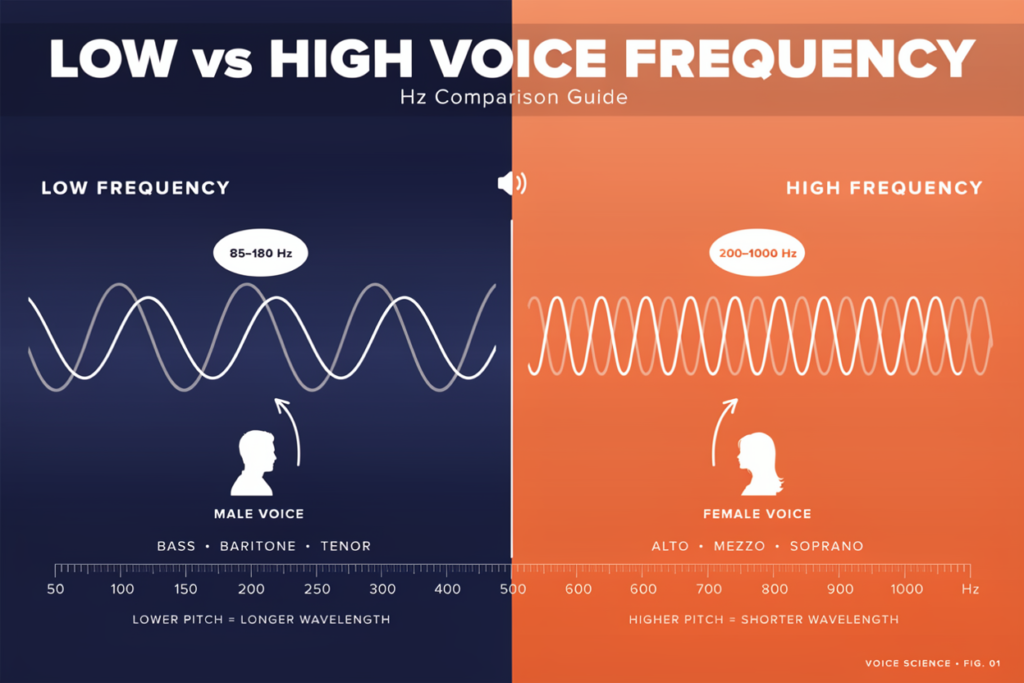
Low vs high voice frequency describes how quickly the vocal folds repeat their vibration. A low voice has a slower fundamental frequency and is heard as lower in pitch, while a high voice has a faster fundamental frequency and is heard as higher. There is no single Hz value that separates the two because speaking patterns, singing ranges, age groups, and individual voices overlap.
The frequency most people mean is fundamental frequency, or F0—the number of vocal-fold vibration cycles completed each second. One cycle per second equals one hertz. If you need the underlying terminology first, this explanation of what frequency means in the human voice separates vocal-fold vibration from the other frequencies present in speech and singing.
What Is the Difference Between Low and High Voice Frequency?
Low-frequency voices combine a relatively slow F0 with a low perceived pitch. High-frequency voices combine a faster F0 with a higher perceived pitch. Frequency is measurable in hertz, whereas pitch is the listener’s perception of how low or high the sound seems.
Low-frequency voices
A low voice may sound deep, weighty, dark, or full, but those qualities do not all come from F0. Adult male speech is often used as a low-frequency reference: the Voice Foundation gives an approximate speaking level of 110 Hz, while the National Center for Voice and Speech cites an average near 125 Hz. These figures describe broad population tendencies rather than a pass-or-fail definition of a deep voice.
Pitch changes with emphasis, emotion, and sentence structure, so the usual range associated with naturally deep voices cannot be reduced to one sustained number.
High-frequency voices
A high voice has a faster F0 and a higher perceived pitch. Common reference values place adult female speech around 180–220 Hz, although individual averages can fall outside that interval. Children tend to have higher speaking frequencies; sources commonly give approximate values around 250–400 Hz, depending on age and the measurement method.
A voice is not abnormal merely because it falls outside a demographic average. A comfortable baseline and variation without strain are more useful measures.
Low vs High Voice Frequency Comparison
The main physical difference is vibration rate, but frequency also changes wavelength and musical pitch. The table below compares the categories without treating them as rigid voice classifications.
| Feature | Lower-frequency voice | Higher-frequency voice |
|---|---|---|
| Vocal-fold vibration | Slower cycles per second | Faster cycles per second |
| Perceived pitch | Lower | Higher |
| Wavelength in the same medium | Longer | Shorter |
| Common speaking reference | Often associated with lower adult speaking averages | Often associated with higher adult and child speaking averages |
| Common singing associations | Bass, baritone, lower alto notes | Tenor upper range, soprano, higher treble notes |
| What it does not determine alone | Loudness, timbre, vocal health, or personality | Loudness, timbre, vocal health, or personality |
Typical speaking-frequency reference points
Approximate reference points are about 110–125 Hz for adult men, 180–220 Hz for adult women, and 250–400 Hz for children. These groups overlap, and a person’s F0 changes continuously in connected speech. A sustained vowel, a read passage, and casual conversation may consequently produce different averages. The broader normal speaking-frequency references are best treated as context, not diagnostic limits.
Frequency and pitch are related but not interchangeable. The ear interprets frequency logarithmically: doubling frequency raises a musical pitch by one octave. A 200 Hz tone is one octave above a 100 Hz tone, even though the numerical difference is only 100 Hz. The distinction between the physical measurement and what listeners hear is explored further in this guide to frequency compared with perceived pitch.
Approximate singing ranges
Singing spans much wider frequencies than normal speech, and voice types overlap. Approximate reference ranges published by DPA Microphones include bass at 73–330 Hz, baritone at 98–392 Hz, tenor at 131–494 Hz, alto at 196–659 Hz, mezzo-soprano at 196–880 Hz, and soprano at 247–1,047 Hz.
Those endpoints describe possible notes, not necessarily tessitura—the area where a singer feels most comfortable. Classification also considers tone, register transitions, vocal weight, and usable range. A frequency breakdown by singing voice type gives better context than labeling every low note “bass” or every high note “soprano.”
What Makes a Voice Sound Low or High?
Vocal-fold vibration sets the fundamental frequency, but vocal-tract resonance and harmonics shape the final sound. Two people can produce the same F0 and still sound noticeably different because their spectra and resonances are different.
Vocal-fold length, thickness, and tension
Longer and thicker vocal folds generally vibrate more slowly and support lower frequencies. Shorter or more tense folds generally vibrate faster and support higher frequencies. Airflow from the lungs initiates vibration, while laryngeal muscles continuously adjust vocal-fold length, tension, and contact.
Pitch rises when the folds lengthen and tension increases in a coordinated way. Forcing the larynx downward to imitate depth is not the same as developing an efficient low register.
Why resonance and harmonics also matter
The vocal folds generate F0 plus harmonics at multiples of that frequency. The throat, mouth, and related cavities filter that source, creating formants—resonant frequency regions that help identify vowels and shape timbre. A voice may therefore seem bright despite a low F0, or rich and dark despite a relatively high F0.
The difference between vocal resonance and frequency explains how the source and filter work together. Microphone placement and room acoustics can change recorded tone without changing F0.
Is a Low or High Voice Better?
Neither low nor high voice frequency is inherently better, healthier, louder, or more attractive. The best pitch area is one the speaker or singer can produce clearly, flexibly, and without pain or excess effort.
Speaking, singing, and recording contexts
Different contexts reward different qualities. A choir needs contrasting parts, a melody may suit a particular tessitura, and expressive speech requires pitch movement. Audio engineers consider the entire spectrum rather than F0 alone.
Loudness is mainly related to sound-pressure amplitude, not whether the voice is high or low. A quiet soprano note can have a much higher frequency than a loud bass note. Likewise, frequency does not reliably reveal confidence, authority, honesty, or personality; such impressions depend on culture, delivery, timing, loudness, and listener expectations.
Healthy pitch versus forced pitch
A naturally low or high voice is not a health problem. Concern is more appropriate when pitch changes suddenly or persistently alongside hoarseness, pain, effort, vocal fatigue, or loss of range. The relationship between frequency and vocal-fold health explains why change from a personal baseline matters more than comparison with an online average.
Avoid pushing beyond your comfortable limits. Persistent symptoms should be assessed by an ear, nose, and throat physician or a speech-language pathologist with voice expertise.
How Can You Measure Your Voice Frequency?
Record in a quiet room, hold a comfortable vowel, and use a pitch analyzer that reports F0 in hertz. Then measure a sample of normal connected speech as well; the sustained vowel shows pitch stability, while speech gives a more representative average and range.
Keep the microphone distance steady, avoid background music, and take several samples. Analyzers can mistake a harmonic for F0 and report an octave error. The method for measuring voice frequency consistently covers recording conditions and interpretation.
A browser-based reading is an estimate, not a clinical measurement. Compare results collected under similar conditions and focus on trends rather than one permanent label.
Frequently Asked Questions
What Hz is considered a low voice?
There is no universal cutoff. In adult speech, values around or below the commonly cited male average of 110–125 Hz are often perceived as low, but context, resonance, and the listener’s reference group affect that judgment.
What Hz is considered a high voice?
There is no fixed high-voice boundary. Adult speech around 180–220 Hz is commonly associated with female averages, while children often average higher; singing can extend well beyond those speaking values.
Is 100 Hz a deep voice?
A 100 Hz speaking F0 will often be perceived as fairly low for an adult, especially if it is the average across connected speech. Resonance and pitch variation can still make two 100 Hz voices sound quite different.
Does a higher frequency always mean a louder voice?
No. Frequency primarily relates to pitch, while loudness is mainly associated with sound-pressure amplitude. A high-frequency voice can be quiet, and a low-frequency voice can be loud.
Can you safely make your voice frequency lower?
Some people can develop more comfortable access to lower notes through efficient technique and training, but forcing a low pitch can cause strain. Work within a comfortable range and seek professional guidance if lowering the voice causes pain, hoarseness, or fatigue.
Why can two voices singing the same note sound different?
The singers share roughly the same F0, but their harmonic balance and formants differ. Vocal-tract shape, articulation, register, breath coordination, and recording conditions all contribute to timbre.

Bobby is a voice analysis and vocal testing writer at VoiceFrequencyTest. He focuses on vocal frequency analysis, pitch recognition, voice measurement tools, and singing education for vocalists, musicians, creators, and beginners.