
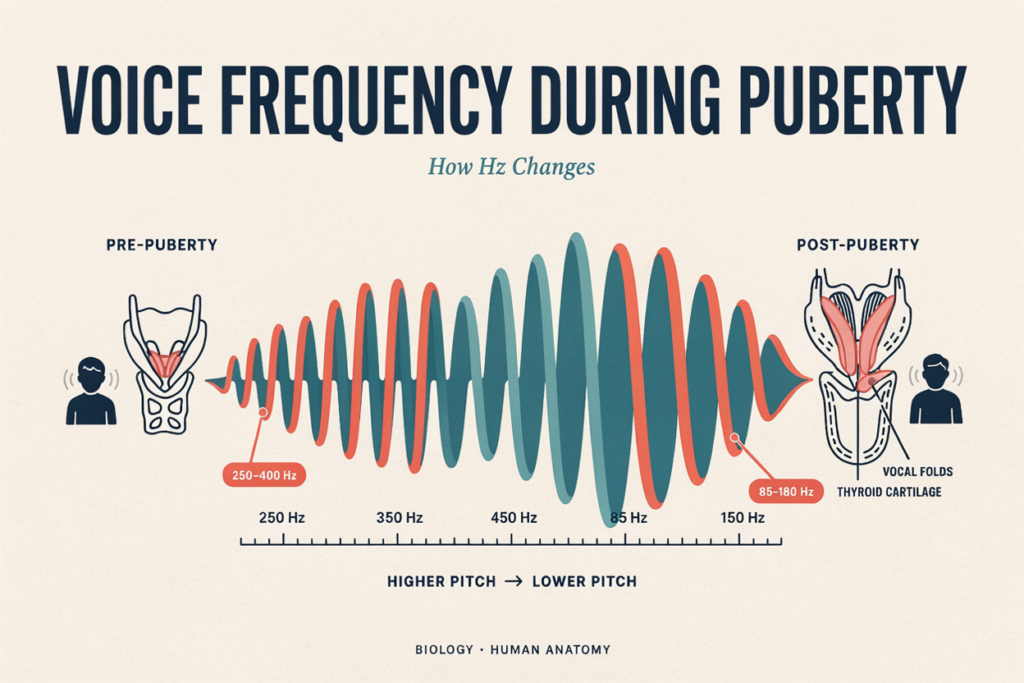
Voice frequency during puberty usually decreases as the larynx grows and the vocal folds become longer and thicker. The change is often more dramatic in boys, but girls and other adolescents can also experience a lower speaking pitch, voice cracks, breathiness, and temporary range instability.
The timing and size of the change vary widely. A teenager’s frequency should be treated as an individual measurement, not as a test of whether puberty is normal or complete.
How Does Voice Frequency Change During Puberty?
Voice frequency usually drops during puberty because the developing vocal folds become longer, thicker, and heavier. Heavier vocal folds tend to vibrate more slowly, producing a lower fundamental frequency.
Fundamental frequency, often written as F0, is the number of vocal-fold vibration cycles produced each second. It is measured in hertz, or Hz. Pubertal hormones also contribute to growth of the larynx and vocal tract, affecting pitch, resonance, tone, and comfortable range.
For more background, see how fundamental frequency describes the voice.
Why the timing differs
Puberty does not begin or progress at the same age for everyone. Genetics, physical development, hormone patterns, health, and anatomy all affect the timing.
A 2026 systematic review of boys’ voice development found that noticeable change commonly began around ages 11 to 13, with the fastest change most often occurring between 12 and 14. These are broad research patterns, not deadlines for an individual teenager.
What Is a Typical Voice Frequency During Puberty?
There is no single normal frequency for puberty. Speaking fundamental frequency generally moves from a higher childhood pattern toward a more adult-like pattern, but it may change unevenly over several years.
Developmental reviews have reported averages near 130 Hz for 16-year-old boys and about 220 to 225 Hz for 16-year-old girls. These are group averages from particular populations, not targets every teenager should match.
A broader guide to average frequency patterns by age can help place a reading in context.
| Developmental context | General frequency pattern | Common experience |
|---|---|---|
| Before major change | Usually higher F0 | More childlike speaking pitch |
| Active voice change | Frequency may fall unevenly | Cracks and reduced control |
| Later adolescence | Frequency often steadies | More adult-like pitch |
Why one reading can mislead
Speaking frequency changes with emotion, emphasis, loudness, fatigue, and sentence type. A teenager may also speak higher or lower because of habit rather than anatomy alone.
A sustained vowel can provide a useful reading, but a longer sample of comfortable speech usually gives a better estimate. The difference between measurement and perception is explained in voice frequency compared with pitch.
Why Does the Voice Crack During Puberty?
Voice cracks occur because a rapidly changing vocal system is learning new muscular coordination. The vocal folds, larynx, and vocal tract are changing size while the nervous system adjusts tension, airflow, and closure.
A crack often happens when the voice shifts suddenly between registers. It is especially likely during excitement, loud speech, singing near a transition, or attempts to control a changing range.
Occasional cracking does not automatically mean damage. Pain, persistent hoarseness, repeated voice loss, or ongoing speaking difficulty are different and should not simply be dismissed as puberty.
How Do Pubertal Voice Changes Differ Among Adolescents?
Pubertal voice changes differ in timing, speed, size, and how noticeable they sound. Some adolescents experience a rapid drop and frequent cracking, while others notice a gradual shift.
Hormonal and anatomical changes are generally more pronounced in testosterone-dominant puberty, producing a larger average reduction in fundamental frequency. Estrogen-dominant puberty also changes the voice, although the average pitch shift is usually smaller. Temporary breathiness, fatigue, range changes, and register breaks may still occur.
A side-by-side discussion appears in male and female voice frequency differences.
What frequency cannot reveal
A frequency reading cannot reliably determine a person’s sex, gender identity, hormone level, or exact stage of puberty. Frequency ranges overlap, and language, emotion, speaking habits, and training influence the result.
An online test is useful for tracking or education, not diagnosis.
How Does Puberty Affect Singing Frequency and Vocal Range?
Puberty can temporarily change a singer’s usable range, tessitura, register transitions, tone, and endurance. Tessitura is the part of the range where the voice feels most comfortable and sustainable.
A singer may lose easy access to notes that were previously reliable. New lower notes may appear before the middle and upper registers feel coordinated, and the usable range may narrow temporarily.
Do not force the old range
Trying to preserve a pre-puberty range through extra pressure can create fatigue. Music may need to be transposed or reassigned while the voice settles.
Gentle humming, lip trills, straw phonation, and comfortable slides can support coordination. Singing should remain easy enough that the teenager can speak normally afterward.
The overall span of the voice is discussed in this guide to human voice frequency limits.
How Can You Measure Voice Frequency During Puberty?
Voice frequency can be estimated by recording comfortable speech or sustaining a steady vowel into a pitch detector or frequency analyzer. Repeated measurements under similar conditions are more useful than one isolated number.
- Use a quiet room.
- Speak naturally for 20 to 30 seconds.
- Avoid deliberately making the voice deeper or higher.
- Record the average F0 if the software provides it.
- Repeat on several days and compare the trend.
For singing, measure stable notes in the comfortable range rather than forcing extremes. More detailed guidance is available in the voice-frequency testing process.
Expect normal variation
Hydration, sleep, illness, stress, shouting, and heavy singing can affect a reading. Microphone quality and background noise may also cause octave errors.
The goal is not to hit a particular number. The useful question is whether the voice is changing gradually while remaining comfortable and functional.
How Should Teenagers Care for a Changing Voice?
A changing voice usually benefits from moderate use, recovery, and technique that avoids force. Complete silence is rarely needed for normal puberty, but repeated shouting or singing through fatigue can reduce stability.
Helpful habits include drinking enough water, using a comfortable volume, warming up gently, resting after heavy use, and avoiding repeated attempts at extreme notes.
This guide to voice frequency and vocal-fold health explains why comfort and voice quality matter alongside frequency.
When to seek professional advice
An evaluation is sensible when hoarseness lasts for several weeks, speaking is painful, the voice repeatedly disappears, breathing or swallowing is affected, or the problem interferes with communication.
Persistent difficulty after pubertal changes may also require assessment by an ear, nose, and throat physician or a speech-language pathologist. Puberphonia, sometimes called mutational falsetto, is one condition in which a high prepubertal speaking pattern continues after the larynx has matured. It cannot be diagnosed from an online frequency reading.
Common Myths About Puberty and Voice Frequency
Myth: Everyone’s voice changes at the same age
Puberty follows a broad developmental window. Earlier or later change is not automatically abnormal.
Myth: Every adolescent voice drops by one octave
The size of the frequency drop varies. Some voices change dramatically, while others shift more gradually.
Myth: Voice cracking always means damage
Occasional cracking is common during changing coordination. Pain, prolonged hoarseness, and loss of function are more meaningful warning signs.
Myth: A frequency test reveals voice type immediately
Voice type depends on tessitura, timbre, vocal weight, register transitions, and usable range as well as frequency.
Myth: Teenagers should stop singing during puberty
Many adolescents can continue singing with suitable repertoire, moderate intensity, and flexible expectations.
Frequently Asked Questions
At what age does voice frequency start changing?
Research on boys commonly places the start of noticeable change around ages 11 to 13, but earlier and later development can occur.
How much does the voice deepen during puberty?
There is no universal amount. Testosterone-dominant puberty usually produces a larger average drop, while estrogen-dominant puberty often causes a smaller shift.
Do girls’ voices change frequency during puberty?
Yes. The average speaking frequency may decrease, and the voice may temporarily become breathier or less stable.
Why does a teenager’s voice crack?
The vocal folds and larynx are growing while the muscles controlling pitch adapt. A brief coordination change can make the voice jump between pitches or registers.
Can puberty temporarily reduce singing range?
Yes. Some singers temporarily lose comfortable high notes or experience unstable transitions while coordination develops.
When should a changing voice be checked by a doctor?
Seek advice for persistent hoarseness, pain, repeated voice loss, breathing or swallowing difficulty, or a problem that interferes with normal communication.

Bobby is a voice analysis and vocal testing writer at VoiceFrequencyTest. He focuses on vocal frequency analysis, pitch recognition, voice measurement tools, and singing education for vocalists, musicians, creators, and beginners.