
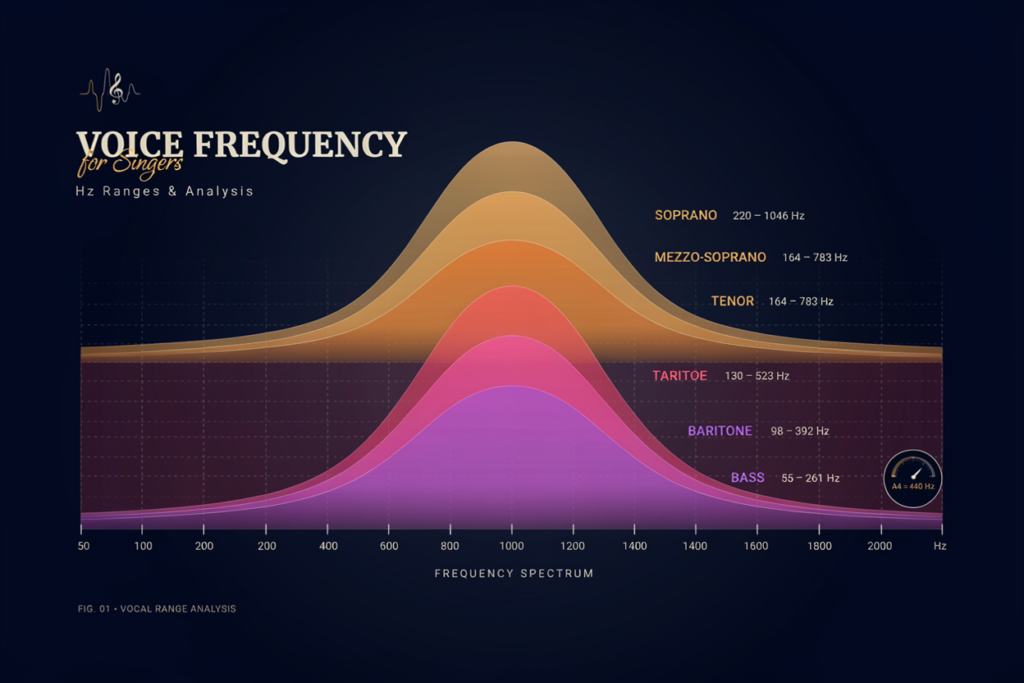
Voice frequency for singers is the fundamental frequency produced when the vocal folds vibrate during a sung note. It changes whenever the singer changes pitch, so a singer does not have one fixed frequency. Across common voice types, typical singing frequencies may extend from about 82 Hz for a low bass E2 to roughly 1,047 Hz for a soprano C6.
Frequency helps singers identify notes, compare ranges, and track progress. However, it cannot classify a voice by itself because tessitura, timbre, vocal weight, resonance, and register transitions also matter.
What Is Voice Frequency for Singers?
Voice frequency is the number of vocal-fold vibration cycles produced per second while singing. It is measured in hertz, abbreviated Hz, and corresponds closely to the pitch you hear.
For example, A4 has a fundamental frequency of 440 Hz in standard concert tuning. A3 is 220 Hz, while A5 is 880 Hz. Moving up one octave doubles frequency; moving down one octave halves it.
The fundamental frequency, often written as F0, is the lowest repeating vibration rate in a voiced sound. The voice also contains harmonics above that fundamental. These additional frequencies help explain why two singers can perform the same note but sound different.
For a broader foundation, see how vocal frequency is defined.
Singing frequency constantly changes
A melody may require the voice to move through many frequencies within seconds. A reading such as 196 Hz only shows the note produced at that moment; it does not describe the singer’s full range or voice type.
Frequency is the physical vibration rate, while pitch is the listener’s perception of how high or low a sound seems. The distinction is covered in more detail in this guide to frequency compared with perceived pitch.
What Is the Typical Voice Frequency Range for Singers?
Typical singer frequency ranges extend from about 82 Hz at E2 to around 1,047 Hz at C6 across the common classical voice categories. These values are approximate references, not strict limits.
| Voice type | Approximate note range | Approximate frequency range |
|---|---|---|
| Bass | E2–E4 | 82–330 Hz |
| Baritone | A2–A4 | 110–440 Hz |
| Tenor | C3–C5 | 131–523 Hz |
| Contralto | F3–F5 | 175–698 Hz |
| Mezzo-soprano | A3–A5 | 220–880 Hz |
| Soprano | C4–C6 | 262–1,047 Hz |
The values use equal temperament with A4 set to 440 Hz. A singer who briefly reaches C5 is not automatically a tenor, just as a singer who touches E2 is not necessarily a bass. Voice type reflects where the voice works comfortably and consistently.
A wider note-by-note reference appears in this voice frequency chart by note and range.
Male and female voice categories
Bass, baritone, and tenor are the broad traditional male categories. Contralto, mezzo-soprano, and soprano are the broad traditional female categories.
These labels describe more than high and low notes. Vocal color, tessitura, flexibility, projection, and passaggi—the transition areas between registers—also influence classification.
Why Doesn’t Every Singer Have One Fixed Frequency?
Every sung note has a different fundamental frequency. The singer’s voice therefore acts as a variable-frequency sound source rather than producing one unchanging tone.
Consider the octave relationship:
- A2 is 110 Hz
- A3 is 220 Hz
- A4 is 440 Hz
- A5 is 880 Hz
This doubling pattern is why notes an octave apart sound closely related. The broader limits of the voice are explained in the human singing frequency range guide.
Fundamental frequency and harmonics
A sung A4 has a fundamental near 440 Hz, but it also contains higher harmonics. The strength of those harmonics shapes tone quality.
Resonance changes which harmonics are emphasized. Vowel shape, tongue position, mouth opening, and vocal-tract adjustments can make a note sound brighter, darker, fuller, or more focused without changing its fundamental pitch.
Classically trained singers may develop a resonance cluster often called the singer’s formant. It can help the voice carry over accompaniment, but it is not the same as the frequency of the sung note.
How Can Singers Measure Voice Frequency?
Singers can estimate frequency with a tuner, pitch detector, spectrum analyzer, or recording program that displays fundamental frequency in Hz. The clearest reading usually comes from a steady, comfortable vowel.
- Warm up gently.
- Sustain an “ah” at moderate volume.
- Record the displayed note and Hz value.
- Repeat gradually upward and downward.
- Stop when the tone becomes strained or unstable.
Browser-based and at-home readings are estimates rather than clinical measurements. Microphone quality, room noise, vibrato, breathiness, and octave-detection errors can affect results.
For a complete process, follow the guide on measuring vocal frequency accurately.
Measure usable range, not only extremes
Absolute range includes the lowest and highest sounds you can produce. Usable range includes notes you can sing with stable pitch, clear tone, controlled volume, and repeatable technique.
Usable range is generally more valuable for choosing songs and assessing voice type. Test on several days because sleep, hydration, fatigue, illness, and warm-up level can change the result.
You can compare repeated readings with this voice frequency breakdown by type.
Can Singers Increase Their Frequency Range?
Many singers can expand their usable range through gradual training and healthier register coordination. The amount of improvement varies with anatomy, age, experience, and technique.
Semi-occluded vocal tract exercises partially narrow the vocal tract. Lip trills, tongue trills, humming, and straw phonation are common examples. These exercises can make it easier to explore pitch without forcing extreme notes.
Short scales, sirens, slides, and arpeggios are usually more useful than repeatedly attacking one high or low note. Begin in a comfortable area and extend by small intervals.
Range work should not cause pain, burning, persistent hoarseness, or loss of speaking voice. Persistent symptoms should be evaluated by a qualified voice professional or healthcare provider. The relationship between training and vocal condition is discussed in this guide to vocal frequency and vocal-fold health.
Voice Frequency vs Vocal Range vs Tessitura
Voice frequency, vocal range, and tessitura describe different aspects of singing. Frequency is the Hz value of one note, range is the span between the lowest and highest notes, and tessitura is the area where the voice feels most comfortable and reliable.
| Term | Meaning | Example |
| Frequency | Vibration rate of one note | A4 = 440 Hz |
| Vocal range | Lowest-to-highest available notes | A2–A4 |
| Tessitura | Comfortable singing area | C3–F4 |
| Voice type | Classification using several traits | Baritone |
Tessitura often matters more than one extreme note. A singer may reach tenor notes but function more naturally as a baritone because the center of the voice, tone, and passaggi align better with that category.
Myth: Higher frequency means better singing
Higher notes do not automatically indicate better technique. Singing quality also depends on pitch accuracy, tone, rhythm, diction, expression, endurance, and healthy coordination.
A low voice can be highly trained and flexible without reaching soprano or tenor frequencies.
Common Mistakes When Measuring Singing Frequency
Common mistakes include testing without warming up, counting unstable sounds as usable notes, singing too loudly, and trusting one reading.
Pitch software may display a value one octave too high or low when it tracks a harmonic instead of the fundamental. Repeat the note at a moderate volume and compare the reading with what you hear.
Background music, fans, room echo, and inconsistent microphone distance can also reduce accuracy. Use a quiet room and keep the microphone position consistent.
For another practical method, see how to check your current voice frequency.
Frequently Asked Questions
What is a normal voice frequency for singers?
There is no single normal singing frequency because singers move across many notes. Common reference ranges extend from roughly 82 Hz for E2 to about 1,047 Hz for C6, though individual singers may go beyond them.
Is vocal frequency the same as vocal range?
No. Vocal frequency is the Hz value of one sound, while vocal range is the span between the lowest and highest notes a singer can produce.
Can two singers have the same frequency but different voice types?
Yes. Two singers can perform the same note while having different timbres, tessituras, vocal weights, and register transitions. One frequency reading cannot determine voice type.
Does training change a singer’s frequency?
Training does not create one new fixed frequency. It may expand the number of frequencies a singer can produce comfortably by improving coordination and register balance.
Why do trained singers sound louder without singing higher?
Projection depends on resonance and harmonic energy as well as fundamental frequency. A trained singer can strengthen useful harmonics while keeping the sung pitch unchanged.

Bobby is a voice analysis and vocal testing writer at VoiceFrequencyTest. He focuses on vocal frequency analysis, pitch recognition, voice measurement tools, and singing education for vocalists, musicians, creators, and beginners.