
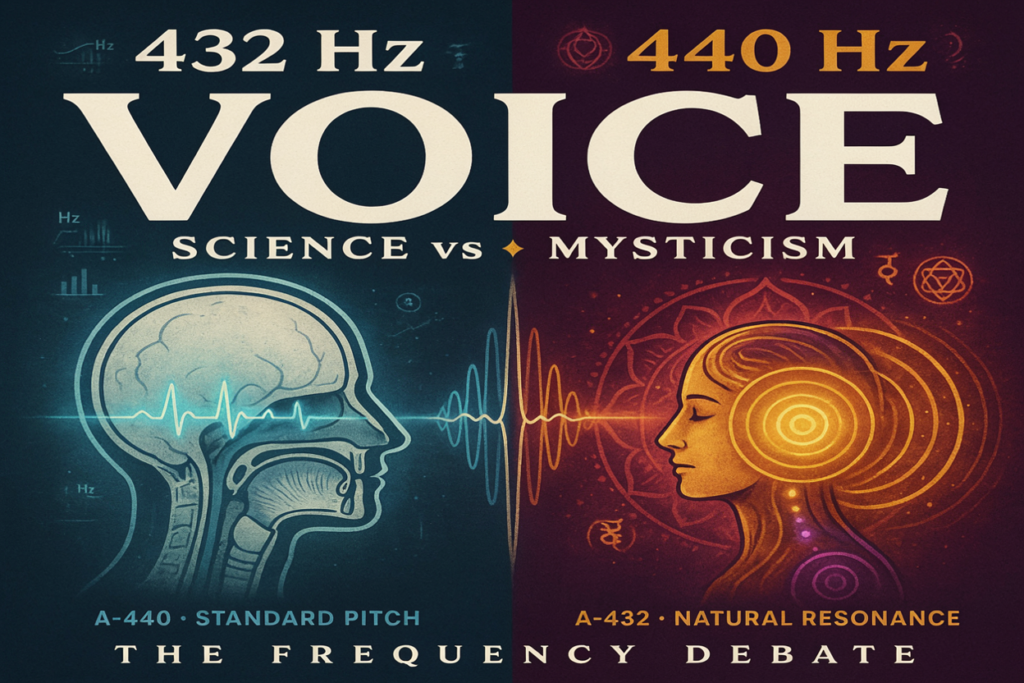
In vocal music, 432 Hz and 440 Hz are two reference tunings for A4, the A above middle C. Using A4 = 432 Hz lowers every note by about 1.8%, or 31.8 cents, compared with A4 = 440 Hz. The shift can make a song feel slightly lower, but it does not expand vocal range, change voice type, or provide scientifically established healing effects.
Singers do not produce only 432 Hz or 440 Hz. Those numbers identify one reference note used to calculate the rest of the tuning system.
What Is the Difference Between 432 Hz and 440 Hz for the Voice?
A4 = 440 Hz is the standard reference pitch used by modern instruments and ensembles. A4 = 432 Hz is an alternative tuning in which the same reference note is eight hertz lower.
| Feature | A4 = 432 Hz | A4 = 440 Hz |
|---|---|---|
| Reference note | A4 at 432 Hz | A4 at 440 Hz |
| Relative pitch | About 1.8% lower | Standard reference |
| Difference | About 31.8 cents lower | — |
| Effect on melody | Every note shifts lower | Standard note frequencies |
| Effect on voice type | None | None |
| Proven special health effect | Not established | Not established |
A cent is one-hundredth of an equal-tempered semitone. The difference is therefore less than one-third of a semitone.
This becomes clearer when you separate voice frequency from perceived pitch. Frequency is measured in hertz, while pitch describes how high or low a sound is perceived musically.
How Does 432 Hz Tuning Change Sung Notes?
Changing the reference from 440 Hz to 432 Hz lowers every note by the same ratio. Intervals, scales, and note names remain unchanged within the new tuning system.
Every Note Becomes Slightly Lower
The ratio is 432 ÷ 440, or approximately 0.9818. Multiplying a standard note frequency by that value gives its 432-tuned equivalent.
| Note | A4 = 440 Hz | A4 = 432 Hz |
| A3 | 220.00 Hz | 216.00 Hz |
| C4 | 261.63 Hz | 256.87 Hz |
| A4 | 440.00 Hz | 432.00 Hz |
| C5 | 523.25 Hz | 513.74 Hz |
| A5 | 880.00 Hz | 864.00 Hz |
The hertz difference grows at higher octaves because frequency doubles with each octave. The musical distance remains approximately 31.8 cents.
432 Hz Does Not Describe the Whole Voice
When someone says a singer is “singing in 432 Hz,” the accurate meaning is that the song uses A4 = 432 Hz as its reference. The singer still produces many fundamental frequencies throughout the melody.
A sung note also contains harmonics above its fundamental. The article on fundamental frequency in the voice explains why one detected pitch does not represent the voice’s complete spectrum.
Is Singing at 432 Hz Easier Than Singing at 440 Hz?
Singing with 432 Hz accompaniment may feel slightly easier at the top of a demanding melody because every note is lower. The effect is small and far less significant than transposing the song down by a full semitone or whole tone.
High Notes Are Slightly Lower
An A5 is 880 Hz in standard tuning and 864 Hz in 432 Hz tuning. A singer may notice that difference near the edge of a usable range.
Comfort still depends more on tessitura, vowel shape, registration, phrase length, dynamics, and the song’s key.
The Difference Is Smaller Than a Semitone
One equal-tempered semitone equals 100 cents. The 432-versus-440 shift is only about 31.8 cents.
A singer struggling with repeated high notes will usually gain more relief by moving the song down one or two semitones. The singer and accompaniment must also use the same reference; standard-tuned singing over a 432 Hz instrumental will sound sharp.
Does 432 Hz Change Vocal Range or Voice Type?
Changing reference tuning does not alter the singer’s anatomy or underlying vocal capacity. It changes the frequencies assigned to note names, not the physical limits of the vocal folds.
Vocal Range Remains Essentially the Same
A singer with a two-octave range has approximately the same interval span in either system. The numerical frequencies of the boundary notes shift slightly, but the distance between them remains the same.
The human voice frequency range varies widely among individuals and is better described through comfortable, repeatable pitches than one tuning reference.
Voice Classification Does Not Change
A soprano does not become a mezzo-soprano, and a tenor does not become a baritone, because an ensemble tunes to 432 Hz. Voice type also depends on tessitura, timbre, vocal weight, register transitions, and repertoire.
Does 432 Hz Sound Better for Singing?
Some listeners describe 432 Hz music as warmer, softer, or more relaxed. Others prefer the slightly brighter impression of 440 Hz. These are subjective reactions, not proof that one tuning is universally superior.
Why It May Sound Warmer
Lowering the performance reduces the absolute frequency of every note. That slight shift may be perceived as darker or less brilliant in a direct comparison.
Arrangement, loudness, recording speed, equalization, and expectation can also affect preference. A differently mastered version may seem better regardless of tuning.
Resonance Does Not Become Universally Better
Vocal resonance comes from interactions between the sound source and the vocal tract. Retuning a melody changes the relationship between fundamentals, harmonics, and resonance peaks slightly, but it does not create one ideal resonance pattern.
The guide to voice resonance and frequency explains why resonance cannot be reduced to one special number.
Are the Health and Healing Claims Proven?
Research has not established that 432 Hz tuning has unique healing properties. A few small studies have reported differences in heart rate, anxiety, stress, or sleep, but the evidence remains limited.
What Small Studies Suggest
Some pilot and clinical studies have compared music tuned to 432 Hz and 440 Hz. Certain outcomes favored the lower tuning during short listening sessions.
Small samples, narrow participant groups, short exposure periods, and study-design differences limit broad conclusions. The findings do not establish a unique biological mechanism.
What the Evidence Does Not Establish
Current evidence does not show that 432 Hz repairs DNA, heals vocal folds, aligns chakras, or matches a universal natural frequency.
A listener may genuinely find the tuning relaxing. That personal response should not be presented as a substitute for medical care or evidence-based vocal treatment. The discussion of voice frequency and meditation provides further context.
Why Is 440 Hz the Standard Tuning?
Pitch varied by region, era, and ensemble before international standardization. A common reference became useful as musicians traveled, instruments were manufactured at scale, and orchestras needed consistent tuning.
A4 = 440 Hz was internationally adopted during the twentieth century and is specified in ISO 16. It remains the common reference for modern instruments, tuners, recording systems, and rehearsals.
Standard does not mean artistically mandatory. Some orchestras tune slightly higher, while early-music ensembles may use historically informed lower pitches.
How Can Singers Compare 432 Hz and 440 Hz?
Compare the tunings under controlled conditions so reference pitch is the only meaningful variable.
Keep the Performance Conditions Equal
Use the same song, key, tempo, loudness, microphone distance, and vocal effort. Retune the entire accompaniment rather than changing only the singer’s target note.
Avoid Speed-Based Comparisons
Slowing a completed recording to reach 432 Hz may also change tempo unless dedicated pitch processing is used. A slower version may feel calmer because of tempo rather than tuning.
Try a Blind Test
Create two level-matched versions, label them anonymously, and compare them without knowing which is which. Repeat the test on different days.
You can inspect the values using the methods in how voice frequency is measured. A blind comparison cannot prove one tuning is superior, but it can reveal your preference.
Frequently Asked Questions
Is 432 Hz exactly eight hertz lower than 440 Hz?
Only A4 differs by exactly eight hertz. Other notes differ by smaller or larger hertz amounts because the system changes proportionally.
How many semitones lower is 432 Hz?
A4 = 432 Hz is about 31.8 cents below A4 = 440 Hz, or approximately 0.318 of a semitone.
Does 432 Hz make high notes easier?
It makes every note slightly lower, so an upper note may feel marginally easier. Transposing down a full semitone usually creates a much larger difference.
Can a singer perform with 432 Hz instruments?
Yes. The singer and accompaniment simply need to use the same reference tuning.
Does 432 Hz increase vocal range?
No. It changes note frequencies but does not expand the singer’s physical or comfortable range.
Is 432 Hz scientifically proven to heal the voice?
No. Research has not shown that 432 Hz uniquely repairs or heals the vocal folds. Persistent hoarseness, pain, or voice loss requires appropriate professional evaluation.

Bobby is a voice analysis and vocal testing writer at VoiceFrequencyTest. He focuses on vocal frequency analysis, pitch recognition, voice measurement tools, and singing education for vocalists, musicians, creators, and beginners.