
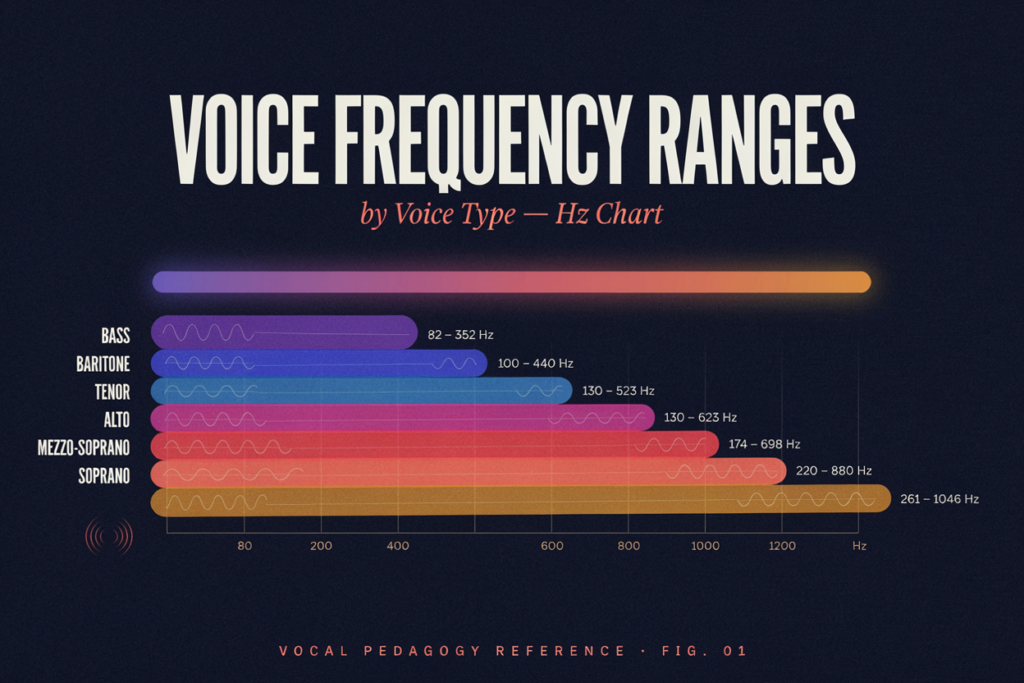
Voice frequency ranges by voice type describe the approximate lowest and highest fundamental frequencies associated with common singing classifications. In a simplified system, the ranges extend from bass at roughly 82–330 Hz to soprano at roughly 262–1,047 Hz, but these values overlap and are not rigid boundaries.
A singer’s voice type also depends on tessitura, the range where the voice feels comfortable and sounds consistent, as well as timbre, vocal weight, register transitions, and repertoire. For a broader reference, compare these figures with the site’s human singing range overview.
What Are the Voice Frequency Ranges by Voice Type?
The seven commonly discussed singing voice types are soprano, mezzo-soprano, contralto, countertenor, tenor, baritone, and bass. The chart below uses widely taught classical ranges and converts their boundary notes into approximate frequencies under A4 = 440 Hz tuning.
| Voice type | Common note range | Approximate frequency range | General position |
|---|---|---|---|
| Soprano | C4–C6 | 262–1,047 Hz | Highest standard voice |
| Mezzo-soprano | A3–A5 | 220–880 Hz | Middle-high voice |
| Contralto | F3–F5 | 175–698 Hz | Lowest standard female voice |
| Countertenor | E3–E5 | 165–659 Hz | High male voice |
| Tenor | C3–C5 | 131–523 Hz | Highest common modal male voice |
| Baritone | A2–A4 | 110–440 Hz | Middle-low male voice |
| Bass | E2–E4 | 82–330 Hz | Lowest common voice |
These are reference ranges rather than diagnostic cutoffs. Another reputable acoustic chart places baritone at G2–G4, or about 98–392 Hz, and bass at D2–E4, or about 73–330 Hz. The difference reflects repertoire, classification tradition, and whether a chart emphasizes possible or consistently usable notes.
You can compare the values with a general voice frequency chart to see how note names and hertz relate.
Voice Frequency Ranges From Highest to Lowest
Voice categories are ordered mainly by tessitura and characteristic sound, not simply by the highest note a singer can touch. Neighboring categories therefore share many pitches.
Soprano, Mezzo-Soprano, and Contralto
Soprano is the highest standard classification, commonly summarized as C4–C6. Some sopranos sing below C4 or above C6, but those extensions do not define every soprano voice.
Mezzo-soprano commonly spans A3–A5. That range overlaps heavily with soprano, yet a mezzo usually has a lower comfortable center and different vocal weight. A mezzo who reaches C6 does not automatically become a soprano.
Contralto is commonly placed around F3–F5. It is the lowest traditional female classification and is associated with a lower tessitura and darker tonal character. In choir music, alto usually names a part rather than a solo voice type. An alto section may include contraltos, mezzo-sopranos, countertenors, or tenors singing the assigned line.
Countertenor, Tenor, Baritone, and Bass
Countertenor commonly occupies approximately E3–E5, overlapping contralto and sometimes mezzo-soprano repertoire. Vocal production, tessitura, and stylistic role also contribute to the label.
Tenor is often summarized as C3–C5, although some charts use C3–B4. Baritone typically sits around A2–A4, while alternative references use G2–G4. See the detailed baritone range breakdown for more context.
Bass commonly spans E2–E4, with some charts extending the lower boundary to D2. True bass voices are identified not only by reaching low notes but by sustaining them with usable volume and resonance. The bass frequency guide explains the difference between touching a low pitch and possessing a bass-centered instrument.
Why Do Voice-Type Charts Show Different Numbers?
Voice-type charts differ because classifications describe practical singing categories rather than fixed biological limits. Classical solo singing, choir writing, contemporary music, and acoustic measurement may each use different boundaries.
Different Systems Emphasize Different Ranges
An operatic range reflects notes expected in repertoire and the projection required over an orchestra. A choir chart may describe notes assigned to a section. A contemporary singer may use chest-dominant, mixed, or falsetto coordination across a wider span without fitting neatly into a classical category.
That is why soprano may appear as B3–C6 in one source and C4–C6 in another. The useful conclusion is that each range establishes an approximate neighborhood, not a mandatory pair of endpoints.
Comfortable Range Is Not Maximum Range
Maximum range includes the lowest and highest sounds a singer can produce. Tessitura describes the narrower area where the singer can perform repeatedly with control, stable tone, and manageable effort.
A singer might produce A2 once, sing comfortably from C3 to E4, and reach A4 only with strain. Calling the entire A2–A4 span equally usable would hide the most important information. The guide to measuring voice frequency accurately helps separate stable notes from accidental readings.
Does Frequency Range Alone Determine Voice Type?
Frequency range alone does not determine voice type. Teachers also consider tessitura, passaggi, timbre, vocal weight, resonance, agility, and how the voice behaves in repertoire.
Tessitura and Passaggi
Passaggi are transition areas where register coordination changes. Their location can help distinguish voices that share similar outer limits.
Consider two singers who can both produce A2–A4. Singer A is comfortable around D3–F4 and sustains upper phrases easily. Singer B sounds fullest around B2–D4 and tires when music stays high. Singer A may be assessed as a tenor with low extension, while Singer B may be a baritone.
Timbre, Vocal Weight, and Repertoire
Timbre is the perceived color of a voice. Vocal weight describes whether the sound behaves as relatively light or substantial, especially through the middle and upper range.
Voice classification is descriptive, not a competition for the highest or lowest pitch. A baritone who reaches C5 has gained an upper extension; that note alone does not erase the voice’s lower tessitura, passaggi, or characteristic sound.
Pitch Frequency vs. the Full Voice Spectrum
Pitch frequency is the fundamental repetition rate associated with the note being sung, while the full voice spectrum also contains harmonics and resonance peaks. A singer producing A3 has a fundamental frequency of 220 Hz, but the sound contains energy well above 220 Hz.
Fundamental Frequency Determines the Note
Fundamental frequency, often written as f0, is the main measurement used when converting a sung pitch into hertz. Doubling frequency raises the pitch by one octave: A3 is 220 Hz, A4 is 440 Hz, and A5 is 880 Hz.
The explanation of fundamental frequency in the voice covers this relationship in more detail.
Harmonics and Formants Shape Tone
Harmonics occur at multiples of the fundamental frequency. Formants are resonance regions created by the vocal tract. Together, they influence brightness, warmth, vowel identity, and projection.
A resonance peak near 3 kHz does not mean a singer is producing a 3 kHz musical fundamental. The comparison between voice resonance and frequency separates these related concepts.
How Can You Estimate Your Voice Type?
Estimate your voice type by finding your lowest and highest comfortable notes, locating the area where your voice remains stable, and comparing the result with several classifications. Treat any browser-based reading or home test as an estimate.
Find Comfortable Boundary Notes
Warm up gently, then sing downward and upward using a piano or reliable pitch reference. Count a note only when you can sustain it without pain, forced volume, excessive breathiness, or unstable pitch.
Do not push for a record. Extreme notes can change with fatigue, illness, hydration, and the vowel being sung.
Identify Your Most Stable Area
Sing short scales and simple phrases through the middle of the range. Notice where tone, volume, and articulation remain consistent. That comfortable area is often more informative than the endpoints.
Compare your result with a broader voice-type frequency reference, but avoid assigning yourself permanently from one session. Developing singers may find that their usable range changes with training.
Frequently Asked Questions
Is alto the same as contralto?
Not exactly. Contralto is a solo voice classification, while alto often refers to a lower choir part. An alto section can contain singers from more than one voice type.
What frequency range does a countertenor sing in?
A simplified countertenor range is approximately E3–E5, or 165–659 Hz. Individual countertenors may extend beyond those notes, and classification also depends on tessitura and vocal production.
Can two voice types have overlapping frequencies?
Yes. Soprano and mezzo-soprano, tenor and baritone, and baritone and bass share many notes. Their comfortable centers, transition points, vocal weight, and timbre help separate them.
Does a deep speaking voice make someone a bass?
No. Speaking pitch may suggest where a voice naturally sits, but singing classification requires evaluation of comfortable sung range, tessitura, resonance, and register behavior.
Can training change your voice type?
Training can expand usable range, improve register coordination, and reveal the voice more clearly. It usually develops the existing instrument rather than turning a naturally bass-centered voice into a tenor.

Bobby is a voice analysis and vocal testing writer at VoiceFrequencyTest. He focuses on vocal frequency analysis, pitch recognition, voice measurement tools, and singing education for vocalists, musicians, creators, and beginners.