
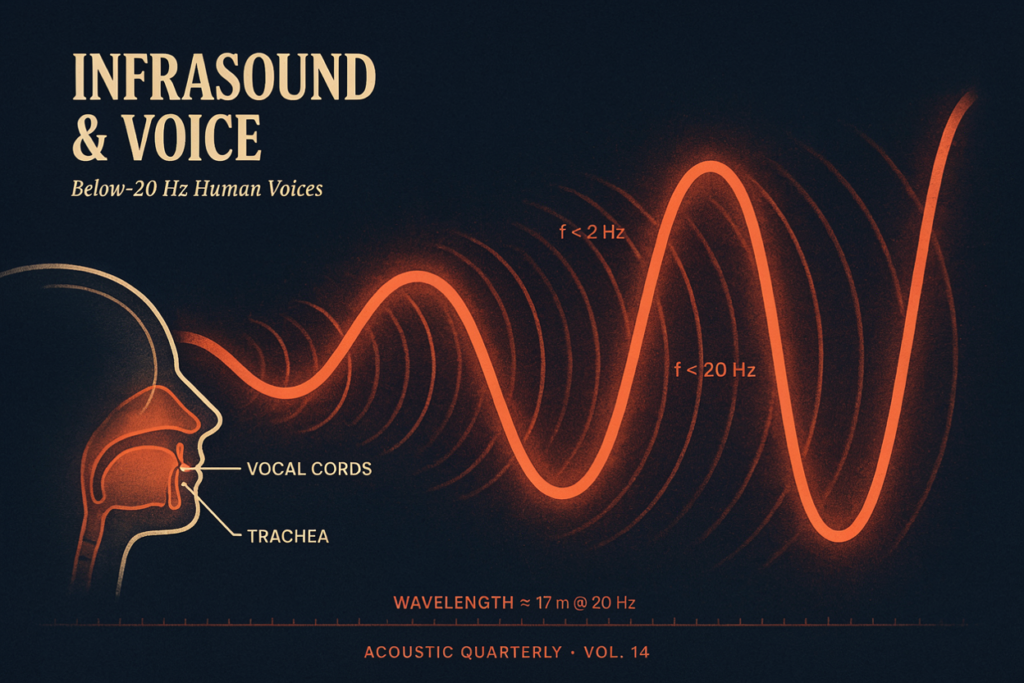
Infrasound and voice overlap only at the extreme edge of human vocal production. Infrasound generally means sound below 20 Hz, while ordinary speech and singing remain far above that boundary. A person may produce slow vocal pulses or subharmonic components below 20 Hz, but that is rare and not the same as having a naturally deep voice.
Understanding how vocal frequency is defined makes the distinction clearer. A voice can sound dark, heavy, or rumbling without its fundamental frequency becoming infrasonic.
What Is Infrasound in the Human Voice?
Infrasound is acoustic energy below about 20 Hz. In the human voice, the term refers to a measured vocal component whose vibration rate falls beneath that conventional boundary.
Why 20 Hz Is Used as the Boundary
The 20 Hz figure is a practical reference, not a perfectly sharp cutoff. Below it, people may perceive pulses, pressure, or vibration rather than a clear musical pitch.
Fundamental Frequency and Harmonics
The fundamental frequency of the voice is the rate at which the vocal-fold vibration pattern repeats. It is written as F0 and measured in hertz.
A vocal sound also contains harmonics above the fundamental. These higher frequencies help create tone color and may remain audible even when the lowest component cannot be heard clearly.
Can the Human Voice Produce Infrasound?
The human voice can produce infrasonic components below 20 Hz, but this is extremely rare and is not typical of ordinary speech or bass singing. Most unusually low results involve vocal fry, subharmonics, or exceptional vibration patterns, and confirming them requires suitable low-frequency equipment.
Ordinary Speech and Singing Stay Above 20 Hz
Typical adult speaking fundamentals are well above the infrasonic range. Male voices often center around roughly 100 to 150 Hz, while female voices commonly center around about 165 to 255 Hz.
Even the usual frequency range of bass voices remains mostly audible. A bass singer may sound exceptionally low while still producing fundamentals several times higher than 20 Hz.
Vocal Fry and Subharmonics
Vocal fry, also called pulse register, uses slow vocal-fold pulses. Published research has measured fry phonation around 30 to 45 Hz, which is very low but usually above the standard infrasound boundary.
Subharmonic singing can create a detected frequency below the ordinary fundamental by forming a repeating pattern across multiple vibration cycles. Not every rough or creaky voice is subharmonic or infrasonic.
The Tim Storms Record
Guinness World Records lists singer Tim Storms as producing a 0.189 Hz vocal frequency, identified as G−7. That result is far below human hearing and represents an exceptional measured event rather than an ordinary musical note.
The record required specialized equipment and does not represent a conventionally audible musical pitch.
Deep Voice vs. Infrasonic Voice
A deep voice and infrasonic vocal output are not interchangeable. The frequencies associated with a deep voice are usually audible and often fall within normal speech or singing ranges.
| Feature | Deep audible voice | Infrasonic vocal output |
|---|---|---|
| Frequency | Usually above 20 Hz | Below 20 Hz |
| Perception | Heard as a low pitch | Often sensed as pulses or vibration |
| Vocal mechanism | Modal voice or low register | Fry, subharmonics, or unusual pulse patterns |
| Measurement | Standard microphones may capture it | Specialized equipment may be needed |
| Practical use | Common in speech and singing | Extremely rare |
Why a Deep Bass Voice Is Usually Not Infrasound
A voice may sound deep because of a low fundamental, strong lower harmonics, vocal-tract resonance, or dark tone quality. None of those features automatically place it below 20 Hz.
Room acoustics and recording equipment can also exaggerate low-frequency rumble.
Why You May Hear Harmonics but Not the Fundamental
The ear can infer a missing fundamental from the spacing between audible harmonics, making a voice seem lower than the equipment can reproduce directly.
The difference between frequency and perceived pitch matters here. A measured frequency and a listener’s pitch impression are related, but they are not always identical.
Can You Hear or Feel an Infrasonic Voice?
An infrasonic vocal component is more likely to be felt or detected indirectly than heard as a clear note. Perception depends strongly on frequency, sound-pressure level, duration, and sensitivity.
Hearing Thresholds Below 20 Hz
As frequency falls, the sound level needed for perception rises sharply. A weak infrasonic component may be measurable while remaining unnoticed by a listener.
Ventilation, traffic, wind, and microphone handling can create low-frequency signals that resemble vocal infrasound.
Physical Sensation Is Not Proof
Feeling pressure or vibration does not prove that the voice produced a stable infrasonic note. Audible bass, room resonance, or speaker movement may create the sensation.
Can a Phone Measure Infrasonic Voice?
Most phones and ordinary voice apps cannot reliably verify infrasonic vocal frequencies. They may estimate normal speaking and singing fundamentals, but their microphones and software are rarely designed for accurate measurement below 20 Hz.
Microphone and Software Limitations
Consumer microphones often reduce very low frequencies. Noise suppression, automatic gain, and high-pass filtering may remove or distort infrasonic information.
What Reliable Measurement Requires
Accurate verification generally needs:
- A calibrated microphone with a documented low-frequency response.
- A recorder or interface that does not filter the target range.
- Spectrum and waveform analysis capable of resolving slow cycles.
- A quiet environment with minimal mechanical rumble.
- Repeated recordings that produce the same pattern.
- Checks that rule out electrical, handling, and room noise.
A guide to how vocal frequencies are measured explains why the recording chain matters as much as the analysis software.
Browser Tests Provide Estimates
Browser tests are useful for ordinary voice frequencies, but their results depend on the microphone, room noise, and detection algorithm.
The accuracy limits of online frequency tests become especially important near the edge of the measurable range. An app displaying 10 Hz does not prove that the vocal folds produced a genuine 10 Hz fundamental.
Is Producing an Extremely Low Voice Safe?
Low pitch alone is not harmful. The concern is whether producing it requires pressure, squeezing, or effort that causes discomfort.
Warning Signs of Strain
Stop attempting extreme low notes if you experience pain, burning, persistent hoarseness, sudden loss of range, throat pressure, or unusual fatigue. Symptoms that continue after rest should be assessed by a qualified voice professional or healthcare provider.
The connection between vocal-fold health and frequency matters more than reaching a dramatic number on an analyzer.
Why Forcing Low Techniques Backfires
Fry and subharmonic techniques should use low effort and controlled airflow. Pressing the larynx downward, pushing excessive breath, or squeezing the throat can reduce control and irritate the vocal folds.
The lowest measurable pulse is not necessarily a note that can be sustained, projected, or used musically.
Myths About Infrasound and Voice
| Myth | Reality |
| Every bass singer produces infrasound | Most bass fundamentals remain above 20 Hz |
| Anything below 20 Hz is completely undetectable | Strong low-frequency energy may be sensed as pulses or vibration |
| A phone app can verify a record | Record claims require appropriate equipment and controlled testing |
| Infrasonic voice is automatically harmful | Risk depends on intensity, exposure, and vocal technique |
| The lowest measurement is a usable note | A detected pulse may not function as a stable musical pitch |
Frequently Asked Questions
Can an ordinary person produce sound below 20 Hz?
A person may produce irregular pulses or subharmonic components near or below 20 Hz, especially during vocal fry. Producing a stable, repeatable infrasonic fundamental is much less common.
Is vocal fry technically infrasound?
Vocal fry is not automatically infrasound. Measurements often place it around 30 to 45 Hz, although some individual pulses or subharmonic components may fall lower.
What is the lowest verified human vocal frequency?
Guinness World Records lists Tim Storms’ 0.189 Hz G−7 as the lowest vocal note produced by a male. It was verified with specialized equipment and is not a normal singing pitch.
Why can you hear a voice with an infrasonic fundamental?
You may hear the voice’s upper harmonics even when the fundamental is below the normal hearing range. The brain can use those harmonics to infer a lower pitch.
Can a smartphone measure below 20 Hz accurately?
Most smartphones cannot verify infrasonic vocal frequencies accurately because their microphones and software may filter or distort very low-frequency signals. Treat such results as estimates, not proof.
Is an infrasonic voice dangerous?
An infrasonic frequency is not automatically dangerous. Vocal safety depends more on sound level, duration, technique, and whether producing it causes pain or persistent hoarseness.

Bobby is a voice analysis and vocal testing writer at VoiceFrequencyTest. He focuses on vocal frequency analysis, pitch recognition, voice measurement tools, and singing education for vocalists, musicians, creators, and beginners.