
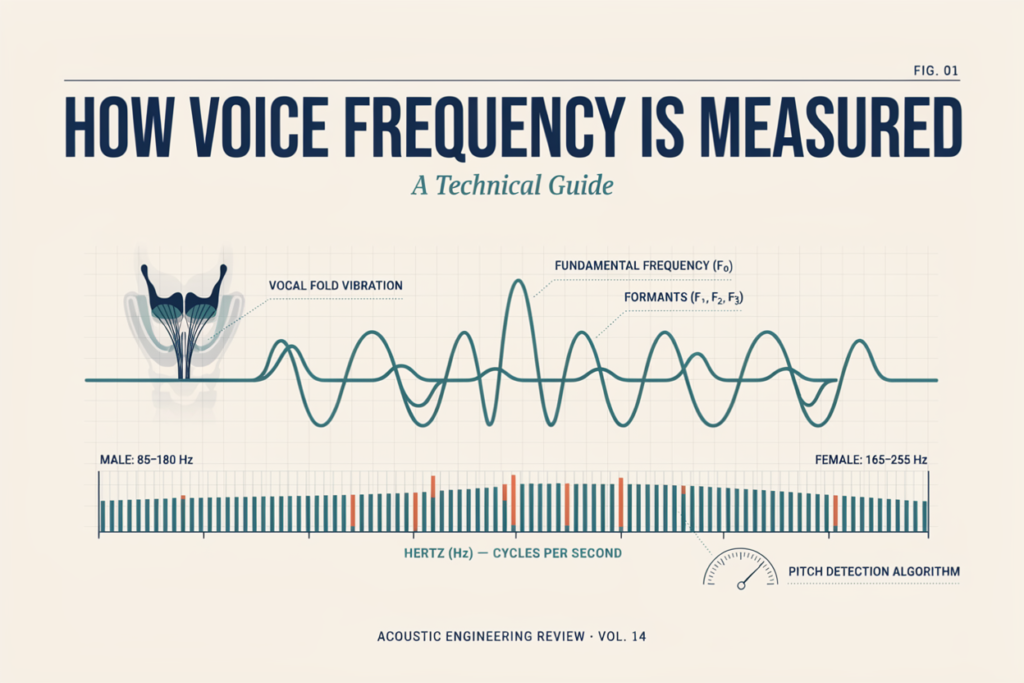
Voice frequency is usually measured by recording the voice with a microphone and using software to estimate the fundamental frequency, or F0, from repeating cycles in the waveform. The software measures the vibration period and converts it into hertz using the relationship frequency = 1 ÷ period.
The basic measurement chain is:
Voice → microphone → digital waveform → pitch-detection algorithm → F0 result
Most apps and analysis programs do not observe the vocal folds directly. They estimate how quickly the acoustic signal repeats.
How Is Voice Frequency Measured?
A microphone converts changing air pressure from the voice into an electrical signal, which a phone or computer stores as digital audio. Pitch-tracking software then searches the waveform for repeating patterns and reports the most likely fundamental frequency in hertz.
For example, if one cycle takes 0.005 seconds:
Frequency = 1 ÷ 0.005 = 200 Hz
That means the repeating vocal cycle occurs about 200 times per second. The guide to fundamental frequency in the voice explains why F0 is the main frequency used for pitch measurement.
What Does Voice Frequency Measurement Actually Measure?
Most voice-frequency tools measure fundamental frequency, not the full set of frequencies present in the voice.
Fundamental Frequency and Vocal-Fold Vibration
Fundamental frequency is the lowest repeating rate in a voiced sound and is closely related to perceived pitch. Faster vocal-fold vibration produces a higher F0, while slower vibration produces a lower F0.
If a voice is measured at 120 Hz, the repeating cycle occurs about 120 times each second.
Frequency, Pitch, Harmonics, and Formants
Frequency is the physical measurement in hertz. Pitch is the listener’s perception of how high or low the sound is.
Harmonics occur at multiples of the fundamental. A 100 Hz voice may also contain energy near 200 Hz, 300 Hz, and 400 Hz.
Formants are resonance regions created by the vocal tract. They shape vowel identity and tone color but are not the same as F0. The comparison between voice frequency and pitch helps separate these terms.
The Voice Frequency Measurement Process
Step 1: Record the Voice
A microphone detects pressure changes in the air. Even a phone microphone can be useful in a quiet environment when distance remains consistent.
Step 2: Create a Digital Waveform
The device samples the signal thousands of times per second. These samples create a digital waveform representing changes in air pressure over time.
Common audio sampling rates such as 44.1 kHz or 48 kHz are adequate for ordinary voice measurement.
Step 3: Detect Repeating Cycles
Pitch software searches for periodicity, meaning a repeating waveform pattern. Voiced vowels usually produce clearer patterns than whispering, breath noise, or strongly irregular phonation.
Step 4: Convert Period Into Hertz
The period is the time required for one cycle. Frequency is the reciprocal of that period.
| Period | Frequency |
|---|---|
| 0.010 seconds | 100 Hz |
| 0.005 seconds | 200 Hz |
| 0.0025 seconds | 400 Hz |
Shorter periods correspond to higher frequencies.
Step 5: Display the Result
Software may display F0 in hertz, the nearest musical note, a pitch contour, an average speaking frequency, or the lowest and highest detected values.
The article on how to measure voice frequency explains how to interpret these outputs.
Which Methods Calculate Voice Frequency?
Different programs use different algorithms, and no single method works best for every voice.
Autocorrelation
Autocorrelation compares the waveform with delayed copies of itself. When a delayed version aligns strongly with the original, the delay suggests the likely period.
Cepstral Analysis
Cepstral analysis helps separate repeating source patterns from spectral shaping. It can identify periodicity when the harmonic structure is complex.
Harmonic and Spectral Methods
Spectral methods examine energy peaks in the frequency domain. Regularly spaced peaks can reveal the fundamental even when the lowest component is weak.
Zero-Crossing Methods
A simple method counts how often the waveform crosses the zero-amplitude line. It is fast but easily confused by noise and harmonics, so modern analyzers generally use more robust methods.
Waveform vs. Spectrogram vs. Pitch Track
| Display | What it shows | Best use |
| Waveform | Amplitude over time | Timing and cycle shape |
| Spectrogram | Frequency energy across time | Harmonics, formants, and noise |
| Pitch track | Estimated F0 across time | Speech pitch and singing notes |
| Spectrum | Frequency energy at one moment | Harmonic structure |
A waveform shows how the signal rises and falls. A spectrogram displays frequency content over time, often revealing harmonics as horizontal bands. A pitch track is the software’s estimated F0 and is usually the easiest display for ordinary users.
The guide to measuring voice in hertz explains how Hz values relate to notes and ranges.
What Equipment Measures Voice Frequency?
Smartphones and Computers
Phones and laptops can record voice and run pitch-analysis software. Built-in noise reduction and automatic gain control may alter the signal, so results should be treated as estimates.
Studio Microphones and Audio Interfaces
A studio microphone and audio interface can provide cleaner recordings, lower noise, and more consistent input levels.
Electroglottography and Accelerometers
Electroglottography uses neck electrodes to estimate changes in vocal-fold contact. Neck-surface accelerometers detect tissue vibration and may help in noisy environments.
Laryngoscopy and Videostroboscopy
Laryngoscopy allows clinicians to view the larynx. Videostroboscopy makes vocal-fold vibration appear slowed. These methods provide visual information and are not simply microphone-based Hz meters.
How Accurate Is Voice Frequency Measurement?
Accuracy depends on recording quality, algorithm choice, voice quality, and sample type.
Microphone and Room Effects
Background noise, echo, music, nearby speech, and poor microphone placement can interfere with detection. A quiet room and stable distance produce more consistent results.
Algorithm Differences
Two apps may report different values from the same recording because they use different smoothing, thresholds, and methods for selecting the fundamental.
The guide to voice frequency test accuracy explains why repeated measurements matter.
Vocal Fry, Roughness, and Subharmonics
Vocal fry and irregular phonation may not produce one clear period. Different algorithms can select different repeating patterns and report different F0 values.
Octave Errors
An octave error occurs when software identifies a harmonic instead of the true fundamental. A voice with a true F0 of 220 Hz may be reported as 440 Hz if the algorithm locks onto the second harmonic.
A sudden doubling or halving of the displayed value often suggests an octave-tracking problem.
How to Measure Voice Frequency at Home
Record a comfortable vowel such as “ah” for two or three seconds at a natural volume. A steady vowel gives the software a clearer signal than speech with rapid consonants.
For average speaking frequency, record 30 to 60 seconds of natural speech. Do not use one sustained note as a substitute for a conversational sample.
Keep the room, microphone distance, speaking level, and device consistent. Repeat the test several times and compare the stable middle result rather than the most extreme number.
The guide to checking voice frequency provides a practical home-testing process.
How Is Voice Frequency Measured Clinically?
Clinical assessment may combine acoustic analysis, perceptual listening, medical history, and visual examination.
Acoustic Voice Assessment
A clinician may measure F0, pitch range, intensity, jitter, shimmer, harmonic-to-noise ratio, and cepstral measures. These values describe different aspects of the signal and should not be interpreted alone.
Electroglottography and Imaging
Electroglottography can track vocal-fold contact patterns and estimate periodicity. Laryngoscopy and videostroboscopy can reveal structural or functional issues that an acoustic measurement cannot identify.
A single F0 result cannot diagnose a voice disorder. Persistent hoarseness, pain, weakness, or sudden pitch change requires appropriate professional evaluation.
Frequently Asked Questions
What instrument measures voice frequency?
A microphone and pitch-analysis software are the most common tools. Clinical settings may also use electroglottography, accelerometers, and laryngeal imaging.
How does an app calculate voice frequency?
The app records the signal, detects repeating patterns, estimates the period, and converts that period into hertz.
What is F0 in voice analysis?
F0 is fundamental frequency, the main repetition rate associated with perceived vocal pitch.
Can a spectrogram measure pitch?
A spectrogram can reveal harmonic spacing and support pitch estimation, but a dedicated pitch algorithm usually calculates the displayed F0.
Why does my frequency reading jump?
Noise, vibrato, vocal fry, irregular phonation, and octave errors can make the reading change suddenly.
Is a phone microphone accurate enough?
A phone is often accurate enough for practice and approximate comparison in a quiet room. It is not equivalent to calibrated clinical or laboratory equipment.

Bobby is a voice analysis and vocal testing writer at VoiceFrequencyTest. He focuses on vocal frequency analysis, pitch recognition, voice measurement tools, and singing education for vocalists, musicians, creators, and beginners.