
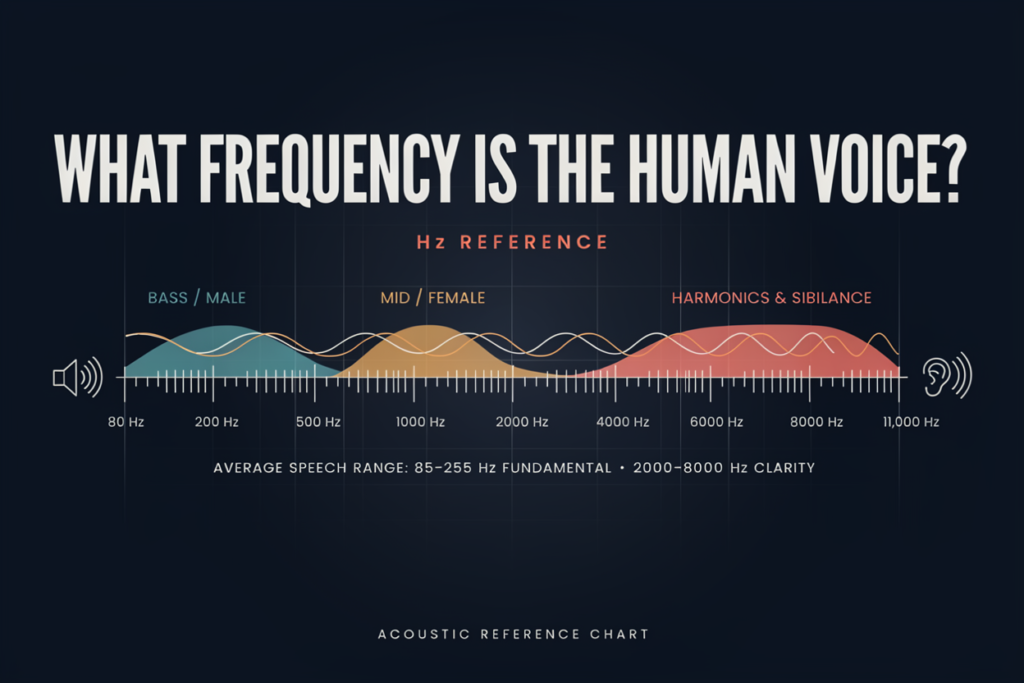
The human voice typically has a fundamental frequency between 85 Hz and 255 Hz, depending on factors such as age, sex, and individual anatomy. Adult men generally speak within a range of 85–180 Hz, while adult women usually fall between 165–255 Hz. Children’s voices are naturally higher, often ranging from 250–400 Hz before puberty.
It’s important to distinguish the frequency of your voice from the full speech frequency spectrum. The numbers above describe the fundamental frequency (F0)—the primary vibration rate of your vocal folds that determines how high or low your voice sounds. Human speech also contains harmonics extending into several thousand hertz, giving voices their unique tone and clarity.
If you’re new to vocal acoustics, understanding what voice frequency means provides a solid foundation before exploring specific frequency ranges.
Human Voice Frequency Chart
The following table summarizes the typical fundamental frequency ranges for different groups.
| Voice Group | Typical Fundamental Frequency (Hz) | Characteristics |
|---|---|---|
| Adult Male | 85–180 Hz | Lower pitch due to longer, thicker vocal folds |
| Adult Female | 165–255 Hz | Higher average pitch with shorter vocal folds |
| Children | 250–400 Hz | High pitch before puberty |
| Bass Singer | 82–330 Hz (approx.) | Lowest classical male voice |
| Baritone Singer | 98–392 Hz (approx.) | Mid-range male voice |
| Tenor Singer | 131–523 Hz (approx.) | Highest common male voice |
| Alto/Contralto | 175–698 Hz (approx.) | Lowest common female voice |
| Soprano | 261–1046 Hz (approx.) | Highest common female voice |
These figures represent typical ranges rather than strict limits. Individual voices naturally vary based on anatomy, training, language, and speaking habits.
For a broader comparison of vocal categories, see this detailed voice frequency chart.
Fundamental Frequency vs. Speech Frequency Range
Many people assume that the frequency of the human voice is the same as the frequency range transmitted during speech or telephone calls. These are different concepts.
What Is Fundamental Frequency (F0)?
Fundamental frequency, often written as F0, is the rate at which your vocal folds vibrate each second.
For example:
- 100 vibrations per second = 100 Hz
- 200 vibrations per second = 200 Hz
This single frequency determines whether your voice sounds deep or high.
If someone says a person’s voice is around 120 Hz, they’re referring to the fundamental frequency, not every sound the voice produces.
For a deeper explanation, read about fundamental frequency of the voice.
Why Human Speech Contains Higher Frequencies
Although your vocal folds may vibrate at only 120 Hz or 200 Hz, the sound travels through the throat, mouth, and nasal cavities, creating harmonics that extend into several thousand hertz.
These higher frequencies improve:
- Speech clarity
- Consonant recognition
- Voice timbre
- Individual vocal identity
This explains why telephone systems typically transmit frequencies between roughly 300 Hz and 3,400 Hz. They don’t transmit the entire voice spectrum but preserve enough information for understandable speech.
Why Human Voice Frequency Changes
Your natural voice frequency isn’t fixed. It changes throughout life and can vary even during a single day.
Age
Children have smaller vocal folds that vibrate more quickly, producing higher frequencies.
As people age, gradual changes in muscle tone and vocal fold elasticity may alter the average speaking pitch slightly.
You can compare these changes in more detail using this guide on average voice frequency by age.
Puberty
Puberty causes the largest natural change in voice frequency.
During male puberty:
- The larynx enlarges significantly.
- Vocal folds become longer and thicker.
- Average speaking frequency often drops by nearly an octave.
Female voices also deepen during puberty, although the change is generally much smaller.
Emotion and Vocal Effort
Your speaking frequency temporarily changes depending on how you feel.
Examples include:
- Excitement often raises pitch.
- Stress may increase average frequency.
- Fatigue can lower vocal control.
- Fear frequently produces a higher-pitched voice.
- Calm speech generally stays closer to your natural baseline.
These changes are temporary and don’t permanently alter your natural speaking frequency.
Speaking Voice vs. Singing Voice
Speaking and singing use the same vocal instrument but produce different frequency ranges.
Speaking Voice
Most everyday conversation stays within a relatively narrow frequency range.
Typical averages:
- Men: 85–180 Hz
- Women: 165–255 Hz
People rarely use the extremes of their vocal range during casual speech.
Singing Voice
Singing requires much greater flexibility.
Professional singers may comfortably produce notes several octaves above or below their speaking voice through training and proper technique.
A bass singer may begin around 82 Hz, while a trained soprano can exceed 1,000 Hz on the highest notes.
This doesn’t mean their speaking voice changes—it simply demonstrates a wider usable vocal range.
How to Measure Your Voice Frequency
Measuring your voice frequency is easier than ever thanks to modern recording software and voice analysis tools.
The most accurate approach is to:
- Record yourself speaking naturally.
- Sustain a vowel sound such as “ah.”
- Analyze the recording using pitch detection software.
- Identify your average fundamental frequency (F0).
For best results:
- Record in a quiet room.
- Use a consistent speaking volume.
- Take multiple recordings rather than relying on a single measurement.
Keep in mind that browser-based and mobile voice tests provide useful estimates but cannot match laboratory-grade acoustic analysis.
If you’re interested in testing your own voice, learn how to measure voice frequency and compare the results with the normal voice frequency range.
Common Myths About Human Voice Frequency
| Myth | Reality |
|---|---|
| Everyone has the same voice frequency. | Every person’s fundamental frequency is unique. |
| A deeper voice always means better singing. | Singing ability depends on technique, control, and training—not simply low frequency. |
| Telephone audio represents the full human voice. | Phone systems transmit only part of the speech spectrum. |
| Voice frequency never changes. | Emotion, age, illness, and fatigue can temporarily or permanently affect it. |
| Higher frequency means louder speech. | Frequency determines pitch, while loudness depends on sound intensity. |
Why Voice Frequency Matters
Understanding your natural voice frequency can help you:
- Identify your typical speaking pitch.
- Monitor vocal changes over time.
- Support singing and vocal training.
- Recognize possible vocal health concerns.
- Better understand voice classification.
Frequency alone doesn’t define the quality of a voice, but it provides valuable insight into how your vocal folds function and where your voice naturally sits.
FAQ
What frequency is the average human voice?
The average adult male speaking voice is approximately 85–180 Hz, while the average adult female voice is around 165–255 Hz. Children generally have much higher frequencies before puberty.
Is 440 Hz the frequency of the human voice?
No. A frequency of 440 Hz is the musical note A4 used as a tuning reference. While singers can produce 440 Hz, it is not the average frequency of normal human speech.
Why are men’s voices usually lower than women’s?
Adult men typically have longer and thicker vocal folds after puberty. These vibrate more slowly, producing lower fundamental frequencies.
Does voice frequency determine voice quality?
Not by itself. Voice quality also depends on resonance, breath support, articulation, harmonics, and vocal health. Two people can have the same frequency but sound completely different.
Can I increase or decrease my natural voice frequency?
You can temporarily modify your speaking pitch through vocal training and technique. However, your natural fundamental frequency is largely determined by your vocal anatomy.
How accurate are online voice frequency tests?
Online tools provide useful estimates when recordings are made in a quiet environment. However, microphone quality, background noise, and speaking style can all influence the measured frequency, so they should not be considered laboratory-level measurements.

Bobby is a voice analysis and vocal testing writer at VoiceFrequencyTest. He focuses on vocal frequency analysis, pitch recognition, voice measurement tools, and singing education for vocalists, musicians, creators, and beginners.