
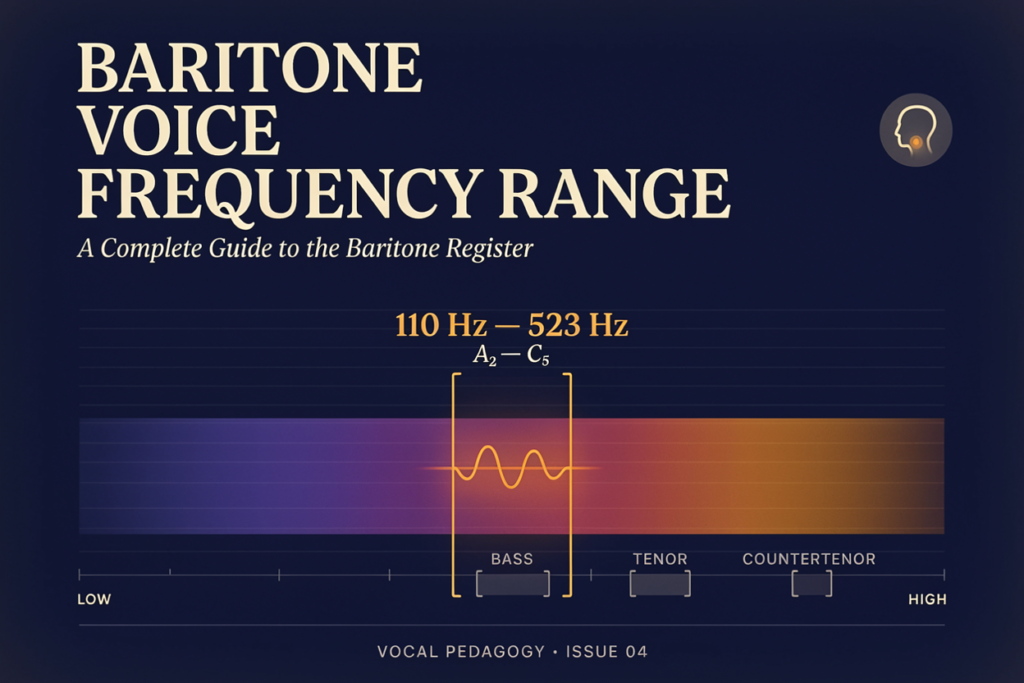
A baritone voice commonly spans about G2 to G4, approximately 98–392 Hz, although A2 to A4, approximately 110–440 Hz, is also widely used in operatic references. These limits are approximate because a true baritone classification depends on tessitura, timbre, vocal weight, and register transitions—not range alone.
Baritone sits between tenor and bass in the standard male voice categories. For a broader overview of how frequencies relate to vocal categories, see the guide to voice frequency by voice type.
What Is the Baritone Voice Frequency Range?
Common range: G2 to G4
G2 to G4 covers two octaves. This range appears often in practical singing references, choir discussions, and general voice-classification guides.
Operatic range: A2 to A4
A2 to A4 is a common operatic reference range for baritone roles. This reflects the demands of classical repertoire, where projection, sustained tone, and comfortable tessitura matter as much as the ability to touch individual notes.
Why different sources give different ranges
Different sources may describe total range, written range, expected repertoire, or comfortable tessitura. These are not always the same.
A choral arrangement may ask for lower notes, while contemporary singing may extend higher through mix or falsetto.
Baritone Note-to-Frequency Chart
The following frequencies assume standard tuning where A4 equals 440 Hz.
| Note | Approximate frequency |
|---|---|
| F2 | 87.31 Hz |
| G2 | 98.00 Hz |
| A2 | 110.00 Hz |
| B2 | 123.47 Hz |
| C3 | 130.81 Hz |
| D3 | 146.83 Hz |
| E3 | 164.81 Hz |
| F3 | 174.61 Hz |
| G3 | 196.00 Hz |
| A3 | 220.00 Hz |
| B3 | 246.94 Hz |
| C4 | 261.63 Hz |
| D4 | 293.66 Hz |
| E4 | 329.63 Hz |
| F4 | 349.23 Hz |
| G4 | 392.00 Hz |
| A4 | 440.00 Hz |
These numbers describe the fundamental frequency of each note. The full sound of a voice also contains harmonics above that fundamental. The explanation of fundamental frequency in voice helps separate the note itself from the higher frequencies that shape tone.
How Does Baritone Compare With Bass and Tenor?
Baritone occupies the middle area between bass and tenor, but the ranges overlap. Voice type is therefore determined by more than the highest and lowest notes a singer can produce.
| Voice type | Approximate common range | General vocal character |
| Bass | E2 to E4 | Lowest male voice, often dark and weighty |
| Baritone | G2 to G4 or A2 to A4 | Middle male voice, balanced depth and upper strength |
| Tenor | C3 to C5 | Higher male voice, often brighter and lighter |
Baritone versus bass
A bass usually has a lower comfortable center and more ease in the lower register. A baritone may occasionally reach bass notes, but those notes may lack the same stability, volume, or resonance.
The guide to the bass voice frequency range shows why shared notes do not make the classifications identical.
Baritone versus tenor
A tenor usually carries greater ease and brilliance in the upper register. A baritone may be able to sing some tenor notes, especially with training, but may not sustain them as comfortably.
This is why the upper limit alone is a weak classification test. A singer who reaches A4 once may still function as a baritone if the middle and lower range remain more comfortable.
Does Vocal Range Alone Make You a Baritone?
No. Vocal range alone does not establish baritone voice type. Tessitura, timbre, passaggio, vocal weight, and sustainable volume all contribute to classification.
Tessitura matters more than isolated notes
Tessitura is the range where your voice feels most comfortable and resonant over time. A singer may technically produce G2 and A4 but feel strongest between B2 and F4.
That comfortable center is often more useful than extreme notes. A range test records what is possible, while tessitura shows where the voice functions best.
Timbre and vocal weight
Timbre is the tonal character of a voice. Baritones often have more depth and weight than tenors, but usually less low-register heaviness than basses.
Passaggio and register transitions
Passaggio refers to the transition area where the voice shifts coordination between registers. Teachers often use the location and behavior of these transitions as part of classification.
Is Baritone Singing Frequency the Same as Speaking Frequency?
No. Baritone singing range and speaking frequency are different measurements. Speaking frequency describes the fundamental frequency used during ordinary speech, while singing range covers many separate musical pitches.
Adult male speech often centers around the lower part of the baritone note range, but a spoken average does not identify a singer’s voice type. A person can have a low speaking voice and still sing tenor, or have an average speaking pitch and sing baritone.
The overview of male voice frequency explains how speaking averages differ from singing classifications. It is also useful to understand the difference between frequency and perceived pitch, because a voice may sound deeper or brighter even when the measured F0 is similar.
What Are the Main Baritone Subtypes?
Baritone is not one uniform sound. Classical singing uses several subtypes based on tone, weight, tessitura, and repertoire.
Lyric baritone
A lyric baritone generally has a lighter, smoother tone and easier access to the upper part of the range. The voice may sound warm without being especially heavy.
Dramatic and Verdi baritone
A dramatic baritone has greater weight and power. A Verdi baritone is associated with demanding operatic roles that require strong upper notes, projection, and dramatic intensity.
Bass-baritone
A bass-baritone combines baritone flexibility with greater low-register strength. The voice may overlap considerably with bass repertoire.
High baritone and baritenor
A high baritone or baritenor sits near the border between baritone and tenor. ## How Can You Check Whether You Are a Baritone?
You can estimate your likely voice type by testing comfortable, repeatable notes and identifying your tessitura. An online or at-home check is only an estimate, not a professional classification.
- Warm up gently before testing.
- Find your lowest clear note without vocal fry.
- Find your highest sustainable note without shouting.
- Sing scales through the middle of your range.
- Notice where the voice feels easiest and most resonant.
- Repeat the test on several days.
A pitch detector can help identify notes. The guide to checking your voice frequency explains how to collect a more consistent measurement.
Consider two singers who can both sing G2 to A4. Singer one feels strongest from A2 to E4 and struggles above F4. Singer two feels strongest from C3 to G4 and carries a lighter tone. ## Common Baritone Range Myths
Every baritone must sing exactly G2 to G4
Reality: G2 to G4 is a useful reference, not a fixed rule. Individual baritones may extend beyond either boundary.
Reaching A4 makes someone a tenor
Reality: One high note does not determine voice type. Comfort, tone, tessitura, and register behavior matter more.
A deep speaking voice means bass
Reality: Speaking pitch and singing classification are related only loosely. A low speaking voice does not automatically make someone a bass.
The lowest note determines voice type
Reality: Low notes can be produced through vocal fry or temporary extension. Classification depends on the full functional range.
The guide to the human voice frequency range shows how much overlap exists across voices.
Frequently Asked Questions
What is the baritone voice frequency range in hertz?
A common baritone range is approximately 98–392 Hz, corresponding to G2–G4. An operatic reference of about 110–440 Hz, or A2–A4, is also widely used.
Is G2 to G4 or A2 to A4 correct?
Both can be correct depending on context. G2–G4 is common in general references, while A2–A4 is often used for operatic baritone classification.
Can a baritone sing above A4?
Yes. Some trained baritones can sing above A4, especially in mixed voice or falsetto. The ability to reach those notes does not automatically make the singer a tenor.
How can you tell a baritone from a tenor?
A baritone usually has a lower tessitura, heavier timbre, and more comfort in the middle-low register. A tenor generally has greater ease and brightness higher in the range.
Does a low speaking voice mean you are a baritone?
Not necessarily. Speaking F0 does not reliably determine singing voice type because singing requires a much broader range and different coordination.
What is the difference between baritone and bass-baritone?
A bass-baritone typically has stronger access to low notes and a darker vocal weight than a standard baritone. However, the categories overlap, and repertoire suitability is often the deciding factor.

Bobby is a voice analysis and vocal testing writer at VoiceFrequencyTest. He focuses on vocal frequency analysis, pitch recognition, voice measurement tools, and singing education for vocalists, musicians, creators, and beginners.