
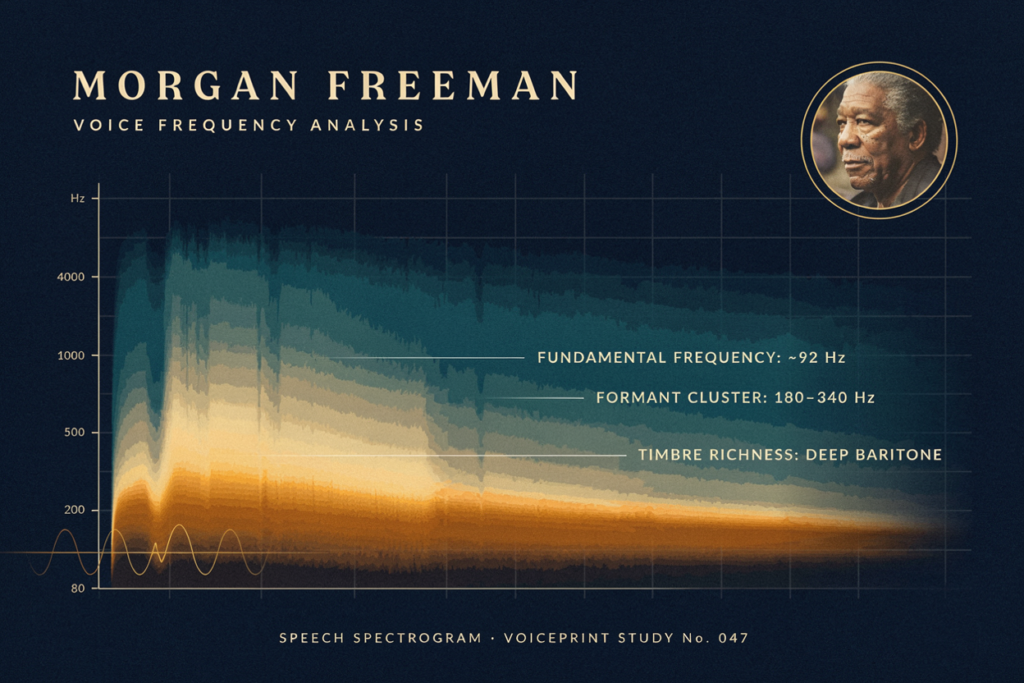
Public estimates commonly place Morgan Freeman’s speaking frequency near 96 Hz, approximately around the musical note G2. However, no peer-reviewed acoustic study confirming one exact value was located, and his pitch naturally changes throughout every sentence.
His recognizable sound also depends on resonance, vocal texture, articulation, pacing, and familiar narration.
What Is Morgan Freeman’s Voice Frequency?
Morgan Freeman’s median speaking frequency is often estimated at about 96 Hz. That figure should be treated as an approximate third-party measurement rather than an official or permanent value.
Fundamental frequency, abbreviated F0, measures vocal-fold vibration cycles per second. A 96 Hz reading means roughly 96 cycles per second during the measured speech.
For a fuller explanation of the term, see how fundamental frequency works in the human voice.
Why 96 Hz is only an estimate
The repeated 96 Hz figure does not appear to come from a published peer-reviewed acoustic study. Pages citing it usually do not identify the recording, software, settings, or statistical method.
Different samples can produce different averages, and Freeman’s pitch rises and falls with emphasis, emotion, and sentence structure.
Where 96 Hz sits musically
A frequency near 96 Hz falls close to G2, which is about 98 Hz in standard equal temperament.
| Frequency | Approximate note | Reference |
|---|---|---|
| 82.4 Hz | E2 | Low bass-region note |
| 98.0 Hz | G2 | Close to the reported estimate |
| 110 Hz | A2 | Common low male reference |
| 130.8 Hz | C3 | Higher low-register reference |
Speech moves continuously between frequencies, so the estimate is not equivalent to one sustained musical note.
Is Morgan Freeman’s Voice Bass or Baritone?
Morgan Freeman’s speaking voice is often described as baritone-like because of its low pitch, warmth, and resonance. However, baritone and bass are formal singing classifications that cannot be confirmed from one speaking-frequency estimate.
Singing classification depends on range, tessitura, timbre, and register transitions. Speaking near G2 does not automatically make someone a bass.
The distinction becomes clearer when comparing the estimate with a typical baritone frequency range.
Speaking pitch versus singing voice type
Speaking F0 describes conversational pitch, while singing voice type describes behavior across a musical range. A baritone may speak relatively high, and a tenor may speak relatively low. Freeman can therefore be called baritone-like without assigning a formal classical category.
Why Does Morgan Freeman’s Voice Sound So Deep?
Morgan Freeman’s voice sounds deep partly because of a low average fundamental frequency, but resonance and timbre are equally important. Two speakers can both average around 96 Hz and still sound completely different.
Frequency sets the vibration rate, resonance shapes amplified harmonics, and timbre describes the resulting tonal character.
For a detailed comparison, see how resonance differs from vocal frequency.
Resonance adds fullness
A low pitch without balanced resonance can sound dull or strained. Freeman’s relaxed production preserves fullness without the squeezed quality of forced depth.
Timbre makes the voice recognizable
Timbre includes texture, roughness, brightness, and harmonic balance. Freeman’s mature texture and long-term diction training help make the voice recognizable.
What Makes Morgan Freeman’s Voice Sound Authoritative?
Morgan Freeman’s voice sounds authoritative because low pitch is combined with measured pacing, clear articulation, controlled pauses, and steady delivery. Frequency supports the effect, but technique completes it.
Listeners often associate lower-pitched male voices with strength and competence, though these are impressions rather than proof of character. Freeman’s familiar roles as narrators, leaders, mentors, and God also reinforce the association.
Clear final consonants
Freeman has credited a diction instructor with teaching distinct speech and clear final consonants. That precision keeps his relaxed, low delivery intelligible.
Controlled pacing and pauses
Freeman rarely sounds rushed. Strategic pauses organize ideas, preserve resonance, and create an impression of calm control.
Did Morgan Freeman Train His Voice?
Yes. Morgan Freeman has repeatedly credited formal voice and diction training with helping him develop his distinctive delivery.
He has said an instructor taught clear speech, final consonants, relaxation, and exercises for a lower working register. His lesson is not to copy an exact pitch, but to reduce unnecessary tension and speak clearly.
How Could Morgan Freeman’s Frequency Be Measured?
A reliable estimate requires a clean recording with little music, noise, reverberation, or overlapping speech.
A practical process would be:
- Select a clean interview recording.
- Remove sections with laughter, music, or other speakers.
- Analyze at least 20 to 30 seconds of natural speech.
- Exclude obvious vocal fry and tracking errors.
- Calculate median F0 rather than choosing one instant.
- Repeat with several recordings.
Median F0 is more useful than one instant because speech naturally contains peaks and dips.
The general acoustic process is explained in how voice frequency is measured.
Why different recordings give different results
Microphones, room acoustics, emotion, fatigue, and sentence type can change results. Software may also track a harmonic and report an octave error, so browser-based values remain estimates.
Can You Develop a Voice Like Morgan Freeman’s?
You can develop similar delivery qualities, but you cannot copy Freeman’s anatomy or guarantee the same frequency. Aim for a relaxed, resonant version of your own voice.
Useful areas to practice include:
- comfortable breath support
- clear final consonants
- moderate speaking pace
- deliberate pauses
- relaxed jaw and throat
- natural resonance
- stable volume
Gentle humming, lip trills, and easy reading aloud may help warm the voice. A mild yawn-like release can reduce tension without being held during speech.
For safer guidance, see how to deepen your voice naturally.
What Should You Avoid When Trying to Sound Deeper?
Avoid pushing the larynx down, squeezing the throat, speaking constantly in vocal fry, or forcing notes below your range. These methods can cause fatigue and strain.
A healthy deep voice feels comfortable and clear. Better articulation, pacing, and resonance often matter more than reaching the lowest Hz value.
Morgan Freeman’s Voice: Frequency vs Other Qualities
| Vocal quality | What it describes | Contribution to his sound |
| Fundamental frequency | Vocal-fold vibration rate | Low perceived pitch |
| Resonance | Harmonics amplified by the vocal tract | Fullness and richness |
| Timbre | Overall tonal character | Recognizable texture |
| Articulation | Clarity of words and consonants | Intelligibility |
| Prosody | Rhythm, stress, and pitch movement | Narrative flow |
| Pacing | Speech speed and pauses | Calm authority |
The wider context for comparing public voices appears in this guide to celebrity voice frequencies.
Common Myths About Morgan Freeman’s Voice
Myth: His voice is always exactly 96 Hz
Speech frequency changes continuously. The 96 Hz figure is best treated as an unverified estimate of a central or median speaking pitch.
Myth: Frequency alone creates his sound
Frequency contributes to depth, but resonance, timbre, articulation, pacing, and familiarity are equally important.
Myth: Anyone who reaches 96 Hz will sound like him
Two speakers at the same frequency can have completely different vocal-tract shapes, harmonics, accents, textures, and speaking styles.
Myth: Forcing the throat down creates a better voice
Artificially lowering the larynx can create tension. Relaxation and efficient resonance are safer than pushing for the lowest possible pitch.
Frequently Asked Questions
What Hz is Morgan Freeman’s voice?
Public estimates commonly place his median speaking pitch near 96 Hz, close to G2. The figure has not been confirmed by a transparent peer-reviewed acoustic study.
Is Morgan Freeman a bass or baritone?
His speaking voice is often described as deep or baritone-like. A formal bass or baritone classification would require analysis of his singing range, tessitura, timbre, and register transitions.
Why does Morgan Freeman’s voice sound so deep?
His relatively low pitch combines with rich resonance, mature timbre, relaxed production, clear diction, and controlled pacing. Frequency alone does not explain the sound.
Did Morgan Freeman train his voice?
Yes. Freeman has credited a voice and diction instructor with teaching him relaxation, distinct speech, final-consonant clarity, and voice-lowering exercises.
Can someone naturally lower their voice to 96 Hz?
Some people can comfortably speak near that frequency, while others cannot because anatomy and natural range differ. Training should improve relaxation and resonance rather than force an exact number.
Does a 96 Hz voice automatically sound authoritative?
No. Authority also depends on articulation, pacing, loudness, resonance, wording, context, and listener expectations.
Bobby is a voice analysis and vocal testing writer at VoiceFrequencyTest. He focuses on vocal frequency analysis, pitch recognition, voice measurement tools, and singing education for vocalists, musicians, creators, and beginners.