
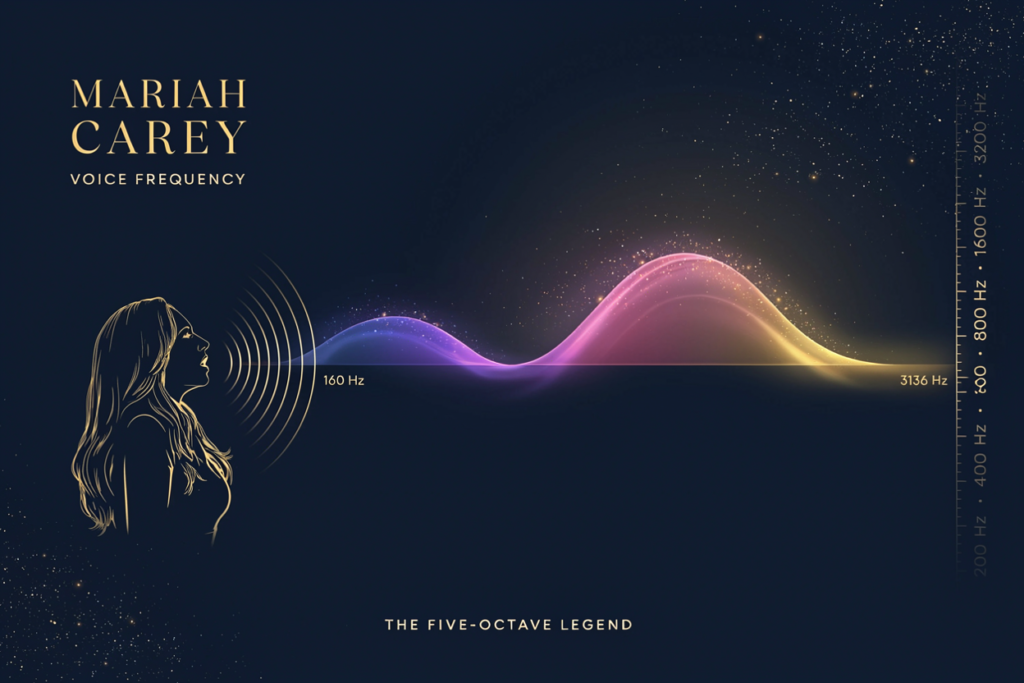
Mariah Carey’s voice frequency range is commonly described as roughly F2 to G7, corresponding to fundamental frequencies of about 87 Hz to 3,136 Hz under A4 = 440 Hz tuning. That reported span is slightly more than five octaves, but the endpoints come from analyses of recordings and performances rather than a standardized clinical test.
Carey is known not only for high notes, but for moving between a dark lower register, powerful belts, agile runs, breathy textures, and whistle-register tones. The Recording Academy has described her five-octave range and signature whistle register as defining features of her sound.
What Is Mariah Carey’s Voice Frequency Range?
Mariah Carey’s commonly cited recorded range is approximately F2–G7. F2 has a fundamental frequency of about 87.3 Hz, while G7 is about 3,136 Hz.
| Range point | Note | Approximate frequency |
|---|---|---|
| Commonly cited lowest note | F2 | 87.3 Hz |
| Middle C | C4 | 261.6 Hz |
| Standard tuning reference | A4 | 440 Hz |
| Upper soprano reference | C6 | 1,046.5 Hz |
| Commonly cited highest note | G7 | 3,136 Hz |
These figures describe pitch fundamentals, not the voice’s entire sound spectrum. Every sung note also contains harmonics and resonance energy at higher frequencies. The guide to fundamental frequency in the voice explains this distinction.
Celebrity range claims should be treated carefully. Analysts may count different studio takes, live performances, background layers, effects, or briefly produced sounds. “Approximately F2–G7” is therefore safer than presenting the boundaries as laboratory-certified limits.
How Wide Is Mariah Carey’s Vocal Range?
F2 to G7 spans five octaves plus a whole tone. Moving from F2 to F7 covers five complete octaves, and G7 sits two semitones above F7.
Maximum Range Is Not Tessitura
Maximum range means the lowest and highest pitches a singer can produce. Tessitura is the narrower area where the voice remains comfortable, repeatable, and musically useful.
A low F2, a sustained belt, a head-dominant note, and a G7 whistle tone use different vocal coordinations. They should not be interpreted as equally comfortable parts of one continuous register.
For comparison, see the site’s overview of voice frequency in singers.
Mariah Carey’s Range in Notes and Hertz
| Note | Approximate frequency | General context |
| F2 | 87.3 Hz | Reported low extreme |
| C3 | 130.8 Hz | Low register |
| C4 | 261.6 Hz | Middle C |
| A4 | 440 Hz | Standard tuning reference |
| C5 | 523.3 Hz | Upper-middle range |
| C6 | 1,046.5 Hz | High soprano territory |
| F6 | 1,397 Hz | Very high register |
| G7 | 3,136 Hz | Reported whistle extreme |
Frequency doubles every octave. C5 is twice the frequency of C4, and C6 is twice the frequency of C5.
The broader human voice frequency range provides context for how these values compare with more typical voices.
What Is Mariah Carey’s Highest Note?
Mariah Carey’s most commonly cited highest note is G7, a whistle-register pitch near 3,136 Hz. “Emotions” is frequently associated with her extreme upper range and signature whistle effects.
Why Highest-Note Claims Differ
Some range compilations report slightly different top notes. Disagreement can arise from live variations, studio layering, background vocals, pitch-shifted audio, tuning references, or software detecting a harmonic instead of the fundamental.
A brief sound in a recording also does not necessarily represent a comfortable, repeatable note. The safest conclusion is that Carey has demonstrated an unusually extensive whistle register, while the exact endpoint depends on which source and performance are counted.
The guide to high-pitched voice frequency explains how note frequency rises in the upper range.
What Is Mariah Carey’s Lowest Note?
F2, approximately 87.3 Hz, is often cited as the lower boundary of Carey’s recorded range. This low fundamental should not be assumed to represent the center of her singing voice.
Carey’s lower register is often described as husky or alto-like, while her whistle register has a thin, piercing quality. The contrast between those sounds contributes to the perception of an exceptionally wide range.
Producing F2 does not automatically make a singer a contralto. Voice classification depends on tessitura, timbre, vocal weight, register transitions, and repertoire.
How Does Mariah Carey Produce Whistle Notes?
The whistle register is the highest vocal register used in singing. It produces very high pitches with a coordination different from ordinary chest-dominant or head-dominant singing.
The exact physiological behavior can vary, and casual listeners cannot determine it accurately from a finished recording. It is therefore better to describe the audible result than claim one anatomical mechanism for every whistle note.
Frequency Is Only Part of the Sound
A G7 can be described as about 3,136 Hz, but frequency alone does not explain its tone. Loudness, resonance, airflow, onset, vibrato, and production all affect what listeners hear.
The difference between voice resonance and frequency is relevant here. Pitch identifies the note, while resonance shapes its color and projection.
Whistle notes should not be forced. Pain, burning, persistent hoarseness, or loss of range are signs to stop.
Is Mariah Carey an Alto or a Soprano?
Mariah Carey has described herself as an alto, while critics and commentators have also called her a soprano or lyric coloratura soprano. These labels reflect different classification approaches.
“Alto” often refers to a choral part or lower vocal identity in non-classical discussion. “Soprano” may describe the height, agility, and upper extension of Carey’s singing.
Applying a strict classical Fach label to a pop singer can be misleading because pop repertoire uses microphones, stylistic registration, studio layering, and effects differently from opera. Range alone cannot decide the issue.
What Makes Mariah Carey’s Voice Distinctive Beyond Frequency?
Carey’s importance comes from musical control, not merely octave count. Her style combines melisma, precise runs, register contrast, dynamic changes, breathy intimacy, resonant belting, and layered background vocals.
Melisma and Vocal Runs
Melisma means singing several notes on one syllable. “Vision of Love” became especially influential for its agile ornamentation and expressive pitch movement.
These passages require rhythmic accuracy, coordination, and clean transitions. A large range is useful, but the musical value comes from how the notes are shaped.
Belting, Texture, and Layering
Carey often contrasts strong chest-dominant phrases with softer lines and whistle-register accents. Her recordings also use stacked harmonies and detailed vocal arrangements.
A celebrity voice Hz comparison can describe pitch boundaries but cannot fully represent her artistry.
Can Mariah Carey’s Voice Frequency Be Measured From a Recording?
Pitch-tracking software can estimate fundamental frequency from an isolated vocal signal, but commercial recordings create complications. Instruments, harmonies, reverberation, distortion, and layered vocals can confuse the analysis.
Software may make octave errors by identifying a harmonic instead of the true fundamental. Studio pitch correction or tape-speed changes can also affect the measured value.
The guide to how voice frequency is measured explains why results from finished songs are estimates rather than clinical measurements.
Frequently Asked Questions
What is Mariah Carey’s vocal range in hertz?
Her commonly cited recorded range is approximately 87 Hz to 3,136 Hz, corresponding to F2–G7 under A4 = 440 Hz tuning.
How many octaves can Mariah Carey sing?
She is widely described as having a five-octave range. The frequently cited F2–G7 span is slightly more than five octaves.
What frequency is Mariah Carey’s G7?
G7 has a fundamental frequency of approximately 3,136 Hz in standard tuning.
Does Mariah Carey have the highest voice ever recorded?
She has one of popular music’s most famous extended ranges, but absolute records depend on measurement rules, accepted registers, and which recordings are counted.
Is Mariah Carey an alto or a soprano?
Carey has called herself an alto, while some commentators classify her as a soprano. Her pop technique and unusually broad range make one strict label difficult to apply.
Can training create a five-octave range?
Training can improve coordination and expand usable range, but anatomy and individual development affect each singer’s limits. Most singers do not need five octaves to perform at a high level.

Bobby is a voice analysis and vocal testing writer at VoiceFrequencyTest. He focuses on vocal frequency analysis, pitch recognition, voice measurement tools, and singing education for vocalists, musicians, creators, and beginners.