
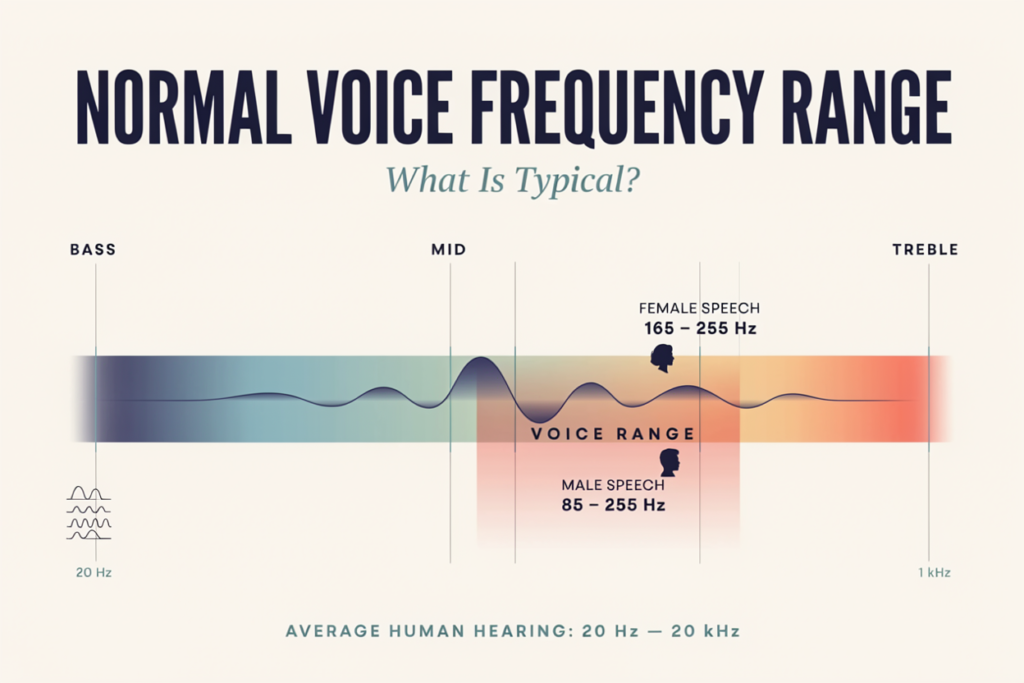
Normal voice frequency range usually refers to fundamental frequency, or F0—the rate at which the vocal folds repeat their vibration cycle. In everyday speech, adult male voices often average around 100–120 Hz, adult female voices often average around 195–220 Hz, and children commonly average around 250–280 Hz.
Learning how fundamental frequency is created makes it easier to interpret any voice-frequency reading correctly.
What Is a Normal Voice Frequency Range?
Normal adult speaking fundamental frequency averages roughly 100–120 Hz for men and about 195–220 Hz for women, while children commonly average around 250–280 Hz. Healthy individual values vary widely and overlap, so these figures are reference ranges rather than diagnostic limits.
Normal Adult Male Voice Frequency
Adult male speech often centers around 100–120 Hz, although individual averages may fall well below or above that region. Research has reported healthy male mean values ranging from roughly 78 to 182 Hz.
For more detail, see typical frequency patterns in adult male speech.
Normal Adult Female Voice Frequency
Adult female speech commonly averages around 195–220 Hz, but the healthy range is broad. Published individual means have extended from roughly 126 to 307 Hz.
A deeper breakdown of average frequency values reported for female voices provides more context.
Normal Voice Frequency in Children
Children usually have higher fundamental frequencies because their vocal folds are shorter and lighter. Studies often place average values around 250–280 Hz, although age and speaking activity can shift the result.
Before puberty, boys’ and girls’ voice frequencies overlap substantially. Pubertal growth then changes vocal-fold size and habitual pitch at different rates for different individuals.
Normal Voice Frequency Range Chart
The table below provides educational reference values rather than diagnostic thresholds.
| Group | Approximate average speaking F0 | Broad reference region | Important limitation |
|---|---|---|---|
| Adult men | About 100–120 Hz | Roughly 80–180 Hz | Fry and delivery style may lower results |
| Adult women | About 195–220 Hz | Roughly 125–310 Hz | Large natural variation exists |
| Children | About 250–280 Hz | Often roughly 180–350+ Hz | Age and speaking task strongly affect F0 |
What Does Voice Frequency Actually Measure?
Most voice apps report fundamental frequency rather than the full frequency content of the voice.
Vocal-Fold Vibration
Hertz means cycles per second. If the vocal folds repeat their vibration pattern 120 times per second, the fundamental frequency is about 120 Hz.
Longer and heavier vocal folds usually vibrate more slowly, while shorter or more tense folds often vibrate faster.
Harmonics and Resonance
A 120 Hz voice contains much more than one frequency. It also produces harmonics at higher multiples, while the throat and mouth shape those harmonics through resonance.
That is why two people with the same F0 can sound completely different.
Frequency vs. Perceived Pitch
Fundamental frequency strongly influences perceived pitch, but the full vocal impression also depends on intonation, resonance, loudness, and harmonic balance.
Why Does Normal Voice Frequency Vary?
Normal voice frequency varies because anatomy, hormones, age, language, emotion, health, and speaking behavior all influence vocal-fold vibration.
Anatomy and Vocal-Fold Size
Longer, thicker vocal folds usually produce lower frequencies. Shorter, lighter folds usually produce higher frequencies.
Age and Puberty
Children generally begin with higher F0 values. During puberty, vocal-fold growth often lowers habitual pitch, especially when the larynx grows substantially.
Voice frequency can continue changing in adulthood and later life. The guide to how voice frequency changes across age groups explains these shifts in more detail.
Emotion and Speaking Style
Excitement, stress, surprise, questioning intonation, and louder speech often raise F0. Calm, tired, authoritative, or deliberately lowered speech may reduce it.
Language and Cultural Patterns
Habitual pitch also varies across languages, dialects, professional settings, and social contexts. The same person may use a different pitch pattern at home, at work, or while performing.
Speaking Frequency vs. Singing Range
Speaking frequency and singing range are different measurements.
| Measurement | What it describes | Best test material |
| Average speaking F0 | Central conversational pitch | Reading or spontaneous speech |
| Speech pitch range | Lowest-to-highest movement in speech | Longer connected sample |
| Sustained-vowel F0 | One held vocal sound | Steady vowel |
| Singing range | Lowest and highest usable notes | Scales or songs |
| Voice spectrum | Fundamental, harmonics, and noise | Spectral analysis |
Habitual speaking frequency describes the center of conversational pitch. The wider pitch movement used during speech may extend far above and below that average.
How Is Normal Voice Frequency Measured?
Sustained Vowel Testing
Holding a comfortable vowel can produce a steady reading, but it may not represent everyday speech.
Reading and Conversational Samples
A 30-second reading or natural speech sample usually provides a better estimate of habitual F0.
Mean vs. Median Frequency
The mean adds all valid readings and divides by the number of measurements. The median identifies the middle value.
Median F0 may be more stable when a recording contains brief fry, squeaks, or tracking errors.
Phone and Browser Limitations
Background noise, microphone filtering, room reflections, distance, and octave errors can affect results.
Is a Voice Outside the Average Range Abnormal?
Natural Individual Variation
Healthy male and female speaking frequencies overlap considerably. The overlap between male and female speaking frequencies shows why pitch alone cannot determine identity, sex, gender, age, or health.
a person may briefly produce 90 Hz during vocal fry but speak around 125 Hz in normal conversation. The 90 Hz minimum does not define the person’s habitual voice.
Deliberate Pitch Changes
Actors, singers, broadcasters, and other speakers may adjust pitch for style or communication. People may also modify habitual pitch as part of gender expression or personal preference.
When a Change May Need Attention
A sudden or persistent pitch change may deserve professional assessment when it occurs with pain, hoarseness, breathiness, vocal fatigue, or loss of range.
The relationship between frequency changes and vocal-fold health is more important than whether a number sits slightly outside an online chart.
How to Check Your Normal Speaking Frequency
1. Record at Least 30 Seconds
Use natural conversation or a reading passage rather than one word or one held note.
2. Use a Quiet Room
3. Check Median or Average F0
Do not rely on the lowest or highest instant shown by the app.
4. Repeat on Different Days
5. Treat the Result as an Estimate
You can measure your habitual speaking pitch and compare it with broad references, but do not use one reading as a diagnosis.
Common Myths About Normal Voice Frequency
| Myth | Reality |
| Every healthy man speaks below 150 Hz | Healthy male averages vary widely |
| Every healthy woman speaks above 165 Hz | Healthy female values can fall below that point |
| One reading reveals sex or gender | Frequency ranges overlap substantially |
| A high voice is automatically unhealthy | High pitch may be natural and comfortable |
| A low app result proves a bass voice | Voice type depends on more than speaking F0 |
| Speaking frequency equals singing range | They measure different vocal tasks |
| Any value outside a chart is abnormal | Reference ranges are not diagnostic cutoffs |
Frequently Asked Questions
What is a normal male voice frequency?
Adult male speech often averages around 100–120 Hz, with broad healthy variation roughly between 80 and 180 Hz across individuals.
What is a normal female voice frequency?
Adult female speech often averages around 195–220 Hz, but healthy individual means may extend from about 125 to 310 Hz.
What is a normal voice frequency for a child?
Children commonly average around 250–280 Hz, although age, activity, emotion, and speaking context can shift the result.
Do normal male and female frequency ranges overlap?
Yes. Healthy male and female frequencies overlap, so voice frequency alone cannot classify a person reliably.
Why does my result change between tests?
Your pitch changes with emotion, speaking task, time of day, microphone conditions, and vocal register. Short samples also create less stable results.
Is a voice outside the average range unhealthy?
Not necessarily. A frequency becomes more concerning when a persistent change appears with pain, hoarseness, fatigue, breathiness, or loss of vocal ability.

Bobby is a voice analysis and vocal testing writer at VoiceFrequencyTest. He focuses on vocal frequency analysis, pitch recognition, voice measurement tools, and singing education for vocalists, musicians, creators, and beginners.