
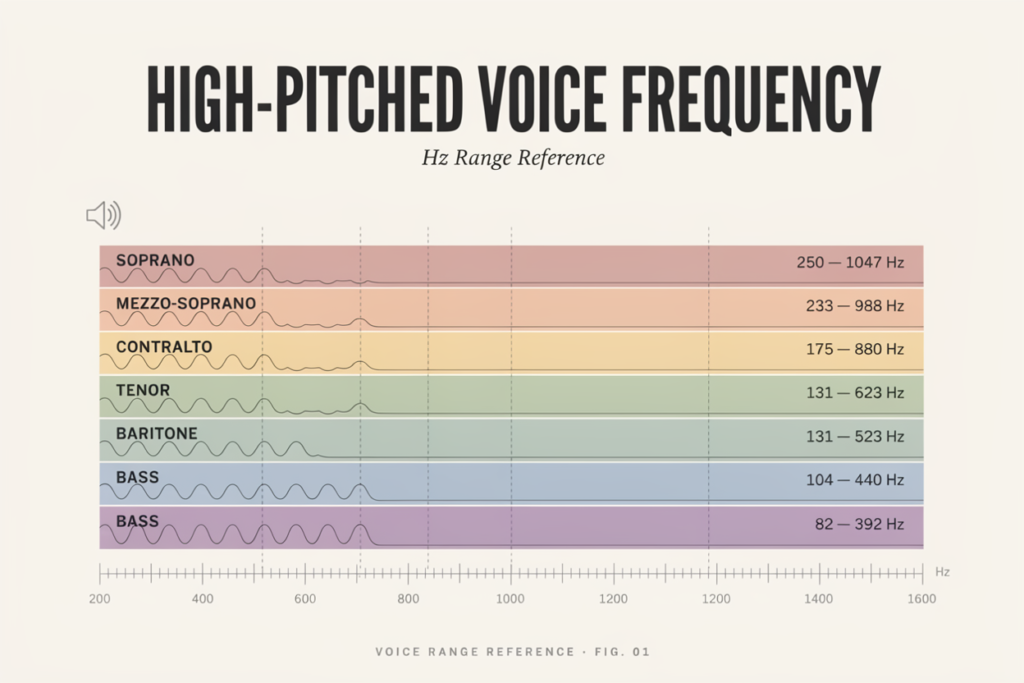
A high-pitched voice does not begin at one universal frequency. In conversational speech, a voice sounds high when its fundamental frequency sits above the usual range for that speaker’s age, anatomy, and speaking pattern. In singing, high pitches commonly extend above 500 Hz, while soprano and whistle-register notes can rise beyond 1,000 Hz or even 2,000 Hz.
Fundamental frequency, often written as F0, is the vibration rate of the vocal folds during voiced sound. It is measured in hertz, where one hertz equals one vibration per second.
What Frequency Is Considered a High-Pitched Voice?
A high-pitched speaking voice is best identified relative to normal speaking ranges rather than by one strict cutoff. Adult male speech commonly centers lower than adult female speech, while children speak at higher frequencies.
A reading near 250 Hz may sound high for many adult male speakers, fall within or near the upper part of an adult female speaking range, and be ordinary for a child. Context matters.
For a broader baseline, compare your result with the site’s normal voice frequency range.
High-Pitched Voice Frequency Chart
This chart separates conversational speech from singing because the same frequency can mean different things in each context.
| Voice context | Approximate frequency reference | Interpretation |
|---|---|---|
| Adult male speech | About 85–180 Hz | Above this range may sound high for many male speakers |
| Adult female speech | About 165–255 Hz | Upper values may sound bright or high |
| Children’s speech | About 250–400 Hz | Naturally higher because of smaller vocal anatomy |
| Tenor singing | Roughly 131–523 Hz | Upper notes extend well above speech |
| Contralto singing | Roughly 175–698 Hz | Singing range overlaps several voice types |
| Mezzo-soprano singing | Roughly 220–880 Hz | High notes may approach 900 Hz |
| Soprano singing | Roughly 262–1,047 Hz | C6 is about 1,047 Hz |
| Whistle register | Often above 1,000 Hz | Extreme notes may exceed 2,000 Hz |
These are approximate reference ranges, not diagnostic limits. See the voice frequency chart for a wider comparison.
Common High Notes in Hertz
| Musical note | Approximate frequency |
| C4 | 261.6 Hz |
| A4 | 440 Hz |
| C5 | 523.3 Hz |
| A5 | 880 Hz |
| C6 | 1,046.5 Hz |
| C7 | 2,093 Hz |
| G7 | 3,136 Hz |
Frequency doubles every octave. C5 is twice the frequency of C4, and C6 is twice the frequency of C5.
What Makes a Voice Sound High-Pitched?
A voice sounds high when the vocal folds vibrate rapidly. Smaller, thinner, or more tightly stretched vocal folds generally vibrate faster and produce a higher fundamental frequency.
Vocal-Fold Size and Tension
The vocal folds open and close repeatedly as air passes through the larynx. Increasing their tension can raise pitch, while greater effective mass generally lowers it.
The article on fundamental frequency in the voice explains how F0 relates to vocal-fold vibration.
Age, Puberty, and Anatomy
Children usually have higher voices because their vocal folds and vocal tracts are smaller. During puberty, vocal growth often lowers habitual pitch, though the amount varies between individuals.
Age, anatomy, hormones, and learned habits all affect pitch. See voice frequency during puberty for more detail.
High Pitch vs. Bright Voice
A high-pitched voice and a bright-sounding voice are not the same thing. Pitch is mainly determined by fundamental frequency, while brightness depends heavily on harmonics, formants, and vocal-tract resonance.
Two singers can produce the same A4 at 440 Hz but sound very different. One may sound warm and rounded, while the other sounds sharp and brilliant.
Fundamental Frequency Determines Pitch
Fundamental frequency identifies the main musical pitch. If the vocal folds vibrate about 440 times per second, the sound is close to A4 in standard tuning.
Resonance Shapes Tone Color
Resonance changes how strongly different frequencies are amplified. A voice with strong high-frequency energy may sound bright even when its fundamental is not especially high.
The distinction between voice resonance and frequency prevents the common mistake of treating brightness as proof of a high F0.
High-Pitched Speaking vs. High-Pitched Singing
Speaking and singing use the same anatomy differently. A frequency that sounds high in speech may be ordinary in singing.
Habitual Speaking Pitch
Habitual speaking pitch is the area used during natural conversation. It moves continuously with emphasis, emotion, questions, and sentence structure.
A single sustained vowel does not represent an entire speaking voice. A 30- to 60-second speech sample gives a more useful average.
Head Voice and Falsetto
Head voice and falsetto describe upper vocal coordination. Both can produce frequencies well above ordinary speech.
Register labels do not identify one exact frequency. A tenor and soprano may produce the same note using different vocal strategies.
Soprano and Whistle Register
Soprano singing commonly extends to C6, about 1,047 Hz. Some singers continue higher, and whistle-register notes may rise above 2,000 Hz.
These extreme frequencies are not part of normal conversational speech. They should also not be forced simply to reach an impressive number.
The comparison between voice frequency and pitch helps explain why register, note name, and frequency are related but not identical concepts.
Is a Naturally High-Pitched Voice Normal?
A naturally high-pitched voice can be normal. Healthy speaking frequencies vary widely, and some people consistently speak above population averages without discomfort or dysfunction.
Language, habit, and social environment can influence pitch. A high voice is not unhealthy simply because it falls outside an average.
Population averages also overlap. The article on male and female voice frequency shows why individual voices cannot always be placed neatly into one group.
When Can a High-Pitched Voice Signal a Problem?
A high pitch becomes more concerning when it changes suddenly, feels forced, or appears with pain, hoarseness, weakness, breathiness, fatigue, or repeated pitch breaks.
Sudden or Persistent Change
A sudden pitch increase may follow illness, overuse, stress, or inflammation. Persistent unexplained changes deserve attention.
High Pitch After Puberty
Some people continue using a high speaking pattern after puberty despite having the anatomy to produce a lower habitual pitch. This functional pattern is sometimes called puberphonia or mutational falsetto.
A frequency reading alone cannot diagnose it. Professional assessment may be appropriate when the voice feels uncomfortable or causes functional difficulty.
The site’s guide to voice frequency and vocal health explains when symptoms matter more than the number itself.
Can You Safely Lower a High-Pitched Voice?
A high voice should not be forced downward with throat pressure. Safer changes focus on comfortable breath flow, relaxed phonation, clear resonance, and gradual pitch exploration.
Speaking on an exaggerated low note can create tension and fatigue. A sustainable voice should feel easy, clear, and repeatable.
Voice therapy may help with habitual pitch or functional voice issues, especially when discomfort or hoarseness is present.
How to Measure a High-Pitched Voice
Record natural speech in a quiet room for 30 to 60 seconds. Keep the microphone distance and speaking volume consistent, then use a pitch-tracking tool to estimate average F0.
Test sustained singing notes separately. Do not combine a speech average with the highest note from a scale and treat them as the same measurement.
Repeat the test several times. Pitch varies with fatigue, illness, emotion, volume, and time of day.
Watch for Octave Errors
Pitch software can confuse the fundamental with a harmonic. A true 220 Hz sound may be reported as 440 Hz, or a 440 Hz sound may be reported as 220 Hz.
If a reading suddenly doubles or halves while the heard note barely changes, an octave-detection error may be responsible.
Frequently Asked Questions
Is 250 Hz a high-pitched voice?
It may be high for many adult male speakers, but it can fall within an adult female speaking range and may be ordinary for a child. Context is essential.
What is a high voice frequency for an adult male?
Adult male speech commonly falls around 85–180 Hz. Frequencies consistently above that range may sound high, though healthy variation exists.
What is a high voice frequency for an adult female?
Adult female speech commonly falls around 165–255 Hz. Values above this range may sound high, but one number cannot determine whether the voice is normal or strained.
Is a naturally high-pitched voice unhealthy?
No. A naturally high voice can be healthy when it feels comfortable and remains clear. Sudden change, pain, fatigue, or persistent hoarseness are more important warning signs.
How high can a soprano voice go?
A common soprano reference range extends to C6, about 1,047 Hz. Trained singers may go higher, especially in whistle register.
Can voice exercises lower speaking pitch?
Exercises may help someone explore a more comfortable lower pitch, but forcing the voice downward can create tension. Persistent concerns are best addressed with qualified professional guidance.

Bobby is a voice analysis and vocal testing writer at VoiceFrequencyTest. He focuses on vocal frequency analysis, pitch recognition, voice measurement tools, and singing education for vocalists, musicians, creators, and beginners.