
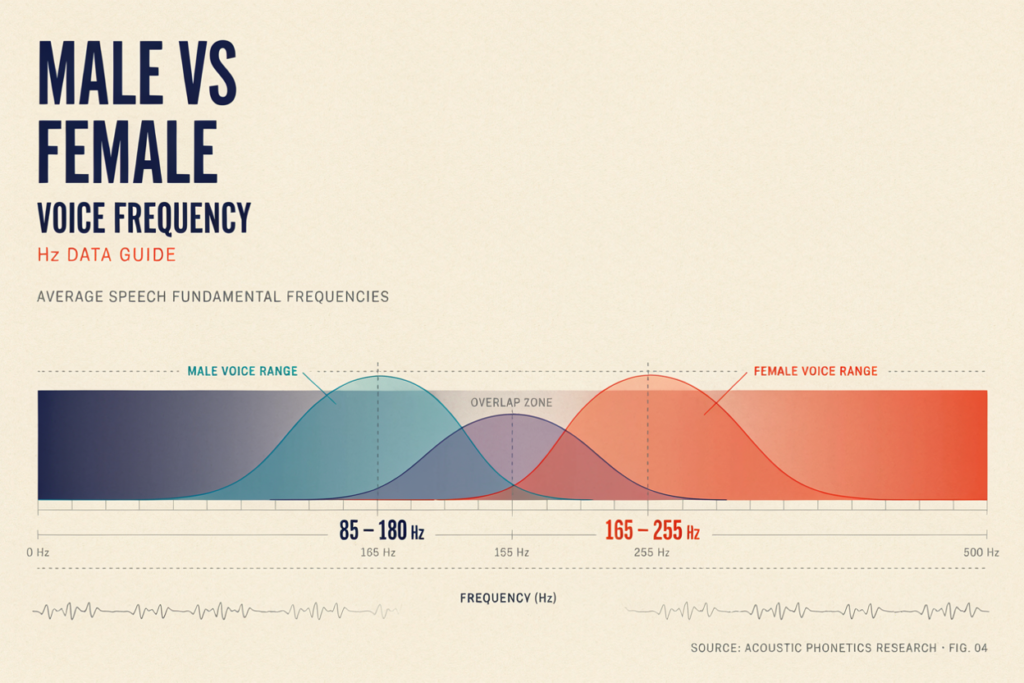
Adult male voices average 100–130 Hz in conversational speech, while adult female voices commonly average 180–220 Hz. These are population averages, not fixed boundaries: voices overlap, and frequency alone cannot reliably identify sex or gender.
The comparison usually refers to fundamental frequency, or F0—the rate at which the vocal folds repeat their vibration cycles. A vocal fold cycle repeating 120 times per second produces an F0 of 120 hertz. For a fuller explanation of this measurement, see how vocal-fold vibration creates fundamental frequency.
What Is the Difference Between Male and Female Voice Frequency?
The main average difference is that adult male vocal folds usually vibrate more slowly, producing a lower speaking F0, while adult female vocal folds usually vibrate faster, producing a higher F0. The Voice Foundation gives approximate reference points of 110 Hz for adult men and 180–220 Hz for adult women.
Typical male speaking frequency
An adult male speaking voice often centers roughly between 100 and 130 Hz. A commonly cited reference value is about 110 or 125 Hz, but the result depends on the speaker and the recording task. Reading a prepared passage, holding a vowel, speaking casually, and using vocal fry can all produce different statistics.
Frequency moves continuously during speech. Emphasis, questions, emotion, and sentence melody push individual moments above and below a person’s median F0. The average male voice frequency guide explores these variations in more detail.
Typical female speaking frequency
An adult female speaking voice commonly centers around 180–220 Hz. One published voice-analysis study reported group means of 112.0 Hz for male speakers and 195.8 Hz for female speakers, illustrating the average difference without establishing a universal cutoff.
Variation within each group is large. Age, anatomy, language, speaking habits, emotion, and sample type can shift the result. Figures in an adult female frequency reference are population tendencies, not pass-or-fail ranges.
Male vs Female Voice Frequency Comparison
Male and female voice frequencies differ on average, but speaking F0, singing range, resonance, and the full audio spectrum are separate measurements. Mixing them is the main reason online charts appear to contradict one another.
| Comparison point | Typical adult male pattern | Typical adult female pattern |
|---|---|---|
| Conversational F0 | Often about 100–130 Hz | Often about 180–220 Hz |
| Common reference value | About 110–125 Hz | About 200 Hz |
| Average perceived pitch | Lower | Higher |
| Vocal folds after puberty | Generally longer and thicker | Generally shorter and thinner |
| Vocal-tract resonances | Often lower formant frequencies | Often higher formant frequencies |
| Individual variation | Wide; overlaps female samples | Wide; overlaps male samples |
| Singing range | Depends on voice type and training | Depends on voice type and training |
A 110 Hz versus 220 Hz example
A voice at 220 Hz has twice the fundamental frequency of a voice at 110 Hz. A doubling of frequency equals one octave, so the two pitches are an octave apart even though the numerical difference is only 110 Hz.
This does not place every female voice an octave above every male voice; it only demonstrates the relationship between two values. A human voice frequency overview shows why real measurements cover broader, overlapping territory.
Frequency is not loudness
Frequency describes how rapidly a periodic vibration repeats; loudness relates more closely to sound-pressure level and perceived intensity. A 100 Hz voice can be quiet or loud, and a 220 Hz voice can be quiet or loud. Pitch and volume are independent dimensions, although changes in vocal effort can affect both during real speech.
Why Are Male Voices Usually Lower Than Female Voices?
Male voices are usually lower after puberty because androgen-driven laryngeal growth generally makes the vocal folds longer, thicker, and more massive. More mass tends to slow the repeating vibration, lowering F0, though vocal-fold tension and airflow also influence the pitch produced at any moment.
Changes during puberty
Every child’s larynx grows, but average growth is more pronounced in testosterone-dominant puberty. The vocal folds lengthen and thicken, and habitual pitch typically falls. Uneven change helps explain temporary pitch breaks. The article on how puberty affects voice frequency covers the process separately.
Tissue flexibility, hormones, muscle function, medications, and voice use can alter adult F0. A persistent change with hoarseness, pain, fatigue, or lost range matters more clinically than being above or below an average.
How resonance changes what listeners hear
The vocal folds supply the source vibration, but the throat and mouth filter that source. Formants—resonance peaks shaped by the vocal tract—help listeners recognize vowels and contribute to perceived vocal size and brightness. Because adult male vocal tracts are longer on average, their formants also tend to be lower on average.
Two people can therefore speak at the same F0 and still sound distinctly different. Harmonic balance, formants, breathiness, articulation, and intonation all shape timbre. This distinction between frequency and vocal-tract resonance explains why changing pitch alone does not reproduce another person’s voice.
Do Male and Female Voice Frequencies Overlap?
Yes. Male and female speaking frequencies overlap substantially at the individual level. Research samples have reported men’s mean F0 values from approximately 78–182 Hz and women’s from about 126–307 Hz, creating an overlapping region rather than a sharp boundary.
Why frequency cannot identify sex or gender reliably
A single Hz reading is not a reliable sex or gender test. ASHA notes that voices below roughly 130 Hz are more likely to be perceived as masculine and voices above roughly 180 Hz as feminine, but the broad middle region overlaps. Perception also depends on resonance, intonation, articulation, language, and culturally learned communication patterns.
This is why a value such as 160 Hz should not automatically be labeled male, female, or gender-neutral. It can only describe the measured F0 in a particular sample. The difference between voice frequency and perceived pitch is especially useful when interpreting results that sit between common averages.
Speaking frequency is not singing range
Habitual speaking F0 summarizes connected speech, whereas singing range covers the lowest and highest notes a singer can produce under stated conditions. Tessitura—the region where the voice remains comfortable and resonant—is narrower than the total range.
Tenor, alto, and other voice types can overlap in note frequency, and classification also considers tessitura, passaggi, timbre, and repertoire. Likewise, a recorded voice contains F0 plus many harmonics extending far above it. Calling the whole recording a “110 Hz voice” is shorthand for its fundamental, not a description of every frequency present.
How Can You Measure Voice Frequency?
Measure voice frequency by recording clean speech, estimating F0 throughout the voiced portions, and reporting a median or average rather than one instantaneous number. A sustained vowel is useful for stability, while connected speech better represents habitual pitch; using both gives more context.
- Record in a quiet room with the microphone at a consistent distance.
- Speak naturally for 20–30 seconds, then sustain a comfortable vowel for several seconds.
- Use pitch-analysis software that reports F0 in hertz.
- Review the median, average, low, and high values instead of keeping only one frame.
- Repeat the recording and compare the results for consistency.
Browser-based and at-home measurements are estimates, not laboratory assessments. Background noise, vocal fry, creaky voice, breathiness, and strong harmonics can make an algorithm report half or double the true F0—an octave error. Following a consistent voice-frequency measurement method makes comparisons more useful, but it does not turn the result into a diagnosis.
Frequently Asked Questions
What is the average male voice frequency?
Adult male conversational speech commonly averages about 100–130 Hz, with reference values near 110 or 125 Hz. Individual results can fall outside that band depending on age, anatomy, language, emotion, and measurement method.
What is the average female voice frequency?
Adult female conversational speech commonly averages about 180–220 Hz, with about 200 Hz often used as a reference value. This is a population tendency, not a required or universal range.
At what frequency does a voice sound gender-neutral?
There is no universal gender-neutral frequency. The approximate 130–180 Hz region is often described as perceptually ambiguous, but resonance, intonation, articulation, and cultural context can change how the same F0 is perceived.
Can a woman naturally have a lower frequency than a man?
Yes. The distributions overlap, so an individual woman can have a lower habitual F0 than an individual man. Frequency by itself does not determine sex, gender, health, or vocal ability.
Why do male and female voices sound different at the same pitch?
Voices at the same F0 can have different formant locations, harmonic balance, breathiness, articulation, and vocal-tract length. Those acoustic differences change timbre even when the perceived musical pitch matches.
Does voice frequency change with age?
Yes. Voice frequency changes during childhood and puberty and may continue shifting with aging, hormonal changes, tissue condition, and speaking habits. Population trends do not predict exactly how one person’s voice will develop.

Bobby is a voice analysis and vocal testing writer at VoiceFrequencyTest. He focuses on vocal frequency analysis, pitch recognition, voice measurement tools, and singing education for vocalists, musicians, creators, and beginners.