
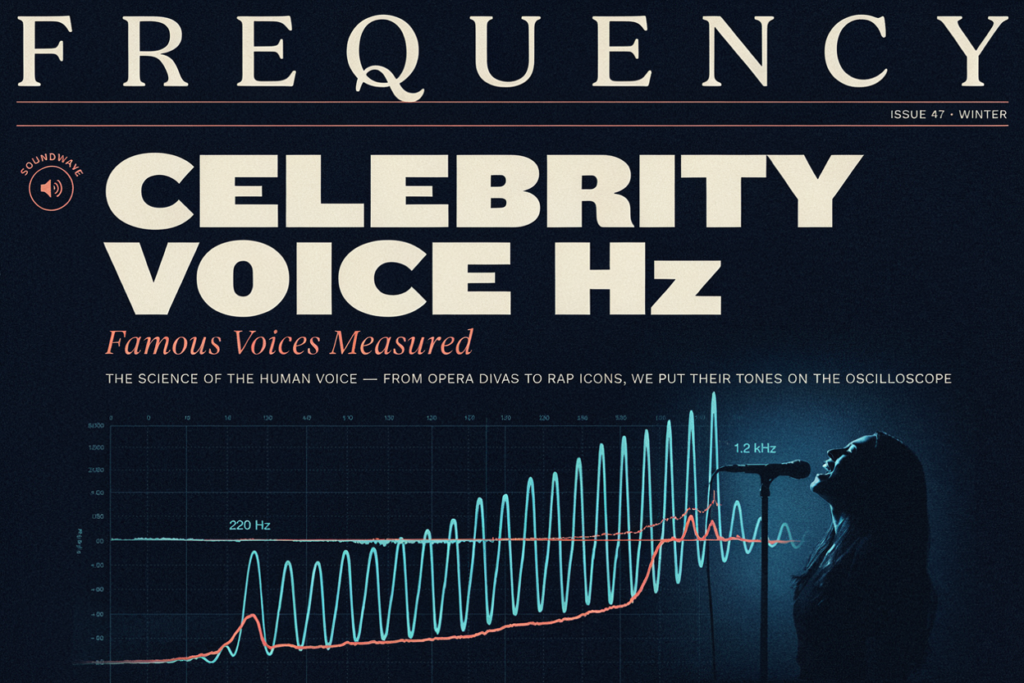
Celebrity voice Hz usually refers to the estimated fundamental frequency (F0) measured from a specific speech or singing sample. It is not a permanent number because pitch changes with emotion, speaking style, vocal register, and recording conditions.
Understanding how fundamental frequency describes vocal-fold vibration helps explain why published celebrity voice values often differ.
What Does Celebrity Voice Hz Mean?
Fundamental frequency is the rate at which the vocal folds vibrate, measured in hertz (Hz). During conversation, this value rises and falls naturally.
A celebrity therefore does not have one fixed voice frequency. Any published value should be treated as an estimate from a particular recording rather than a permanent biological characteristic.
How Are Celebrity Voice Frequencies Measured?
Voice analysts usually:
- Select a clean speech recording.
- Remove background music where possible.
- Analyze the clip with pitch-tracking software.
- Calculate an average or median F0.
You can learn more about how speech frequency is measured.
Why Results Differ
Different recordings produce different values because of:
- Emotion
- Acting style
- Vocal fry
- Microphone quality
- Background noise
- Different analysis software
Approximate Celebrity Voice Examples
The figures below are commonly reported estimates from specific recordings rather than fixed lifetime values.
| Celebrity | Approximate Hz | Context | Reliability |
|---|---|---|---|
| Morgan Freeman | ~95–105 Hz | Speaking | Clip-dependent estimate |
| Barry White | ~80–95 Hz | Speaking | Clip-dependent estimate |
| Sean Connery | ~70–100 Hz | Speaking | Reported estimate |
| Jennifer Lawrence | ~170–220 Hz | Speaking | Varies by interview |
| Emma Watson | ~190–240 Hz | Speaking | Varies by recording |
| Queen Elizabeth II | ~220 Hz | Public speech | Based on analyzed clips |
| Mariah Carey | Speaking varies | Speech | Singing range is separate |
For a detailed breakdown, see an analysis of Morgan Freeman’s speaking voice and Mariah Carey’s measured singing range.
Speaking Hz vs. Singing Hz
Speaking frequency and singing frequency measure different things.
| Measurement | Meaning |
| Speaking F0 | Average conversational pitch |
| Lowest sung note | Lowest musical performance |
| Highest sung note | Highest musical performance |
A singer’s highest note should never be described as their everyday voice frequency.
Low, Average, and High Speaking Frequencies
| Approximate F0 | Description |
| Below 90 Hz | Very low speaking voice |
| 90–155 Hz | Common adult male range |
| 165–255 Hz | Common adult female range |
| Above 255 Hz | Relatively high speaking pitch |
These are broad reference ranges rather than identity tests.
Why Two Celebrities Can Share the Same Hz
Two people may have identical average F0 while sounding completely different.
The reason is that voice identity also depends on:
- Resonance
- Formants
- Harmonics
- Accent
- Rhythm
- Articulation
- Speaking rate
This is why why resonance changes how a voice sounds matters as much as pitch.
Can Voice Frequency Identify a Celebrity?
Pitch alone cannot reliably identify a person.
Modern speaker-recognition systems analyze many characteristics, including resonance, timing, articulation, and spectral features rather than one Hz value.
The accuracy limits of voice-frequency tests also mean browser tools should be treated as estimates.
How to Compare Your Voice With a Celebrity
- Record clean speech.
- Use the same sentence.
- Compare median F0 instead of one instant.
- Compare resonance and speaking style.
- Treat the result as an estimate.
Comparing lower and higher voice frequencies provides better context than focusing on one number.
Common Myths
| Myth | Reality |
| Every celebrity has one exact Hz | Pitch changes constantly |
| Lower Hz always sounds better | Voice quality depends on many factors |
| Same Hz means same voice | Resonance and articulation differ |
| Highest singing note equals speaking pitch | These are different measurements |
| Apps identify celebrities from pitch alone | Pitch is only one feature |
Frequently Asked Questions
What is Morgan Freeman’s voice frequency?
Published analyses usually place his conversational pitch around 95–105 Hz, depending on the recording.
What is Barry White’s speaking frequency?
Reported estimates commonly fall around 80–95 Hz, although different clips produce different values.
Which celebrity has the deepest speaking voice?
Barry White and Morgan Freeman are frequently cited because of their low conversational pitch and distinctive resonance.
Can two celebrities have the same voice Hz?
Yes. They can share a similar average F0 while sounding completely different because resonance, articulation, and vocal quality differ.
Can a pitch app tell which celebrity I sound like?
No. Pitch is only one characteristic of a voice. Reliable comparisons require many additional acoustic features.
Bobby is a voice analysis and vocal testing writer at VoiceFrequencyTest. He focuses on vocal frequency analysis, pitch recognition, voice measurement tools, and singing education for vocalists, musicians, creators, and beginners.