
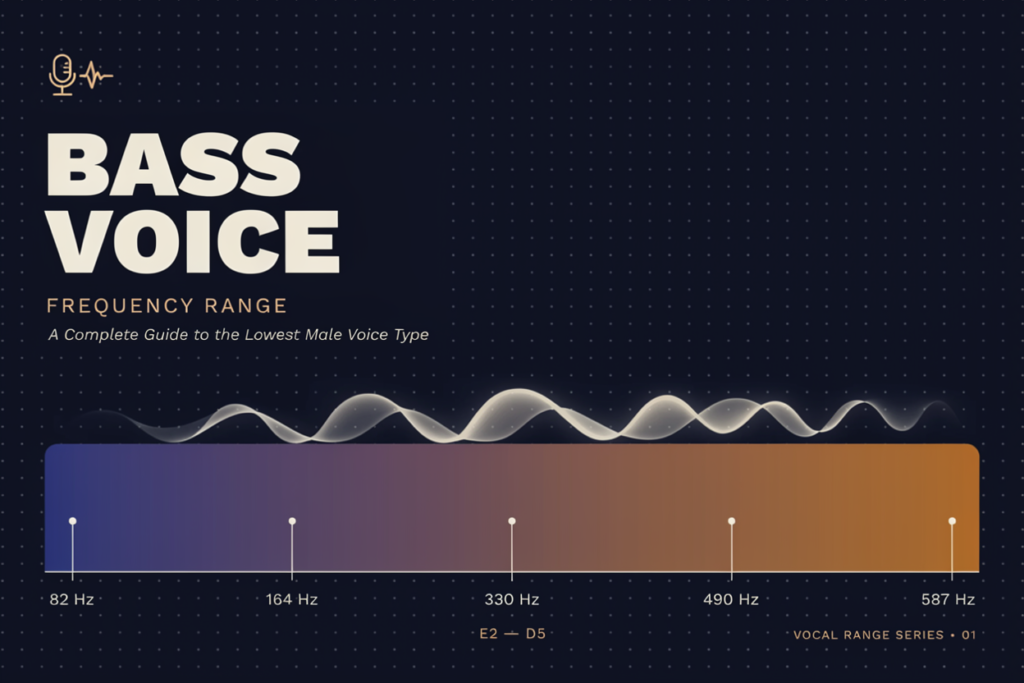
A bass voice frequency range typically spans E2 to E4, which corresponds to approximately 82 Hz to 330 Hz. Bass is the lowest standard male singing voice, known for its deep, rich, and resonant tone. While some professional bass singers can sing lower than E2 or higher than E4, voice classification depends on much more than the highest or lowest note you can produce.
If you’re trying to determine whether you’re a bass singer, focus on your comfortable singing range (tessitura), vocal quality, and resonance—not just a single frequency measurement. If you’re unfamiliar with vocal frequencies, you may first want to explore the complete voice frequency chart to understand how bass compares with other voice types.
What Is the Bass Voice Frequency Range?
The standard bass vocal range covers E2 to E4, making it the lowest of the traditional male voice classifications.
| Note | Frequency (Hz) |
|---|---|
| E2 | 82.41 Hz |
| F2 | 87.31 Hz |
| G2 | 98.00 Hz |
| A2 | 110.00 Hz |
| B2 | 123.47 Hz |
| C3 | 130.81 Hz |
| D3 | 146.83 Hz |
| E3 | 164.81 Hz |
| F3 | 174.61 Hz |
| G3 | 196.00 Hz |
| A3 | 220.00 Hz |
| B3 | 246.94 Hz |
| C4 | 261.63 Hz |
| D4 | 293.66 Hz |
| E4 | 329.63 Hz |
These frequencies represent equal-tempered tuning with A4 = 440 Hz.
Although these notes define the standard range, many experienced bass singers can extend below E2 or above E4 through training.
Bass Voice Frequency Chart
The following chart compares the three primary male voice classifications.
| Voice Type | Typical Note Range | Approximate Frequency Range |
| Bass | E2–E4 | 82–330 Hz |
| Baritone | G2–G4 | 98–392 Hz |
| Tenor | C3–B4 | 131–494 Hz |
Notice that these ranges overlap. A singer who reaches low bass notes isn’t necessarily a bass if their most comfortable singing range lies higher.
For a detailed comparison, see our guide on baritone voice frequency range.
What Makes a Bass Voice Different?
The defining characteristic of a bass voice isn’t simply low notes.
Professional vocal coaches evaluate several factors:
Comfortable Tessitura
Tessitura is the range where your voice feels strongest and most natural. A true bass spends most of their singing comfortably in the lower register.
Rich Resonance
Bass voices typically have:
- Warm tone
- Dark vocal color
- Strong chest resonance
- Powerful low-frequency projection
These qualities often matter more than the absolute lowest note.
Vocal Weight
Bass voices generally sound fuller and heavier than baritone or tenor voices, especially in the lower octave.
You can learn more about how voice categories are determined in our guide to voice frequency by type.
Bass Voice Subtypes
Not every bass singer sounds the same. Classical voice pedagogy recognizes several bass subtypes.
Basso Profondo
This is the deepest bass classification.
Characteristics include:
- Exceptional low-note capability
- Extremely dark tone
- Powerful resonance below E2
- Frequently used in opera
Lyric Bass
A lyric bass has a lighter, smoother sound while maintaining the lower bass range.
These singers often have:
- Better vocal flexibility
- Easier upper extension
- Warm, rounded tone
Bass-Baritone
Bass-baritones combine characteristics of both voice types.
They usually possess:
- Strong low notes
- Comfortable middle register
- Greater versatility across musical styles
How to Tell If You’re a Bass Singer
Many people mistake a deep speaking voice for a bass singing voice.
Measure Your Comfortable Singing Range
Rather than finding the single lowest note you can produce, determine:
- Lowest comfortable note
- Highest comfortable note
- Range where singing feels effortless
- Notes you can sustain with good tone
If your comfortable singing range consistently centers around E2–E4, you may be a bass.
Our guide on how to check your voice frequency explains how to measure your voice accurately.
Don’t Rely on Speaking Voice Alone
Your speaking voice usually falls within a much narrower frequency range than your singing voice.
Someone with a naturally deep speaking voice may actually be a baritone, while another singer with an average speaking pitch could still qualify as a bass because of their comfortable singing tessitura.
For more information about speaking frequencies, read our article on male voice frequency.
Consider Professional Assessment
A vocal coach evaluates:
- Tessitura
- Tone quality
- Register transitions
- Vocal weight
- Resonance
- Endurance
These factors provide a much more accurate classification than frequency alone.
Can You Extend Your Bass Range?
You can often improve your lower singing range through proper training, but you cannot completely change your natural voice type.
Healthy techniques include:
- Daily vocal warm-ups
- Breath support exercises
- Resonance training
- Relaxed larynx exercises
- Consistent practice
Avoid forcing lower notes by pressing your voice downward. Doing so may create strain instead of genuine vocal development.
If you’re interested in naturally developing a deeper sound, our guide to deep voice frequency range explains realistic expectations.
Bass Voice Examples
Many well-known singers and classical performers are recognized for their bass voices.
Examples include:
| Singer | Style |
| Fyodor Chaliapin | Opera |
| Kurt Moll | Opera |
| René Pape | Opera |
| Tim Storms* | Extreme low-range vocalist |
| Avi Kaplan | Contemporary/Folk |
*Tim Storms is famous for producing notes well below the standard bass range, making him an exceptional case rather than a representative example of a typical bass voice.
Bass Voice vs. Speaking Frequency
One of the biggest misconceptions is assuming that a bass singer always speaks with an extremely low voice.
In reality:
- Speaking frequency measures your habitual conversational pitch.
- Singing range measures the musical notes you can comfortably perform.
- Vocal classification considers resonance, tessitura, tone, and technique.
Someone with an average speaking frequency may still be a bass singer if their singing voice naturally performs best in the bass range.
For a broader overview of vocal frequencies across all voice types, see our article on human voice frequency range.
Frequently Asked Questions
What is the normal bass voice frequency range?
A typical bass singing voice spans E2 to E4, corresponding to approximately 82 Hz to 330 Hz. Professional singers may extend beyond these limits through training.
Can a bass singer sing higher than E4?
Yes. Many trained bass singers can sing above E4, although those notes are usually outside their most comfortable singing range.
Is every man with a deep voice a bass?
No. Speaking pitch alone doesn’t determine voice type. Professional classification also considers tessitura, resonance, vocal weight, and overall tone quality.
What’s the difference between a bass and a baritone?
A bass generally sings lower and has a darker, heavier vocal tone than a baritone. Baritones typically have greater comfort in the middle register and a slightly higher tessitura.
How rare is a true bass voice?
True bass voices are less common than baritone voices. Many men who believe they are basses are actually baritones with good low-note extension.
Can vocal training turn a baritone into a bass?
No. Vocal training can improve range, technique, and resonance, but it cannot fundamentally change your natural voice classification. Training helps you develop your existing voice rather than creating a completely different one.

Bobby is a voice analysis and vocal testing writer at VoiceFrequencyTest. He focuses on vocal frequency analysis, pitch recognition, voice measurement tools, and singing education for vocalists, musicians, creators, and beginners.