
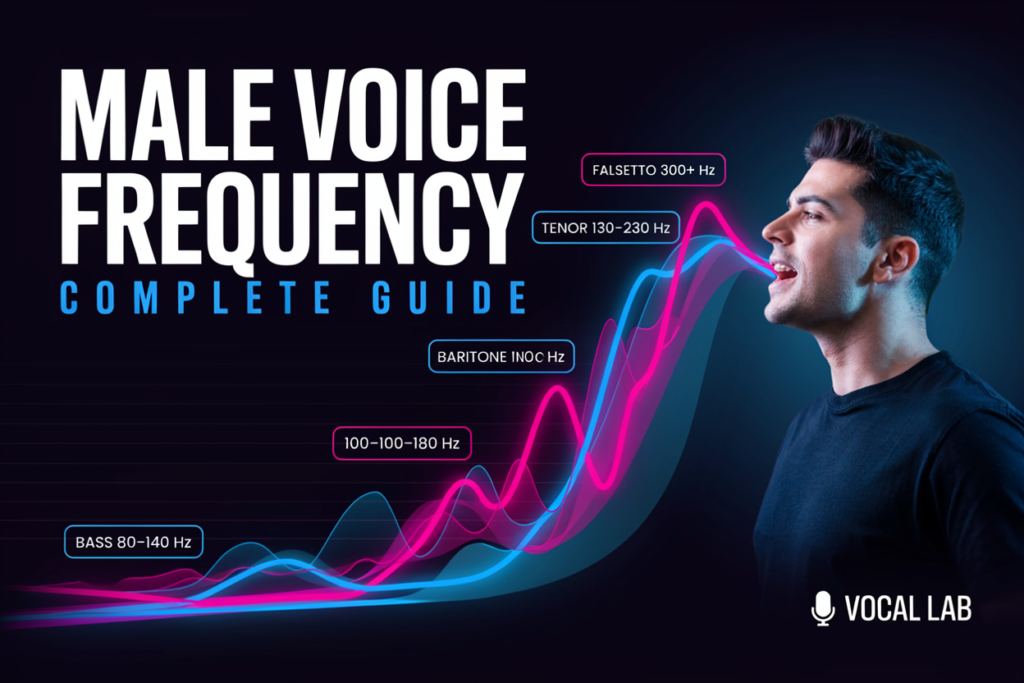
The average adult male speaking voice commonly centers near 110–120 Hz, though everyday speech moves below and above that point. These are population averages, not strict limits.
For a broader overview, see the guide to average male voice frequency. Most practical measurements focus on fundamental frequency, or F0—the rate at which the vocal-fold vibration pattern repeats.
What Is the Typical Male Voice Frequency?
A typical adult male speaking voice often centers near 110–120 Hz. A broader 85–180 Hz span is a practical guide, not a fixed boundary.
Average adult male speaking F0
Fundamental frequency is measured in hertz. A reading of 110 Hz means the vocal-fold vibration pattern repeats about 110 times per second.
Why 85–180 Hz is not a strict boundary
Speech naturally rises and falls. A man may speak below 85 Hz during vocal fry or above 180 Hz during emphasis, surprise, laughter, or expressive speech.
Mean, median, and modal frequency
The mean is the arithmetic average of all measured values. The median is the middle value after the readings are ordered, while the mode is the most frequently occurring value.
| Measurement | What it describes |
|---|---|
| Average speaking F0 | Central pitch across a speech sample |
| Conversational range | Normal pitch movement during speech |
| Maximum phonational range | Lowest to highest producible sound |
| Singing range | Sustainable musical notes |
| Full speech bandwidth | F0, harmonics, formants, and consonant energy |
What Does Male Voice Frequency Measure?
Male voice frequency usually refers to F0, not every frequency in the recording. F0 begins at the vocal folds and is the main acoustic measurement associated with perceived pitch.
Fundamental frequency and vocal-fold vibration
When the vocal folds vibrate faster, F0 rises. When they vibrate more slowly, F0 falls.
The guide to fundamental frequency in voice explains why F0 is only one part of the complete vocal signal.
Frequency versus perceived pitch
Frequency is a physical measurement. Pitch is the listener’s perception of how high or low the voice sounds.
The two are closely related, but resonance, harmonics, loudness, and vocal tone can affect perception. The comparison between voice frequency and pitch explores this difference in more detail.
Why one number cannot describe the whole voice
A male voice with an F0 of 110 Hz does not contain only 110 Hz. The vocal-fold source also produces harmonics above F0, while the vocal tract shapes formants and upper-frequency energy.
Male Voice Frequency Chart
The following note equivalents assume standard tuning where A4 equals 440 Hz.
| Frequency | Approximate note |
| 82.41 Hz | E2 |
| 87.31 Hz | F2 |
| 98.00 Hz | G2 |
| 110.00 Hz | A2 |
| 123.47 Hz | B2 |
| 130.81 Hz | C3 |
| 146.83 Hz | D3 |
| 164.81 Hz | E3 |
Why Does Male Voice Frequency Vary?
Male voice frequency varies because vocal-fold anatomy, development, age, language, emotion, and vocal behavior all affect F0.
Anatomy and vocal-fold size
Longer and more massive vocal folds generally vibrate more slowly than shorter, lighter folds. This contributes to lower average F0 in many adult male speakers.
Puberty and development
During puberty, the larynx grows and the vocal folds become longer and thicker. This often produces a substantial drop in speaking F0.
The guide to voice frequency changes during puberty explains why pitch may fluctuate while the voice is developing.
Age-related changes
Voice frequency can change across adulthood. Tissue changes, muscle function, health, and habitual voice use can all influence the result.
Emotion and speaking style
Excitement, stress, politeness, emphasis, and public-speaking style can raise or lower F0. Language and dialect also shape intonation patterns.
Is Male Speaking Frequency the Same as Singing Range?
No. Speaking F0 describes the central pitch pattern used in speech, while singing range covers the lowest through highest sustainable musical notes.
Habitual speech versus sustained notes
Speech moves continuously between frequencies. Singing usually targets specific notes and may extend much lower or higher than habitual speech.
Bass, baritone, and tenor
Bass, baritone, and tenor are singing classifications, not speaking-frequency labels.
| Voice type | Common approximate singing range |
| Bass | E2 to E4 |
| Baritone | G2 to G4 or A2 to A4 |
| Tenor | C3 to C5 |
Why speaking pitch does not determine voice type
A low speaking voice does not automatically make someone a bass. Singing classification requires examining the voice across sustained notes and repertoire, not just measuring ordinary speech.
Does a Lower Frequency Always Mean a Deeper Voice?
A lower F0 usually contributes to a deeper perceived pitch, but frequency alone does not determine vocal depth. Resonance, formants, vocal-tract length, and harmonic balance also affect the result.
F0 and perceived depth
A voice at 100 Hz will usually sound lower than the same voice at 140 Hz. However, two men speaking at 100 Hz may still differ greatly in warmth, brightness, weight, and clarity.
Resonance and formants
The guide to voice resonance frequency explains why perceived depth depends on more than F0.
Why two men at the same F0 sound different
One speaker may have stronger low-frequency resonance and a darker timbre, while another may have more upper-frequency energy and a brighter sound.
How Can You Measure Male Voice Frequency?
You can estimate male voice frequency by recording both natural speech and a sustained vowel, then reviewing the average or median F0.
Record natural speech
Speak normally for 20–30 seconds in a quiet room. Read a short passage or describe your day without deliberately changing your voice.
Record a sustained vowel
Hold “ah” for three to five seconds at a comfortable pitch. This gives the detector a steady signal and helps reveal tracking errors.
Repeat the test
The guide to checking your voice frequency provides a more detailed measurement process.
Recognize common errors
Octave doubling can make a 110 Hz voice appear near 220 Hz. Octave halving can make it appear near 55 Hz.
Vocal fry may also create unusually low values that do not represent habitual speech.
How Should You Interpret a Male Voice Reading?
Interpret the result as a personal baseline rather than a rigid gender or voice-type label. Repeated values under consistent conditions are more meaningful than one extreme reading.
Suppose a speaker records a median F0 of 105 Hz during natural speech but briefly reaches 70 Hz at the end of sentences. If the 70 Hz moments occur in vocal fry, the 105 Hz median is the better description of habitual speaking frequency.
The comparison of male and female voice frequency also shows why population ranges overlap and should not be treated as absolute categories.
Common Male Voice Frequency Myths
Every male voice is between 85 and 180 Hz
Reality: That span is a broad reference, not a hard limit. Real speech can move outside it.
A 100 Hz voice means you are a bass
Reality: Bass is a singing classification based on range, tessitura, timbre, and repertoire.
Lower frequency always sounds more masculine
Reality: Listeners also respond to resonance, articulation, loudness, and vocal style.
One sustained vowel reveals normal speaking pitch
Reality: A sustained vowel provides a snapshot. Natural speech gives a better estimate of habitual F0.
A pitch detector measures the whole voice
Reality: Most pitch detectors mainly estimate F0. They do not summarize all harmonics, formants, and speech bandwidth.
For context on lower-pitched voices, see the guide to the deep voice frequency range.
Frequently Asked Questions
What is the average male voice frequency in hertz?
A practical adult male average is around 110–120 Hz. Individual speaking voices can center lower or higher.
Is 100 Hz a normal male voice?
Yes. A habitual F0 near 100 Hz can fall within normal adult male variation, especially when the speech is clear and comfortable.
What frequency is usually considered a deep male voice?
There is no universal cutoff. Voices centered near the lower end of common adult male ranges may be perceived as deep, but resonance and timbre also matter.
Can an adult man naturally speak above 180 Hz?
Yes. Some men have higher habitual speaking frequencies, and many speakers move above 180 Hz during emphasis or expressive speech.
Does male voice frequency change after puberty?
Yes. Puberty usually lowers F0 substantially, and smaller changes can continue with age, health, and vocal use.
Does a low speaking pitch mean someone is a bass singer?
No. Speaking pitch alone cannot determine singing type. A proper classification must examine sustainable range, tessitura, tone, and register transitions.

Bobby is a voice analysis and vocal testing writer at VoiceFrequencyTest. He focuses on vocal frequency analysis, pitch recognition, voice measurement tools, and singing education for vocalists, musicians, creators, and beginners.