
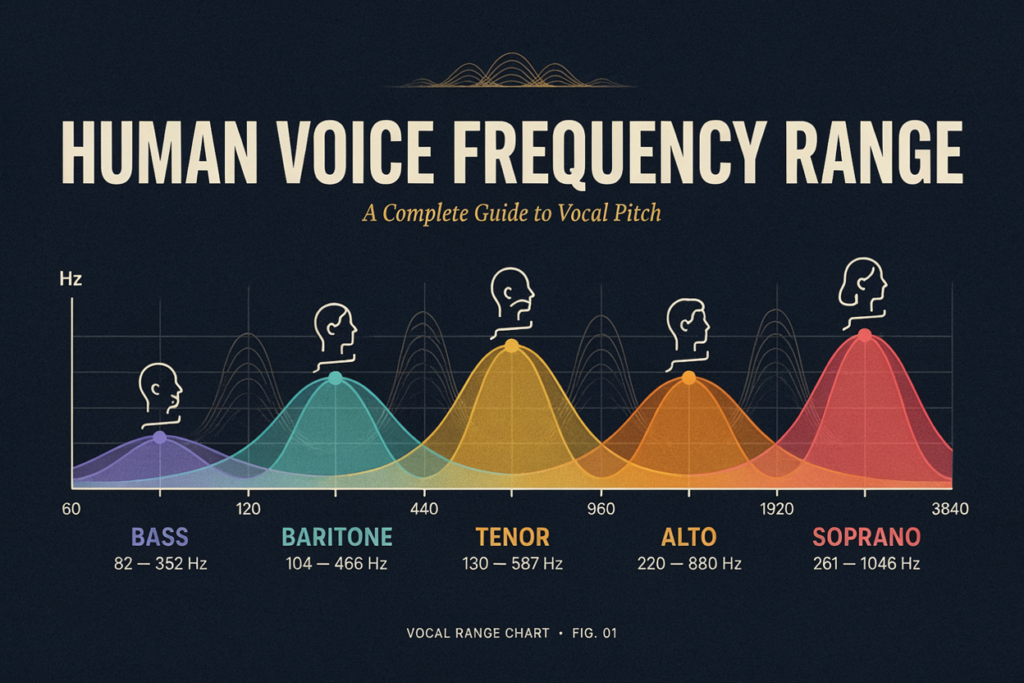
The human voice frequency range depends on the measurement. Ordinary speech often centers near 110 Hz for adult men, 180–220 Hz for adult women, and around 300 Hz for children. The complete signal is wider because harmonics and resonances extend into several thousand Hertz.
A person speaking at 120 Hz is not producing sound only at 120 Hz. Harmonics, formants, and noise components also shape clarity and tone.
For the basic definition behind these measurements, see what voice frequency means.
What Is the Human Voice Frequency Range?
The human voice frequency range can refer either to fundamental frequency, or F0, or to the complete acoustic spectrum of speech and singing. F0 describes the primary rate of vocal-fold vibration, while the full spectrum includes higher harmonics and resonances.
In everyday speech, F0 stays relatively low, while the full signal extends through several kilohertz and sometimes higher.
Fundamental frequency
Fundamental frequency is the lowest repeating rate in a voiced sound. It is measured in Hertz, where one Hertz equals one cycle per second.
A voice with an F0 of 100 Hz completes about 100 vocal-fold vibration cycles per second. This fundamental frequency guide explains why F0 is the main value shown by voice-analysis tools.
The complete voice spectrum
The vocal folds create a complex signal with harmonics at multiples of F0. At 100 Hz, harmonics may appear near 200, 300, 400, and 500 Hz, while the vocal tract shapes them into formants.
What Are Typical Speaking Frequency Ranges?
Speaking frequency varies by age, anatomy, language, health, emotion, and task. Reference figures are group averages, not strict limits.
The Voice Foundation lists about 110 Hz for men, 180–220 Hz for women, and 300 Hz for children. One clinical study reported means of 112.0 Hz for male voices and 195.8 Hz for female voices.
| Speaker group | Common conversational reference | What the figure represents |
|---|---|---|
| Adult men | Around 110 Hz | Typical central F0, not a fixed limit |
| Adult women | Around 180–220 Hz | Common average region |
| Children | Around 300 Hz | Approximate value before later development |
| Individual speakers | Wide personal variation | F0 changes throughout speech |
A broader human speech frequency guide can help separate conversational F0 from the frequencies needed for speech clarity.
Adult male speaking frequency
Adult male conversational F0 is often reported around 85–180 Hz, with many averages near 110–120 Hz.
One large study found male averages from about 78 to 182 Hz, showing why charts are not biological boundaries.
Adult female speaking frequency
Adult female conversational F0 commonly falls around 165–255 Hz, with many averages near 180–220 Hz. One clinical study reported 195.8 Hz.
Anatomy, hormones, age, language, and speaking style all influence habitual F0.
Children’s speaking frequency
Children generally have higher F0 because their vocal folds and vocal tracts are smaller. A reference near 300 Hz is common, though values change with development and puberty.
Why Does the Full Voice Extend Beyond F0?
The voice extends beyond its fundamental because vocal-fold vibration creates harmonics and the vocal tract creates resonances carrying vowel, consonant, and quality information.
A 120 Hz voice may contain components at 240, 360, and 480 Hz, continuing upward. Energy above 5 kHz may also contribute to quality and intelligibility.
Harmonics create a complex tone
Harmonics are frequencies occurring at whole-number multiples of the fundamental. Their relative strength helps determine whether a voice sounds bright, dark, rich, thin, or breathy.
Harmonic patterns change with vocal-fold closure, airflow, loudness, and register, so two people on the same note can sound different.
Formants shape vowels and resonance
Formants are resonance regions produced by the shape of the throat and mouth. Moving the tongue, lips, jaw, and soft palate changes those resonances.
Formants help distinguish vowels and vocal identity. See this voice resonance and frequency comparison for more detail.
Human Voice Frequency Range Chart
| Measurement | Approximate range or value | Important limitation |
| Adult male conversational F0 | Often about 85–180 Hz | Individual averages may fall outside it |
| Adult female conversational F0 | Often about 165–255 Hz | Considerable overlap and variation exist |
| Child conversational F0 | Commonly near 250–300 Hz or higher | Strongly age-dependent |
| Typical vocal harmonics | Multiples of F0 | Continue far above speaking F0 |
| Important speech spectrum | Extends through several kHz | Includes formants and consonant energy |
| Recorded high-frequency vocal energy | Can extend beyond 20 kHz | Much of it is weak and not equally important |
Use these as acoustic references. A voice-frequency chart with interpretation provides more comparisons.
Speaking Frequency vs Singing Range
Speaking frequency and singing range are different measurements. Speaking F0 describes vibration during speech, while singing range describes the lowest to highest musical pitches a singer can produce.
| Feature | Speaking frequency | Singing range |
| Main purpose | Communication | Sustained musical pitch |
| Typical measurement | Mean or median F0 | Lowest and highest notes |
| Amount of movement | Relatively narrow | Often several octaves |
| Classification use | Limited | Combined with tessitura and timbre |
| Common unit | Hertz | Notes, semitones, or Hz |
Why speech uses a narrower range
Conversation stays near a habitual pitch, with smaller changes for intonation, emotion, language, and emphasis.
Why singing covers more frequencies
Singing moves between sustained pitches across a wider span. Speaking F0 cannot determine bass, tenor, alto, or soprano classification, which also considers tessitura, timbre, vocal weight, and passaggi.
What Affects Human Voice Frequency?
Human voice frequency is affected by vocal-fold length, mass, stiffness, tension, age, hormones, health, language, emotion, and technique. F0 is therefore dynamic rather than fixed.
Anatomy and development
Longer, more massive vocal folds generally vibrate more slowly, while shorter, thinner folds vibrate faster. Puberty and aging can change laryngeal dimensions, tissue flexibility, and habitual frequency. See this age-based voice frequency overview.
Health and vocal condition
Swelling, dehydration, illness, fatigue, and heavy voice use may alter F0 and stability. Persistent hoarseness, pain, or sudden range loss needs professional assessment.
Emotion, language, and speaking task
Emotion, social context, language, and dialect can shift F0. Sustained vowels, reading, and spontaneous speech may return different averages.
How Is Human Voice Frequency Measured?
Voice frequency is measured by recording a voiced sound and estimating repeating waveform cycles. Software may report mean, median, minimum, maximum, and a frequency trace.
record a sustained vowel and a spoken passage in a quiet room, keeping microphone distance consistent.
Sustained vowels versus connected speech
A sustained “ah” is stable and easy to track. Connected speech is more realistic but includes consonants, pauses, vocal fry, and rapid intonation.
Comparing both gives a better view of stable phonation and everyday speech.
Limits of online measurements
Noise, microphone quality, room echo, breathiness, and detection errors affect results. Browser-based measurements are estimates.
A consistent voice-frequency measurement process improves repeatability but does not replace clinical examination.
Common Misunderstandings About Human Voice Frequency
Myth: the entire human voice exists between about 85 and 255 Hz
Reality: that range describes common adult fundamental frequencies. Harmonics, formants, and consonant energy extend into several kilohertz.
Myth: lower F0 always means a deeper-sounding voice
Reality: F0 influences perceived pitch, but resonance and harmonic balance also shape vocal depth. Two voices at the same F0 can sound very different.
Myth: speaking frequency determines voice type
Reality: singing voice type depends on range, tessitura, timbre, register transitions, and trained function. Speaking F0 alone is insufficient.
Myth: one recording reveals a person’s normal range
Reality: frequency changes with task, emotion, fatigue, and recording conditions. Several consistent samples are more informative than one.
Frequently Asked Questions
What is the full frequency range of the human voice?
There is no universal range. Many adult fundamentals fall around 85–255 Hz, while harmonics and resonances extend through several kilohertz and may reach beyond 20 kHz.
What is the lowest frequency a human voice can produce?
Some people can produce frequencies below common adult speaking ranges, especially through vocal fry or specialized singing.
Why does speech contain frequencies above F0?
Vocal-fold vibration creates harmonics at multiples of F0, while the vocal tract adds resonances called formants. Consonants and turbulent airflow also generate higher-frequency energy.
Do male and female voice-frequency ranges overlap?
Yes. Individual ranges overlap substantially. Anatomy, hormones, age, language, and speaking habits all contribute to variation.
Can age change voice frequency?
Yes. Childhood development, puberty, hormonal changes, and aging can all change vocal-fold structure and habitual F0.
Is human voice frequency the same as vocal range?
No. Voice frequency is an acoustic value at a particular moment, while vocal range is the span between the lowest and highest usable pitches.

Bobby is a voice analysis and vocal testing writer at VoiceFrequencyTest. He focuses on vocal frequency analysis, pitch recognition, voice measurement tools, and singing education for vocalists, musicians, creators, and beginners.